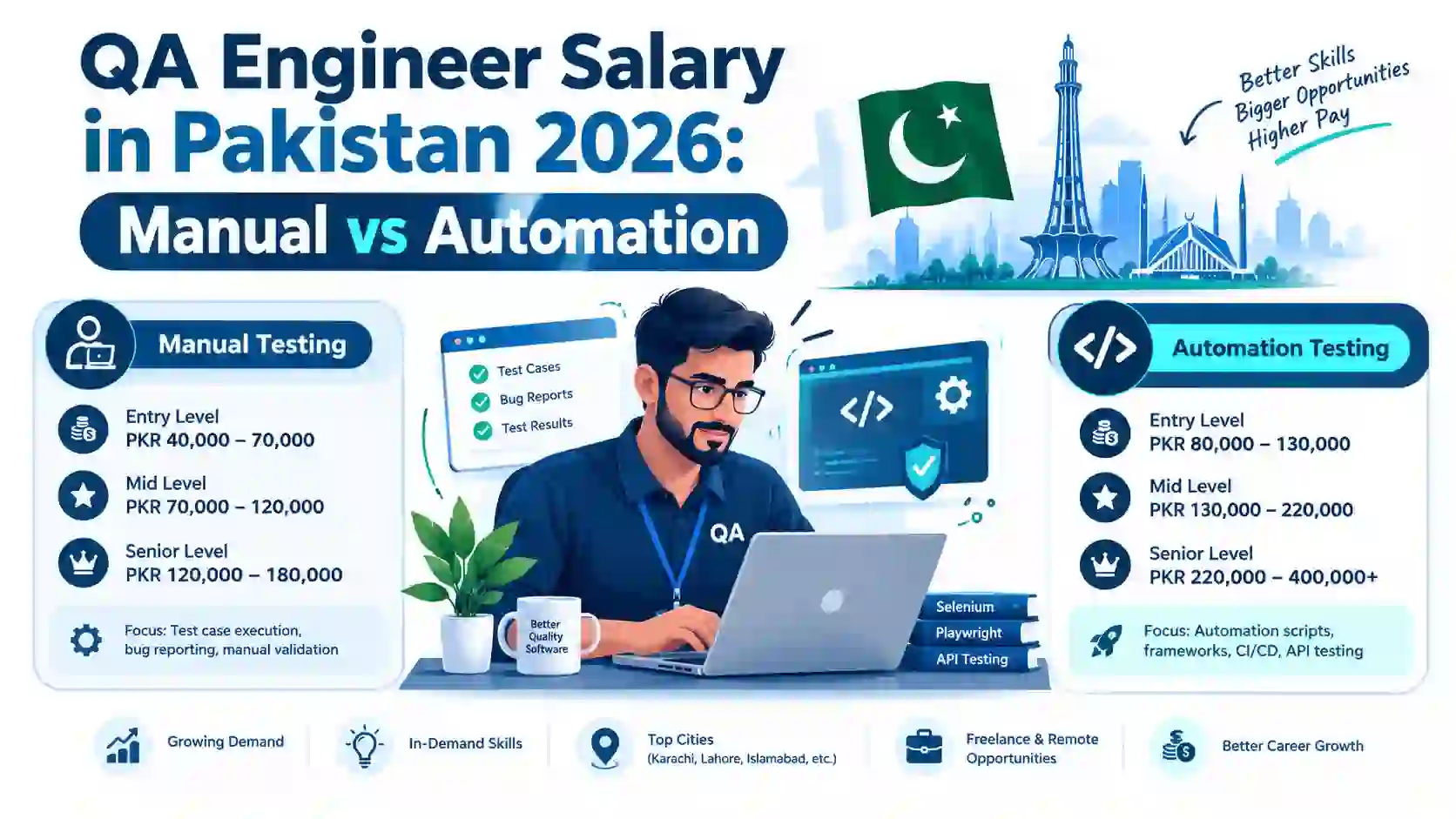
QA Engineer Salary in Pakistan 2026: Manual vs Automation
Public job-board data shows a wide range. Freshers often start near Rs 30,000 a month, while experienced QA engineers can reach above Rs 200,000. Pay usually grows as your skills and responsibility grow.
You may be wondering whether to start with manual testing or jump straight to automation. This guide explains the QA engineer salary in Pakistan using named sources, so you can see where the numbers come from. It also compares manual and automation roles, shows pay by experience and city, and gives you a step-by-step plan. At IDT Pakistan, we want you to choose a path with clear facts, not hype.
What is a QA engineer, and how do manual and automation roles differ?
A QA engineer is a software professional who checks that apps, websites and systems work correctly before users see them. Manual QA engineers test by hand and report bugs. Automation QA engineers write scripts and use tools to repeat those checks quickly. Both roles protect product quality.
Let us break that down in plain words.
A manual tester opens the app, follows a test plan and tries to break it. They write test cases, log bugs in a tracker such as Jira and retest after fixes. They also do exploratory testing, where they use the product like a curious user.
An automation tester turns repeated checks into code. Instead of clicking through the same login screen fifty times, they write one script that does it in seconds. They use tools such as Selenium, Playwright or Cypress and run those scripts in a CI/CD pipeline.
Many job titles blur the line. You will see "QA Engineer", "SQA Engineer", "QA Analyst", "Software Tester" and "SDET" (Software Development Engineer in Test). An SDET is usually a tester who also codes at a developer level.
Quick note: Be careful with the title "Automation Engineer". In Pakistan, it often means factory or industrial automation, not software testing. Read the job description before you compare salaries.
Why QA jobs matter in Pakistan
Pakistan has a growing software industry. Software houses build products for local and overseas clients. Product companies, fintech teams and startups also ship apps every week. Each release needs someone to check it.
Remote work adds another door. Some Pakistani testers work for foreign teams from home. Others take freelance testing tasks on platforms such as Upwork or Fiverr. Treat these platforms as places to find work, not as a promise of income.
Local businesses also need testing. A bank app, an online shop or a delivery app can lose customers if checkout fails. Good testers help prevent that.
The Pakistan Software Export Board (PSEB) publishes information about the country's IT sector at pseb.org.pk. It is a useful place to follow industry news.
AI tools are also changing the work. Testers now use AI to draft test cases and speed up scripts. People who understand products, risks and users remain important. We cover this in the FAQ section below.
How much is the QA engineer salary in Pakistan in 2026?
Indeed Pakistan reports an average of about Rs 80,941 per month for QA engineers, based on 384 reported salaries. Other sources show lower or higher figures, because each site uses different samples and methods. Treat every number as a guide, not a promise.
Here is a snapshot from public sources, collected in October 2026.
Source
What it shows
Figure
Sample and date
Average monthly base pay
Rs 80,941 per month
384 salaries, updated 6 July 2026
Spread from 10th to 90th percentile
Rs 32,230 to Rs 203,271 per month
Same sample
Indeed Pakistan, Software Test Engineer
Average monthly base pay
Rs 103,221 per month
15 salaries, March 2026
Median yearly base pay
Rs 718,985 per year (about Rs 59,900 per month)
2026 page
Payscale, QA with test automation skills
Median yearly base pay
Rs 660,000 per year
15 profiles, updated May 2025
Why do the numbers differ so much? There are four main reasons.
- Small samples. Some figures come from only 15 reports. One high or low salary can move the average.
- Different pay types. Some sites show base pay. Others include bonus or total pay.
- Different employers. A small local software house and a foreign-funded product company pay very differently.
- Different titles. "QA Engineer", "SQA Engineer" and "Software Test Engineer" are grouped differently on each site.
Some salary tools also publish much higher modelled estimates. For example, SalaryExpert lists averages above Rs 2.8 million per year for QA engineers in major cities. These are model-based estimates, and they sit far above what local job boards report. We show them in the city section with a clear label.
Pro tip: Compare at least three sources, and then check live job ads in your own city. Real offers matter more than averages.
Manual vs automation testing: which pays more in Pakistan?
Public data does not split manual and automation QA pay cleanly, so no source gives one exact gap. In general, employers pay more as your skills cover more of the work. Testers who add automation, API testing and CI/CD usually have more room to grow.
Look at the data we do have. Payscale's figure for QA engineers with test automation skills is Rs 660,000 per year. That is based on only 15 profiles and sits below Payscale's general QA median. Please do not read this as "automation pays less". The sample is tiny and the data is older.
Indeed's "Automation Engineer" average is Rs 94,698 per month, based on 94 salaries updated in March 2026. But that title often includes industrial roles, so it is not a clean QA figure.
So what can you say honestly? Pay depends on four things: your skills, your employer, your city and your English and communication level. Automation skills tend to widen your choices, because more job ads ask for them at mid and senior levels.
Here is a side-by-side view of the two paths.
Point
Manual testing
Automation testing
Main work
Test by hand, write test cases, report bugs
Write scripts, build frameworks, run tests in pipelines
Coding needed
Little to none at the start
Basic to strong coding
Common tools
Jira, Postman, test case sheets
Selenium, Playwright, Cypress, Appium, Git, CI/CD
Entry barrier
Lower
Higher, but learnable
Strength
Human judgment, user thinking
Speed, repeatability, wider job options
Pay pattern
Starts at entry level and grows with domain knowledge
Often grows as scope and technical depth grow
Risk
Repetitive work may shrink as teams automate
Needs steady learning as tools change
Quick note: The best-paid testers are often not "pure manual" or "pure automation". They combine both. They design good tests, and they automate the boring parts.
Is manual testing dead in 2026? No. Teams still need people to explore new features, check usability and judge risk. But manual-only roles are a smaller part of senior job ads. Learning automation protects your career.
QA engineer salary by experience level
Payscale reports a median of about Rs 366,000 per year for entry-level QA engineers. For mid-career QA engineers, it reports about Rs 1,000,000 per year. These are base pay figures from Pakistan, and your offer may differ.
Here is how the main figures line up by level.
Level
Figure
Monthly equivalent
Source
Entry level (fresher)
Rs 366,251 median per year
About Rs 30,500
All QA engineers
Rs 80,941 average per month
Rs 80,941
Mid-career
Rs 1,000,000 median per year
About Rs 83,300
High end of the market
Rs 203,271 per month (90th percentile)
Rs 203,271
Sample job ads on Indeed Pakistan also show the spread. One SQA Engineer ad in Lahore listed Rs 140,000 to Rs 200,000 per month. A mid-level QA Engineer ad in Karachi listed Rs 80,000 to Rs 120,000. An entry-level SQA Engineer ad in Karachi listed Rs 60,000 to Rs 80,000. Ads change daily, so check the current listings yourself.
What does this tell you? A fresher should plan for a modest start. Two to five years of solid experience can move you into a much stronger range. The gap between the lowest and highest figures is large, and skills explain much of it.
Pro tip: Salary growth often comes from changing roles, not only from yearly increments. Many testers raise their pay by adding a new skill and then moving to a stronger team.
QA engineer salary by city: Lahore, Karachi and Islamabad
Salary estimates are higher in Islamabad, Karachi and Lahore than in smaller cities, mainly because most software houses and product teams are based there. The SalaryExpert figures below are modelled estimates, so treat them as the upper side of the market.
City
Average yearly estimate
Entry level (1 to 3 years)
Senior (8+ years)
Source
Lahore
Rs 2,831,437
Rs 2,046,292
Rs 3,271,774
SalaryExpert Lahore, updated April 2026
Karachi
Rs 3,085,582
Rs 2,229,963
Rs 3,565,442
SalaryExpert Karachi, updated August 2026
Islamabad
Rs 3,310,244
Rs 2,392,327
Not listed
SalaryExpert Islamabad, updated August 2026
These numbers are much higher than Indeed's reported pay. SalaryExpert collects survey data from employers and employees and then models it. Local job boards show what people and employers report in ads. Both views are useful, but they answer different questions.
For a local view, Indeed's Software Test Engineer page lists an average of Rs 80,992 per month in Lahore, based on 7 salaries. That is a small sample, so use it only as a rough check.
Rawalpindi and Islamabad share one job market in practice. Many people live in one city and work in the other. If you are in the twin cities, search both when you compare offers.
Which city pays the highest QA salary in Pakistan? Modelled estimates put Islamabad first and Karachi second. Real offers depend on the company more than the city. A strong employer in Lahore can pay more than a weak one in Islamabad.
What changes your QA salary?
Your QA salary mostly depends on skills, employer type, experience and communication. City and certification matter too, but less. Here are the factors that most often change an offer.
Employer type. Software houses that serve overseas clients, product companies and multinationals often pay differently from small local firms. Check each employer's reviews and current job ads, and avoid guessing from brand names alone.
Skills depth. Testers who can do API testing, SQL checks and basic scripting stand out. Automation with Selenium or Playwright adds more options.
Domain knowledge. Knowing fintech, e-commerce or healthcare software makes you more useful. You test better when you understand the business.
Communication. QA is a talking job. You explain bugs to developers and risks to managers. Clear English writing helps you in interviews and in remote work.
Certification. The ISTQB Foundation Level is a well-known testing certificate. It helps most for freshers who lack work history. It does not replace practical skills, so check whether your target employers ask for it.
Remote and overseas work. Some testers work for foreign teams. Pay and requirements differ by employer. Do not rely on any single figure you read online, including ours.
Skills and tools that raise your value as a QA engineer
Employers look for a mix of testing knowledge, tool skills and clear communication. You do not need everything on day one. Build the list step by step.
Core testing skills
- Writing test cases, a test plan and a test strategy
- Functional, regression, smoke and sanity testing
- Understanding the SDLC and STLC
- Bug reporting and the defect life cycle
- Working in Agile and Scrum teams
- Exploratory testing and UAT support
Tools to know
- Jira for bug tracking
- Postman for REST API testing
- SQL for checking data in databases
- Git for version control
- Selenium and Playwright for web automation
- Cypress for front-end focused automation
- Appium for mobile app testing
- JMeter for performance testing
- Jenkins or GitHub Actions for CI/CD
Programming languages
- Java, Python or JavaScript. Pick one and go deep before adding another.
You can read the official guides at Selenium documentation and Playwright. They are free and kept up to date by the tool makers.
Pro tip: Build one small automation project and keep it on GitHub. A simple login and checkout test suite shows more than a long list of tool names.
How to move from manual to automation testing, step by step
Yes, a manual tester can switch to automation. You already know test design and bug reporting, so you only need to add code and tools. Follow these steps in order.
Check your base. Review test cases, bug reports and the basics of web pages. If you are new to testing, start with the Software Quality Assurance course at IDT Pakistan or any course with a clear syllabus.
Pick one language. Choose Python, Java or JavaScript. Learn variables, loops, functions and simple object-oriented ideas.
Learn one tool well. Start with Selenium or Playwright. Write a script that logs in, searches and checks a result.
Add API testing. Use Postman to send requests and check responses. Many teams test APIs before the screen is even built.
Build a small framework. Organise your tests, add reports and store the code on GitHub.
Run tests in a pipeline. Learn the basics of CI/CD with GitHub Actions or Jenkins. Then update your resume with the project link.
How long does it take? It depends on your time and background. Many learners need a few months of steady practice to reach a junior automation level. Do not rush, and do not skip the coding basics.
Quick note: A career switch works best when you practise on real apps. Test public demo websites, write the scripts yourself and keep notes on every bug you find.
QA career and freelance paths
A QA career can grow in several directions. You can deepen your technical skills, move into leadership or branch into related fields. Here are the typical roles you will meet.
- Junior QA or manual tester. You run test cases, log bugs and learn the product.
- QA analyst or SQA engineer. You design tests, own a feature area and work closely with developers.
- QA automation engineer. You build and maintain automated test suites.
- SDET. You write test code and tools at a developer level.
- Performance tester. You use tools such as JMeter to check speed and load.
- API or mobile tester. You focus on back-end services or on Android and iOS apps.
- QA lead or test manager. You plan testing, guide a team and talk to stakeholders.
- QA architect. You design the test approach for large systems.
Freelance paths exist too. Some testers take short testing projects, app review tasks or bug-finding work from clients. Others join remote teams as contractors. Work volume and rates vary widely, and no platform guarantees orders.
Many testers also move sideways. Some become business analysts, DevOps engineers or developers. Our guide on data analytics career scope in 2026 shows one related path, and the front-end vs back-end vs full-stack guide helps if you want to understand how developers work.
Software Quality Assurance course at IDT Pakistan
IDT Pakistan (Institute of Digital Trainings) is a digital skills training institute based in Islamabad, with Lahore and Karachi also listed on the website. It lists a Software Quality Assurance course among its programmes.
Here is what we can say from verified facts.
- Students receive a certificate on completion, and you can check certificates on the Certificate Verification page.
- Most IDT courses run about 3 to 6 months.
- Most courses do not require prior experience.
- Some courses include recorded lectures through an LMS portal.
Details you should confirm before you enrol:
- Course fee: [VERIFY: course fee in PKR]
- Exact duration: [VERIFY: exact duration]
- Next batch date: [VERIFY: next batch date]
- Online or on-campus: [VERIFY: online or on-campus]
- Topics covered: [VERIFY: topics listed on the course page]
You can also see the full list of IDT courses and meet the IDT mentors on the website. For questions, use the Contact page or message us on WhatsApp.
Who should enrol (and who may not need it)
A structured QA course suits learners who want a clear path and guided practice. It may not suit those who already work in testing and only need one narrow skill. Be honest with yourself about where you stand.
A course may suit you if you are:
- A fresh graduate or a student who wants a practical entry into software jobs
- A beginner, since most IDT courses do not need prior experience
- A manual tester who wants a guided route into automation
- A professional from another field who is curious about tech
You may not need a course if you:
- Already work as an automation tester and only need a specific tool, where free documentation may be enough
- Prefer to learn fully on your own and can keep a steady routine
- Want a short trick for fast money. QA needs patience and practice
Quick note: A certificate helps, but your projects and your interview answers decide most hiring results.
Tips and common mistakes when building a QA career
Most QA career mistakes come from chasing tools before basics, or from trusting salary averages too much. Use these seven tips to stay on track.
Learn testing basics first. Test design and bug reporting come before any tool.
Pick one language and one tool. Depth beats a long list of half-learned tools.
Build proof. Keep two or three small projects on GitHub with a clear README.
Write good bug reports. Clear steps, expected result and actual result make you valuable.
Check live job ads. Read the skills employers ask for in your city and match your learning to them.
Do not trust a single salary number. Compare Indeed, Payscale and real job ads, as we did above.
Practise interviews. Prepare answers on the defect life cycle, regression testing and your project.
How to compare any training institute: Look at the syllabus, the practical projects, access to mentors, certificate verification and support after class. Ask to see a sample lecture or outline. A good provider will answer these questions openly.
Common mistakes to avoid:
- Skipping manual testing basics and jumping straight to scripts
- Copying code from videos without understanding it
- Expecting a high salary right after a short course
- Ignoring English writing and communication practice
- Applying to every job with the same resume
Real-world examples
These are hypothetical scenarios to help you picture different paths. They are not testimonials, and they do not promise any result.
For example, a fresh graduate. A computer science graduate learns test case writing and Jira. She builds a small portfolio by testing a public demo site and applies for junior QA roles. Later, she adds Selenium and Python.
For example, a working manual tester. A tester with two years of experience mostly runs regression checks by hand. He learns Playwright on weekends and automates his team's most repeated checks. That work gives him a stronger story for his next interview.
For example, a freelancer. A freelancer who builds websites adds testing to her services. She checks forms, mobile layouts and payment flows for small business clients. She finds work through her network and online platforms.
For example, an office employee. An accounts executive wants to switch fields. He starts with manual testing and SQL basics, since he already understands business reports. He aims at testing roles in finance software.
Each person starts from a different point. What they share is steady practice and proof of work.
Related courses and guides
If this topic interests you, these pages may help.
- Data Analyst course at IDT Pakistan for readers who like working with data
- Cloud Computing course for a related IT skill that pairs well with DevOps and testing
- AI Automation course for readers curious about automation with AI tools
- How AI is replacing traditional jobs in 2026 to understand how AI changes work
- Freelancing vs job in Pakistan, 2026 to compare working styles
Frequently Asked Questions
What is the average QA engineer salary in Pakistan in 2026?
Indeed Pakistan reports an average of about Rs 80,941 per month for QA engineers, based on 384 reported salaries updated in July 2026. Pay ranges widely, from roughly Rs 32,000 at the low end to above Rs 200,000 at the high end.
How much does a fresher QA engineer earn in Pakistan?
Payscale shows a median base salary of about Rs 366,000 per year for entry-level QA engineers, which is roughly Rs 30,500 per month. Actual offers vary by city, company and skills. Practical projects and a clear portfolio help you negotiate.
Which pays more in Pakistan: manual or automation testing?
Public data does not split manual and automation QA pay cleanly. In general, employers pay more as your skills cover more of the work, so engineers who add automation, API testing and CI/CD usually have more room to grow.
Do QA engineers need coding skills?
Manual testers can start without coding, but automation roles need basic programming in Java, Python or JavaScript. Even manual testers benefit from SQL and API testing knowledge. Learning one language gradually opens more job options.
Can a manual tester switch to automation testing?
Yes. Start with one language, one tool such as Selenium or Playwright, and a small practice project. Most manual testers already know test design and bug reporting, which makes the switch easier. Plan for a few months of steady practice.
Is ISTQB certification worth it in Pakistan?
It can help, especially for fresher resumes, because it shows you know standard testing terms. It does not replace practical skills. Check your target employers' job ads to see whether they ask for ISTQB before you pay for the exam.
Will AI replace QA engineers?
AI is changing testing work, but it is unlikely to remove the need for people who understand products, risks and users. Testers who use AI tools to write checks faster, while still judging quality, are better placed.
Is QA a good career in Pakistan?
It can be a good career if you enjoy finding problems and learn steadily. Software houses, product companies and remote teams all hire testers. Results depend on your effort, your skills and the market, so no job or pay is guaranteed.
Conclusion
The QA engineer salary in Pakistan depends on your skills, your employer and your city, and the public numbers vary widely. Manual testing is a fair place to begin, and automation skills open more doors over time. Pick one path, build proof and check live job ads often.
Ready to start? Explore the Software Quality Assurance course at IDT Pakistan, visit the Contact page, enrol through [paste current enrolment form link], or ask your questions on WhatsApp.