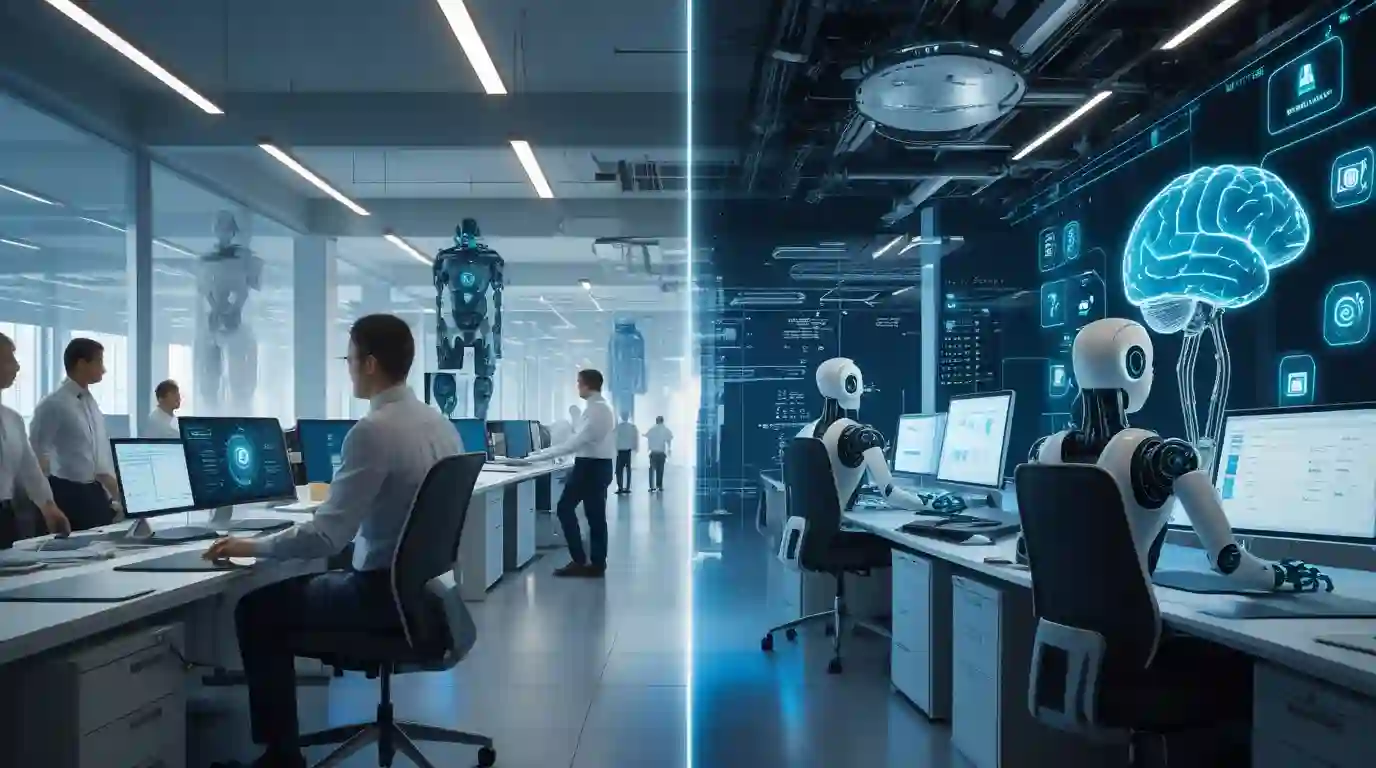
The workplace is transforming faster than ever before. As we step into 2026, artificial intelligence job replacement isn't just a distant possibility anymore—it's happening right now, reshaping industries and redefining what work means in the modern economy. Whether you're a fresh graduate in Pakistan exploring career options or a seasoned professional worried about your future, understanding how AI will replace traditional jobs by 2026 is no longer optional—it's essential.
The question isn't whether AI automation impact on employment will affect you, but rather how you'll adapt to this unprecedented workforce transformation. Let's explore what this means for your career and how you can stay ahead of the curve.
The Current State of AI in 2026: Where We Stand Today
We're living through a remarkable moment in history. The AI replacing jobs 2026 trend has accelerated beyond what most experts predicted just two years ago. Recent studies indicate that intelligent automation now handles tasks that once required human judgment, creativity, and decision-making abilities.
Machine learning automation has evolved from performing simple, repetitive tasks to tackling complex challenges in healthcare, legal services, and creative industries. Technologies like ChatGPT job replacement tools, advanced robotic process automation, and computer vision technology are transforming workplaces across America, Europe, Asia, and increasingly in Pakistan.
The economic impact AI automation brings is staggering. Companies report productivity gains from AI ranging from 30% to 60% in specific departments, while cost savings automation delivers are prompting businesses worldwide to accelerate their digital transformation initiatives. In Silicon Valley AI job displacement is already visible, while AI replacing jobs in UK 2026 statistics show similar patterns emerging across developed economies.
But here's what's different in 2026: the technology has become accessible and affordable. Small businesses in Rawalpindi, startups in Karachi, and enterprises in Lahore can now deploy AI solutions that were once exclusive to tech giants. This democratization of AI means the Pakistan AI job market changes are happening faster than many anticipated.
Which Traditional Jobs Will AI Replace First?
Understanding which industries most affected by AI automation helps you make informed career decisions. Let's break down the sectors experiencing the most significant disruption.
Customer Service and Support Roles
AI chatbot customer service systems have reached a sophistication level where they handle 80-90% of routine customer inquiries without human intervention. Call center AI replacement is particularly advanced, with natural language processing enabling AI assistants to understand context, emotion, and complex requests.
Customer service jobs replaced by AI chatbots include first-line support representatives, phone operators, and basic troubleshooting roles. However, complex complaint resolution and relationship management still require human emotional intelligence vs AI capabilities.
Data Entry and Administrative Tasks
Data entry job automation represents one of the clearest examples of AI replacing white collar jobs timeline acceleration. Robotic process automation RPA now handles invoice processing, form filling, database management, and routine paperwork with near-perfect accuracy.
Entry level positions being replaced by AI in administrative sectors include data clerks, filing specialists, and basic bookkeeping roles. The shift is particularly evident in banking AI replacement operations and accounting automation software adoption.
Manufacturing and Production
Manufacturing jobs automated by AI robots continue the trend that began with earlier industrial automation but with unprecedented sophistication. Warehouse robotics employment has transformed logistics, with Amazon robotics warehouse operations serving as a prime example of how autonomous systems can manage inventory, picking, packing, and shipping.
Blue collar jobs at risk from AI automation include assembly line workers, quality control inspectors, and material handlers. However, maintenance technicians and skilled machinists remain in demand.
Transportation and Delivery
The transportation autonomous vehicles jobs sector faces dramatic upheaval. Autonomous vehicle drivers technology is advancing rapidly, threatening positions for truck drivers, taxi operators, and delivery personnel. While full automation isn't universal yet, the trajectory is clear.
Retail and Sales
Retail automation and job loss accelerates as self-checkout systems, inventory management AI, and personalized recommendation engines reduce the need for floor staff and cashiers. The shift toward e-commerce, powered by AI-driven efficiency, further reduces traditional retail employment.
Financial Services
The banking AI replacement trend extends beyond tellers to loan officers, financial advisors, and insurance underwriters. Algorithmic decision making now handles credit scoring, fraud detection, and investment portfolio management with speed and accuracy humans cannot match.
Industries Most Affected by AI Automation
Healthcare AI Workforce Changes
While AI cannot fully replace doctors and lawyers, it's transforming how they work. Healthcare AI workforce changes include AI diagnostic tools, predictive analytics for patient care, and automated administrative tasks. Radiologists now work alongside computer vision automation that spots anomalies in medical images, while AI handles appointment scheduling and medical record management.
The question "Can AI replace doctors and lawyers?" has a nuanced answer: AI augments their capabilities rather than replacing them entirely, creating a hybrid human-AI workforce model.
Marketing and Content Creation
Marketing AI content creation tools have disrupted traditional advertising and copywriting. AI content generators writers produce blog posts, product descriptions, and social media content. However, creative jobs safe from AI replacement include strategic brand development, complex storytelling, and campaigns requiring deep cultural understanding.
Legal Services
Legal AI document review systems process contracts, legal research, and due diligence faster than junior associates. HR recruitment AI tools screen resumes and conduct initial candidate assessments, transforming how law firms and corporate legal departments operate.
Education
The question "Will AI replace teachers by 2026?" concerns many educators. The reality is more complex. While AI tutoring systems and personalized learning platforms handle certain teaching functions, the interpersonal communication jobs and emotional support teachers provide remain irreplaceable.
Jobs That Cannot Be Replaced by AI 2026
Understanding AI-resistant skills helps you future-proof your career. Here are positions where human capabilities remain superior:
Creative and Strategic Roles
Jobs requiring creativity in AI era thrive because AI lacks genuine creative intuition. Strategic planners, brand directors, and innovative product designers combine human experience, cultural awareness, and emotional insight that AI cannot replicate.
Leadership and Management
Leadership in automated workplace environments requires human skills AI cannot replace—empathy, motivation, conflict resolution, and team building. Critical thinking jobs that involve complex problem-solving careers with multiple stakeholders remain firmly in human hands.
Healthcare Professionals
Nurses, therapists, and surgeons require hands-on care, bedside manner, and split-second judgment in unpredictable situations. These human skills AI cannot replace make healthcare professionals invaluable.
Skilled Trades
Electricians, plumbers, HVAC technicians, and specialized craftspeople perform adaptability in changing workplace scenarios that require physical dexterity, creative problem-solving, and situational awareness beyond current AI capabilities.
Social and Human Services
Counselors, social workers, and community organizers rely on soft skills importance—empathy, trust-building, and cultural sensitivity—that AI struggles to replicate authentically.
Geographic Impact: How AI Affects Different Regions
AI Job Replacement in America
US jobs at risk from AI 2026 concentrate in routine office work and manufacturing. However, California AI employment trends show job creation in AI development, maintenance, and oversight offsetting some losses. Texas jobs affected by AI automation are primarily in energy sector data analysis and logistics.
AI Replacing Jobs in UK 2026
British workforce automation trends mirror US patterns, with London AI employment impact felt particularly in financial services. Manchester AI workforce changes show manufacturing automation accelerating.
AI Job Replacement in Europe
The European Union AI employment policies emphasize worker protection automation through retraining programs AI and social safety nets. German manufacturing AI automation leads globally, while France AI workforce transformation focuses on balancing innovation with employment security.
AI Replacing Jobs in China and Asia
India AI workforce impact is significant given the country's large IT and business process outsourcing sectors. Japan robotics job replacement continues decades of automation innovation. Singapore AI employment trends show proactive reskilling programs addressing technological unemployment.
Pakistan AI Job Market Changes
Pakistan faces unique challenges and opportunities. AI automation impact on middle class jobs in urban centers like Karachi, Lahore, and Islamabad is growing. However, Rawalpindi AI career opportunities in AI development, data science, and digital transformation consulting are emerging.
Learning artificial intelligence course in Pakistan positions you for these opportunities. Whether you pursue an artificial intelligence course in Islamabad, artificial intelligence course in Karachi, or artificial intelligence course in Lahore, gaining technical skills for AI age is crucial.
How Can I Protect My Career from AI?
The key to surviving automation wave lies in strategic preparation. Here's how to prepare for AI replacing your job:
Invest in Future-Proof Education
Pursue artificial intelligence and machine learning courses to understand AI rather than fear it. Free courses on artificial intelligence provide foundational knowledge, while comprehensive artificial intelligence online course programs offer deeper expertise.
The Institute of Digital Trainings (IDT) offers an advanced artificial intelligence course that covers machine learning algorithms jobs, deep learning applications, and predictive analytics—exactly what employers need in 2026.
Develop AI-Proof Skills
Focus on these AI-resistant skills:
Emotional Intelligence: Understanding and managing emotions, building relationships, and reading social situations
Critical Thinking: Analyzing complex problems, questioning assumptions, and developing innovative solutions
Creativity: Generating original ideas, artistic expression, and innovative approaches
Adaptability: Learning new skills quickly, embracing change, and thriving in uncertainty
Communication: Persuasion, negotiation, storytelling, and interpersonal effectiveness
Learn to Work With AI (Human-AI Collaboration)
The future isn't human jobs vs robot jobs—it's augmented intelligence vs replacement. Professionals who master human-AI collaboration create the most value. Learn to use AI assistants, understand AI advantages over humans workplace, and identify where human judgment adds critical value.
Upskilling Workforce Strategies
Commit to continuous learning. Reskilling programs through online platforms, community colleges, and specialized institutes help you transition careers AI era successfully. Digital literacy requirements extend beyond basic computer skills to understanding data, algorithms, and automation tools.
Position Yourself in Growth Industries
Some sectors are creating jobs faster than AI eliminates them. Opportunities exist in:
How Many Jobs Will AI Replace in the Next Two Years?
AI job replacement statistics and predictions vary, but research suggests 15-25% of current jobs will face significant automation by late 2026. However, job creation vs job loss AI analysis shows new positions emerging in AI oversight, maintenance, and application.
The AI job replacement rate differs by sector. Some industries see 40-50% task automation, while others experience minimal disruption. The unemployment statistics AI impact depends largely on how quickly workers adapt through learning AI-resistant skills and transition careers AI era.
Economic inequality automation is a genuine concern. Workers with access to invest in future-proof education fare better than those without resources for upskilling workforce initiatives. This makes affordable artificial intelligence free course options and government-supported retraining programs AI essential.
Preparing for the AI Workplace: Practical Steps
For Current Professionals
For Students and Early Career
For Career Changers
Why Choose IDT for Your AI Education
The Institute of Digital Trainings stands out in Pakistan's education landscape by offering practical, industry-relevant artificial intelligence courses designed for real-world application. Unlike theoretical programs, IDT focuses on hands-on projects that prepare you for actual workplace challenges.
Whether you're looking for an artificial intelligence course in Pakistan that fits your schedule or want intensive training, IDT provides flexible options. Their advanced artificial intelligence and machine learning courses cover everything from algorithmic decision making to cognitive computing applications.
Located conveniently with courses accessible from Rawalpindi, Islamabad, Karachi, and Lahore, IDT brings world-class AI education to Pakistani students and professionals ready to thrive in AI economy.
Explore Advanced Artificial Intelligence Courses at Institute of Digital Trainings
The Positive Impact AI Employment Can Bring
While much discussion focuses on AI job replacement fears, we should acknowledge the positive impact AI employment creates:
Productivity Enhancement: AI handles tedious tasks, freeing humans for meaningful work requiring creativity and judgment
Safety Improvements: Dangerous jobs performed by autonomous systems protect human workers
Healthcare Advances: AI diagnostic tools improve patient outcomes and accelerate medical research
Economic Growth: GDP growth artificial intelligence drives creates new industries and opportunities
Work-Life Balance: Automation of routine tasks potentially enables shorter workweeks and flexible arrangements
The key is ensuring benefits distribute fairly and workers receive support navigating AI transformation in workplace environments.
Future Outlook: Beyond 2026
Looking at immediate AI threats jobs versus long-term trends reveals important insights. The near-term automation impact concentrates on routine tasks and predictable work. The next two years job market will likely see stabilization as initial disruption settles and new roles emerge.
Discussions around universal basic income AI era reflect concerns about wage impact AI replacement and economic inequality automation. While policy debates continue, practical solutions involve robust social safety net automation and accessible retraining programs AI workers can utilize.
The future optimism AI jobs perspective recognizes that technological progress employment disruption has occurred before—from agricultural mechanization to industrial automation—and societies adapted by creating new types of work. The challenge is managing transition speed and supporting affected workers.
Frequently Asked Questions
Will AI replace my job by 2026?
The likelihood depends on your specific role. Jobs involving routine, predictable tasks face higher risk than those requiring creativity, emotional intelligence, or complex problem-solving. Assess your position by identifying which tasks could be automated versus which require uniquely human capabilities. Proactively learning AI-resistant skills significantly reduces your risk regardless of your current field.
What percentage of jobs will AI replace?
Current estimates suggest 15-25% of jobs will experience significant automation by late 2026, though this varies dramatically by industry. However, this doesn't mean 25% unemployment—many affected workers will transition to new roles, and entirely new job categories are emerging. The net employment impact depends on how quickly new opportunities develop and how effectively workers adapt.
How do I prepare for AI in the workplace?
Start by developing skills AI cannot easily replicate: emotional intelligence, creativity, critical thinking, and complex communication. Learn to work alongside AI tools rather than competing with them. Invest in continuous education through courses like those offered at IDT, stay informed about industry trends, and cultivate adaptability as your core professional strength.
What skills are AI-proof?
Skills requiring human judgment, creativity, empathy, and complex interpersonal dynamics remain most resistant to automation. These include strategic thinking, relationship building, cultural sensitivity, ethical reasoning, innovative problem-solving, and leadership. Technical skills that complement AI—like data interpretation, AI system management, and human-AI collaboration—also provide strong career protection.
Can AI replace creative professionals?
AI can generate content and assist creative work, but it struggles with truly original thinking, cultural nuance, strategic brand development, and emotionally resonant storytelling. While AI handles routine creative tasks like basic graphic design or formulaic writing, high-level creative strategy, artistic vision, and innovative conceptualization remain distinctly human domains. The most successful creatives learn to use AI as a tool enhancing their unique vision.
Will AI create more jobs than it replaces?
Historical technological revolutions eventually created more jobs than they eliminated, but transitions were often painful for displaced workers. Early evidence suggests AI will follow similar patterns—creating roles in AI development, data science, AI ethics, system maintenance, and entirely new fields we haven't imagined yet. The critical question is whether new job creation happens fast enough and whether displaced workers can access retraining for these opportunities.
How is AI already replacing jobs today?
AI is currently handling customer service inquiries through chatbots, processing insurance claims, managing warehouse operations, screening job candidates, writing basic news articles and reports, diagnosing certain medical conditions, trading stocks, and driving vehicles in controlled environments. The technology advances daily, with capabilities expanding from simple tasks to increasingly complex cognitive work.
Should I be worried about AI taking my job?
Concern is reasonable, but panic isn't productive. Channel that energy into strategic preparation. Understand your role's vulnerability, develop complementary skills, stay informed about industry changes, and maintain career flexibility. Workers who proactively adapt generally navigate technological transitions successfully. Those who ignore changes or resist adaptation face greater challenges.
Are white collar jobs safe from AI?
No job category is entirely safe. AI increasingly handles tasks once thought uniquely human—legal research, financial analysis, medical diagnosis, and even creative writing. However, jobs requiring complex human judgment, relationship management, strategic thinking, and emotional intelligence across unpredictable situations remain more secure than routine white collar work like data entry, basic accounting, or simple analysis.
What are the benefits of AI in the workplace?
AI eliminates tedious tasks, improves accuracy in data-heavy work, enables faster decision-making through better analytics, personalizes customer experiences, reduces workplace injuries by handling dangerous tasks, and frees humans for more creative and strategic work. When implemented thoughtfully with worker support, AI can improve job quality and productivity while creating new opportunities.
Conclusion: Your Action Plan for an AI-Powered Future
The reality of how AI will replace traditional jobs by 2026 is neither as apocalyptic as skeptics fear nor as effortlessly beneficial as optimists suggest. We're navigating complex workforce transformation that demands strategic thinking, adaptability, and proactive skill development.
The future of work with AI belongs to those who embrace learning, develop uniquely human capabilities, and position themselves at the intersection of human judgment and artificial intelligence. Whether you're concerned about AI and job displacement or excited about opportunities in this AI-driven efficiency era, action beats anxiety every time.
Start your journey today by exploring what artificial intelligence means for your specific field. Consider enrolling in quality education programs like the advanced artificial intelligence course offered by the Institute of Digital Trainings. Build the technical skills for AI age while cultivating the human skills AI cannot replace.
The question isn't whether artificial intelligence job replacement will affect the workforce—it already is. The question is whether you'll be ready when it reaches your industry, your company, and your role.
Ready to future-proof your career? Book a seat at the Advanced Artificial Intelligence Course offered by IDT and transform from AI-anxious to AI-ready.
The AI revolution isn't coming—it's here. Your move determines whether you'll be disrupted by it or empowered through it. Choose wisely, learn continuously, and remember that adaptability in changing workplace environments has always been humanity's greatest strength.
Looking for more guidance on navigating the AI transformation? Why Choose IDT for comprehensive training that prepares you for real-world AI challenges in Pakistan's evolving job market.