
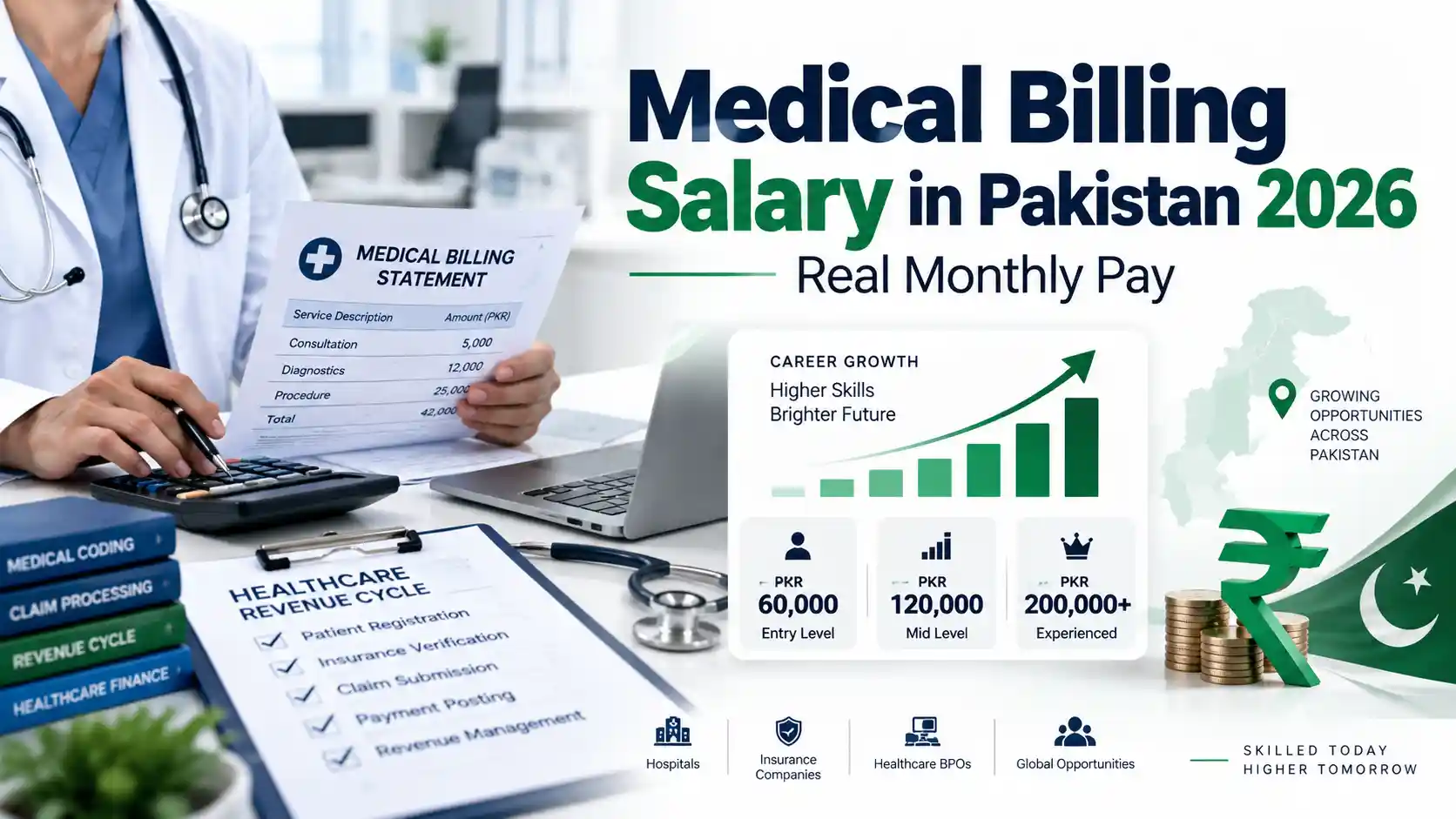
Quick Answer
The average medical billing salary in Pakistan in 2026 is roughly PKR 65,000 to PKR 73,000 per month for a general medical biller. Freshers typically start between PKR 30,000 and PKR 50,000. Experienced AR and denial-management specialists earn PKR 120,000 to PKR 250,000, while remote billers working directly for US practices earn USD 600 to USD 2,500 monthly.
Introduction
Ask ten people in Pakistan what a medical biller earns and you will get ten different answers, most of them either wildly optimistic or depressingly low. One cousin says PKR 250,000 a month. A LinkedIn post says PKR 30,000. A YouTube thumbnail promises dollars in ninety days. None of them show you a payslip. That confusion is exactly why so many capable students either skip the field entirely or walk into an interview and accept the first number they hear. At the Institute of Digital Trainings (IDT), we sit on the other side of that conversation every intake cycle — students arrive with a screenshot of a foreign salary site and leave with a realistic plan, which is the same approach our Medical Billing course is built around.
This article gives you the honest version. Not a single figure below is invented. Every range is anchored to a live Pakistani job posting, a salary aggregator with a stated sample size, or a clearly flagged observation from the market we work in daily. Where the data is thin, we say so rather than dressing up a guess as a statistic.
You will get the national average, the fresher reality, the role-by-role breakdown, the city differences, the night-shift arithmetic, the dollar-earning routes, and — most usefully — the specific capabilities that separate a PKR 45,000 biller from a PKR 180,000 AR specialist. If you are still deciding whether the field suits you at all, our guide on starting medical billing in Pakistan with zero experience is the natural companion piece to this one.
Key Takeaways
- The national average sits near PKR 65,000–73,000 per month. Indeed Pakistan reported an average medical biller salary of about PKR 65,723 per month from 642 reported salaries as of 30 January 2026.
- Freshers are not paid the average. A first job in Pakistan realistically pays PKR 30,000–50,000 for the first three to six months, and PKR 45,000–75,000 once you are productive.
- AR is where the money is. Accounts Receivable and denial management roles consistently pay 40–80% more than charge entry or payment posting at the same experience level.
- Night shift pays a premium. US-hours roles (typically 5:30 PM to 2:30 AM Pakistan time) carry transport allowances, meals and shift differentials that base-salary figures hide.
- Remote work breaks the local ceiling. Direct US contracts are quoted in dollars, and at roughly PKR 278–281 to the dollar in 2026, USD 1,500 a month converts to over PKR 400,000.
- Published salary data disagrees badly. Some global aggregators list Pakistani monthly salaries under an "annual" label. This article explains how to read those numbers correctly instead of repeating them.
- Specialisation beats seniority. Mental health, DME, behavioural health and multi-specialty AR pay more than general billing — often to people with fewer total years of experience.
What Is the Average Medical Billing Salary in Pakistan in 2026?
The average medical billing salary in Pakistan in 2026 falls between PKR 65,000 and PKR 73,000 per month for a general medical biller with one to three years of experience. Indeed Pakistan reported an average of approximately PKR 65,723 per month from 642 self-reported salaries, updated 30 January 2026. Independent compensation databases place the typical figure slightly higher, near PKR 68,000–73,000.
That range holds up across several independent sources, which is unusual for Pakistani salary data. Indeed Pakistan lists the average medical biller salary at about Rs 65,723 per month, drawn from 642 reported salaries and last updated on 30 January 2026. PayScale's 2026 figure for a medical biller in Pakistan is Rs 65,000, though its sample is far smaller. WorldSalaries places a typical Pakistani medical billing specialist at around PKR 68,175 per month before tax, and ERI's aggregated survey data puts the average annual figure at PKR 874,849 — roughly PKR 72,900 a month — with a typical band running from PKR 647,389 to PKR 1,035,822 a year.
Three separate methodologies landing inside a PKR 8,000 spread is a strong signal. Treat PKR 65,000–73,000 as the honest centre of the market.
But here is the part most articles skip: the average describes almost nobody. The distribution in medical billing is heavily two-humped. A large cluster of freshers and charge-entry staff sits well below it, and a smaller cluster of AR specialists, coders and team leads sits well above it. Very few people actually earn the average. Knowing which hump you are in matters far more than knowing the mean, which is why the rest of this article breaks the number apart rather than repeating it. For readers weighing the field against alternatives, our medical billing career scope guide for 2026 maps the longer arc.
Why Published Medical Billing Salary Data for Pakistan Contradicts Itself
Global salary websites frequently mislabel Pakistani monthly salaries as annual figures, and several rely on sample sizes in the single digits. Before trusting any published number, check three things: the sample size, whether the figure is monthly or annual, and the last-updated date. Applying that filter removes most of the contradictions readers encounter.
This section exists because we watched it confuse students repeatedly, and because no competing article addresses it.
Consider the evidence. Glassdoor's Pakistan page states an average of "PKR 54,750 per year" for a medical biller while simultaneously reporting top earners at PKR 143,900 — figures that only make sense as monthly amounts. Its Karachi page is built on just two anonymously submitted salaries as of September 2026, which is not a sample, it is an anecdote. Meanwhile ERI SalaryExpert reports a Pakistani medical billing specialist average of Rs 1,067,950 with entry level at Rs 815,979 and senior level at Rs 1,308,437 — annual figures that are internally consistent but reflect larger, more formal employers than the average Rawalpindi billing office.
The practical rule: if a site quotes an "annual" Pakistani salary under PKR 200,000, it is almost certainly a monthly figure. If it reports fewer than 20 submissions, ignore it. And if the last-updated date predates 2025, discard it entirely, because the rupee, the minimum wage and the outsourcing market have all moved since.
The most reliable source for a Pakistani jobseeker is not a global aggregator at all — it is the live posting. Rozee.pk and Indeed Pakistan listings state actual offered bands, because employers have to compete for candidates in public. We reference several of those postings directly in the sections below. If you are still at the stage of choosing a field, comparing our truck dispatcher salary guide for 2026 using the same filter is a useful exercise in reading salary claims critically.
Medical Billing Salary in Pakistan by Experience Level
Medical billing salaries in Pakistan rise sharply between year one and year four, then flatten unless you move into AR, coding, or management. A fresher earns PKR 30,000–50,000 monthly. At two years, PKR 75,000–130,000 is standard. Senior AR and denial specialists reach PKR 120,000–250,000, and RCM managers exceed PKR 200,000.
| Experience Level | Typical Title | Monthly Range (PKR) | What Drives the Number |
| 0–6 months | Trainee / Intern / Junior Billing Executive | 30,000 – 50,000 | Attendance, English clarity, typing accuracy |
| 6–18 months | Medical Billing Executive | 45,000 – 75,000 | Clean-claim rate, software familiarity |
| 18 months – 3 years | Medical Biller / AR Caller | 70,000 – 120,000 | Payer knowledge, call confidence, collections |
| 3–5 years | AR Specialist / Denial Management | 100,000 – 180,000 | Appeal success rate, specialty depth |
| 5–8 years | Senior AR Specialist / Team Lead | 150,000 – 250,000 | Team output, client retention |
| 8+ years | Billing Manager / RCM Manager | 200,000 – 400,000+ | Client portfolio size, margin ownership |
| Any (remote, direct US client) | Remote Billing Specialist | USD 600 – 2,500 (≈ PKR 167,000 – 700,000) | Client acquisition, autonomy, time-zone commitment |
Ranges reflect advertised and offered compensation in Pakistani medical billing companies during 2025–2026. They are indicative market bands, not a statistical survey.
Two observations that the table cannot show.
First, the jump between year one and year two is the largest single percentage increase in the entire career. A biller who becomes independently productive — meaning a supervisor no longer re-checks their claims — typically negotiates a 40–60% raise or switches employers for one. Miss that window and you can stay at fresher pay for three years.
Second, the curve flattens hard after year five for generalists. The people who break PKR 250,000 almost always did one of three things: specialised into a high-value niche, moved into credentialing or coding, or acquired their own clients. Staying a competent generalist is a plateau, not a path. Our breakdown of medical billing versus medical coding for 2026 covers the second of those routes in depth.
How Much Does a Fresher Earn in Medical Billing in Pakistan?
A fresher with no experience typically earns PKR 30,000–50,000 per month in the first three to six months at a Pakistani medical billing company, rising to PKR 45,000–80,000 once independently productive. Candidates with completed training, strong spoken English and hands-on software practice enter at the top of that band rather than the bottom.
Let us be blunt about the low end. Some Rawalpindi and Lahore offices advertise PKR 25,000–30,000 for absolute beginners on a probation basis. That is legal, it is common, and it is also negotiable — but only if you bring something the next candidate does not.
Industry guidance for the Pakistani market places fresher earnings at a Pakistani medical billing company in the PKR 40,000–80,000 range, rising to PKR 80,000–150,000 or more with one to two years of experience. Our experience matches the upper half of that for trained candidates and the lower half for walk-in hires with no preparation.
What we observe in our own classrooms. Students who enroll with zero background almost always struggle with the same two things in the first fortnight: the alphabet soup of CPT, ICD-10-CM, HCPCS, EOB and ERA, and the accent barrier on recorded payer calls. Neither is an intelligence problem. Both dissolve with structured repetition, which is why our sessions front-load payer terminology before touching software. The students who quit are almost always the ones who tried to learn billing from scattered YouTube videos first and arrived already discouraged.
What actually moves a fresher offer upward:
- Hands-on practice in at least one practice-management platform before the interview
- The ability to read an EOB out loud and explain each line
- Clear, unhurried spoken English — not a fake accent, just clarity
- Willingness to commit to the US night shift without renegotiating in month two
- A completed course certificate that the employer can verify
Entry-level postings in the twin cities confirm the shape of this market. Live Rawalpindi and Islamabad listings in 2026 include Junior Medical Billing Executive roles requiring six months to 1.5 years of experience or a relevant medical billing internship, alongside explicitly labelled "Entry Level / Fresher" Medical Billing Executive positions. That internship pathway is the cheapest entry ticket available, and it is exactly why our medical billing course with internship in Pakistan exists as a distinct track. Indeed
Enroll in the IDT Medical Billing Course — and if you want to confirm fee structure, batch timings or internship placement before committing, Contact IDT Now
Medical Billing Salary by Job Role and Designation
Medical billing is not one job. Charge entry pays PKR 30,000–55,000, payment posting PKR 40,000–70,000, AR specialists PKR 70,000–140,000, certified coders PKR 80,000–180,000, and RCM managers PKR 180,000–400,000. Choosing the right sub-function matters more to your income than choosing the right company.
| Role | Core Responsibility | Monthly Range (PKR) | Difficulty to Enter |
| Data / Charge Entry Operator | Entering demographics and charges | 30,000 – 55,000 | Low |
| Payment Posting Executive | Posting ERAs, EOBs, patient payments | 40,000 – 70,000 | Low |
| Eligibility & Prior Authorisation | Verifying coverage before service | 45,000 – 85,000 | Low–Medium |
| AR Caller (voice process) | Calling payers on unpaid claims | 50,000 – 95,000 + incentives | Medium |
| AR / Denial Management Specialist | Analysing denials, filing appeals | 70,000 – 150,000 | Medium–High |
| Credentialing Specialist | Enrolling providers with payers | 60,000 – 130,000 | Medium–High |
| Certified Medical Coder (CPC) | Assigning CPT / ICD-10-CM codes | 80,000 – 180,000 | High |
| QA / Billing Auditor | Pre-submission claim quality control | 90,000 – 170,000 | High |
| Team Lead / Supervisor | Managing 6–15 billers | 120,000 – 230,000 | High |
| Billing / RCM Manager | Owning client accounts and margins | 180,000 – 400,000+ | Very High |
Real postings confirm the AR band. One Lahore AR Specialist role advertised Rs 50,000 to Rs 70,000 per month with performance-based incentives, requiring proficiency across multiple EMR and practice-management systems, knowledge of CPT and ICD coding standards, and familiarity with Medicare and Medicaid guidelines. A senior equivalent in Rawalpindi went higher: a Senior A/R Specialist position offered a monthly range of Rs 60,000 to Rs 90,000, with transport allowances for female staff, complimentary dinner and tea served twice daily, and working hours of 5:30 PM to 2:30 AM on a night-shift schedule.
Read that second posting carefully, because it teaches something the salary tables cannot. The advertised base is only part of the offer. Transport, meals and shift structure are real economic value, and in Pakistan's current cost environment a fully-covered commute plus two meals can be worth PKR 15,000–25,000 a month that never appears in a salary statistic.
Notice also what employers list as requirements. Rozee.pk medical billing listings repeatedly demand accounts receivable management, denial management, revenue cycle management, payment posting, claims appeals and collections, plus named-payer familiarity with Medicare, Medicaid, Aetna, UnitedHealthcare and Blue Cross Blue Shield. Those named payers are not decoration. A candidate who can discuss BCBS timely-filing rules specifically will out-negotiate one who says "I know insurance." Our complete guide to becoming a certified medical biller works through that payer-by-payer knowledge systematically.
Medical Billing Salary in Pakistan by City
Islamabad and Rawalpindi offer the highest concentration of US medical billing employers and the strongest salary bands in Pakistan, followed closely by Lahore and Karachi. Secondary cities pay 20–35% less for equivalent roles. Remote work removes the city penalty entirely, which is the single most important fact for candidates outside the big three.
| City / Region | Market Depth | Typical Monthly Band (PKR) | Notes |
| Islamabad / Rawalpindi | Highest — dense cluster of RCM firms | 45,000 – 160,000 | Strongest fresher intake; most night-shift roles |
| Lahore | High — large BPO setups | 40,000 – 150,000 | Competitive; strong AR and coding demand |
| Karachi | High — mixed BPO and healthcare IT | 40,000 – 140,000 | Broader BPO competition for talent |
| Faisalabad / Multan / Gujranwala | Moderate and growing | 30,000 – 95,000 | Fewer employers, less negotiating leverage |
| Peshawar / Quetta | Limited | 30,000 – 85,000 | Remote work strongly advised |
| Fully remote (Pakistan-based) | Unlimited by geography | 60,000 – 700,000+ | Depends entirely on client, not location |
Islamabad and Rawalpindi host multiple medical billing companies across G-10, Blue Area and I-8, and medical billing jobs in Islamabad for freshers are frequently posted on Rozee.pk and LinkedIn, while Lahore hosts several large BPO setups where roles are plentiful but highly competitive.
The twin-cities advantage is real but often overstated in a way that traps people. Candidates from Multan and Faisalabad routinely relocate to Rawalpindi for a PKR 55,000 job, then lose PKR 30,000 to rent and transport — a net loss disguised as a promotion. Run that arithmetic before you move. In many cases, staying home and building toward a remote role produces better take-home income within eighteen months. Our 30-day roadmap after completing a digital course sets out that remote-first sequence step by step.
What Does a Medical Billing Payslip Actually Contain?
A Pakistani medical billing payslip typically combines a base salary, a night-shift or transport allowance, performance incentives tied to collections or call volume, and occasionally a quarterly or annual bonus. Base salary alone understates total compensation by 15–35% in most US-hours roles.
Break a realistic mid-level offer into parts:
Base salary — the advertised figure, paid monthly, usually by bank transfer
Night-shift allowance or transport — cash allowance, company pick-and-drop, or fuel reimbursement for the 5:00 PM–3:00 AM window
Meal provision — increasingly standard in twin-cities night-shift offices
Performance incentive — commonly tied to collections recovered, claims touched per day, or appeal success rate
Annual or festival bonus — variable, and worth asking about explicitly
Provident fund / EOBI — offered by formalised employers; often absent at small firms
On bonuses, the evidence is mixed and worth knowing before you negotiate. Roughly 52% of medical billing specialists in Pakistan reported receiving a bonus of some kind over a twelve-month period, with reported bonuses ranging from 3% to 6% of base salary, while the remaining 48% reported no bonus at all. In other words, treat a bonus as a bonus. Never accept a below-market base on the promise of one.
The question to ask in every interview: "What did someone in this role actually take home last month, including allowances and incentives?" Most managers will answer it. The ones who refuse have told you something useful. For broader negotiation groundwork, our comparison of freelancing versus a job in Pakistan in 2026 lays out how benefit structures differ across the two models.
Remote and Freelance Medical Billing Income in Dollars
Pakistani medical billers working directly for US practices typically earn USD 600–2,500 per month, while hourly freelance work on platforms like Upwork commonly ranges from USD 8–20 per hour. Percentage-of-collections arrangements, usually 4–8% of collected revenue, offer the highest ceiling for billers who can manage an entire practice's revenue cycle.
This is where the medical billing salary conversation in Pakistan becomes genuinely interesting.
Dedicated remote billers working directly for US practices can earn USD 1,000–2,500 per month, medical billing work on Upwork typically pays USD 8–20 per hour, and many Pakistani freelancers charge a percentage of collections — usually 4–8%. Income also varies sharply by specialization: mental health billing, DME billing, behavioural health billing and multi-specialty AR consistently pay more than general billing.
Convert those numbers honestly. At the 2026 exchange rate — roughly PKR 278.6 to the US dollar in mid-2026 — a USD 1,200 monthly retainer equals approximately PKR 334,000. That is more than most Pakistani billing team leads earn, achieved by someone who may have only two to three years of experience.
But the honest caveats matter more than the headline.
- Dollar income is not salary. There is no HR department, no paid leave, no EOBI, and no guaranteed renewal. A client can end the engagement in a week.
- Acquisition is the hard part, not the work. Most Pakistani billers who fail at remote work fail at finding and keeping clients, not at billing.
- Trust is the currency. US practices are handing you access to protected health information. HIPAA compliance, secure systems and verifiable credentials are non-negotiable prerequisites, not optional polish.
- Percentage-of-collections cuts both ways. A 6% arrangement on a small practice collecting USD 40,000 monthly yields USD 2,400. On a struggling practice collecting USD 8,000, it yields USD 480 for identical effort.
The sector-level context supports the opportunity. Pakistan's IT and IT-enabled services exports reached a record USD 4.6 billion in fiscal year 2025-26, rising 21% from USD 3.814 billion in FY25, and this category generated almost 46% of total services exports of USD 10.034 billion. Those receipts include IT-enabled services, freelance services and call-centre operations, and the FY27 federal budget extended the preferential tax regime for the IT sector and freelancers for another three years.
Medical billing sits squarely inside that export category. The policy environment, the demand and the payment rails all currently favour Pakistani remote billers. If platform work is your intended route, start with our comparison of Upwork versus Fiverr for Pakistani freelancers in 2026.
Explore all IDT professional courses — for guidance on which track fits a remote-first career plan, Talk to an IDT Advisor
In-House Job vs Remote Contract vs Freelancing — Which Pays More?
An in-house Pakistani job pays least but offers the most stability and the fastest skill acquisition. A remote contract with a US practice pays three to six times more but carries no employment protection. Freelancing has the highest ceiling and the highest failure rate. For most people, the correct sequence is job first, remote second.
| Feature | In-House Pakistani Job | Remote Contract (US Practice) | Freelance / Platform Work | Recommendation |
| Typical monthly income | PKR 40,000 – 160,000 | USD 600 – 2,500 (≈ PKR 167,000 – 700,000) | USD 300 – 3,000+, highly variable | Remote contract for income; job for entry |
| Income stability | High | Medium | Low | In-house job in year one |
| Experience required to start | None to 6 months | 1–2 years minimum | 1–2 years plus portfolio | Start in-house |
| Skill development speed | Fastest (supervised, corrected daily) | Medium (you self-correct) | Slowest (no feedback loop) | In-house first, always |
| Benefits, leave, EOBI | Usually yes | No | No | In-house for security |
| Payment risk | Minimal | Low–medium | Medium–high | In-house for risk-averse |
| Ceiling | PKR ~400,000 | USD ~3,000+ | Effectively uncapped | Freelance for ambition |
| Time-zone burden | Night shift, structured | Night shift, self-managed | Flexible but client-driven | Equal burden, different control |
The sequencing advice is the whole point of this table. Almost every Pakistani biller earning USD 2,000 a month today started in a Rawalpindi or Lahore office at PKR 40,000. The in-house year is not a detour from remote income — it is the qualification for it. Skipping it produces confident beginners who lose their first client in six weeks.
Our guide to starting freelancing in Pakistan in 2026 covers the transition mechanics once you have the in-house year behind you.
What Factors Decide Your Medical Billing Salary?
Ten variables determine a medical biller's pay in Pakistan: specialty focus, AR capability, English fluency, software range, certification, employer type, city, shift commitment, client-facing exposure, and negotiation. Specialty focus and AR capability move the number more than the other eight combined.
1. Specialty focus. General billing is the commodity end of the market. Behavioural health, DME, mental health and surgical billing carry complexity premiums because fewer people can do them.
2. AR and denial capability. Anyone can submit a clean claim. Recovering a 90-day-aged denied claim from a hostile payer is a scarce skill, and it is directly measurable in rupees recovered — which makes it the easiest skill to price in a salary negotiation.
3. Spoken English clarity. Voice-process AR roles pay a premium precisely because many technically competent billers cannot hold a payer call confidently. This is trainable and underinvested in.
4. Software range. Familiarity with multiple EMR and practice-management platforms widens your employable surface. Employers explicitly list proficiency with multiple EMRs, PM software and insurance portals as a requirement in AR specialist postings.
5. Certification. Coding certifications from recognised bodies carry the clearest premium, particularly for roles touching CPT and ICD-10-CM assignment.
6. Employer type. Large formalised RCM firms pay more and offer provident funds. Small five-person offices pay less but often promote faster.
7. City. Covered above — real, but solvable through remote work.
8. Shift commitment. Full US-hours availability is worth money. Candidates who negotiate "evening shift only" are competing for a much smaller pool of lower-paying roles.
9. Client-facing exposure. Billers who speak directly to the US practice manager become hard to replace. Billers who only touch a queue do not.
10. Negotiation. The most underrated factor. Most Pakistani candidates accept the first offer. The gap between "yes, thank you" and "I was targeting PKR 15,000 higher based on my AR background" is frequently PKR 180,000 a year.
Interestingly, formal degrees barely feature. Compensation survey data indicates that a high school education is the most common highest qualification for medical billers, which makes this one of the few well-paying fields in Pakistan where demonstrated skill genuinely outranks credentials. That is good news for anyone weighing digital skills to learn after matric. ERI
Which Skills Add the Most Money to a Medical Biller's Salary?
Denial management, payer-specific appeal writing, credentialing, CPT and ICD-10-CM coding accuracy, and multi-platform software fluency produce the largest measurable salary increases in Pakistani medical billing. Each maps to a revenue outcome the employer can count, which is why each is negotiable.
Here is the principle that governs all salary movement in this field: you get paid for revenue you can prove you recovered, not for hours you sat at a desk.
Skills ranked by salary impact:
Denial management and appeals — Learn the top fifteen denial codes and the exact appeal route for each. This single capability regularly justifies a PKR 25,000–40,000 monthly increase.
Aged AR recovery (90+ days) — The claims everyone else abandoned. Recovering them is visible, countable and immediately valuable.
Credentialing and provider enrolment — A narrow, high-friction specialism with persistently short supply in Pakistan.
CPT / ICD-10-CM accuracy — Even without a coding job title, coding literacy reduces denials at source and marks you as senior.
Prior authorisation management — Prevents denials rather than fixing them, which practices value increasingly.
Payer-specific rule knowledge — Timely filing limits, modifier requirements and documentation standards differ by payer. Specific knowledge beats general knowledge in every negotiation.
Reporting and analytics — Billers who can produce a clean AR aging summary and explain it to a practice owner cross into management territory early.
Multi-platform fluency — Practical hands-on time across several practice-management systems.
A note from our training floor. The students who progress fastest are not the ones who memorise the most codes. They are the ones who learn to read a denial and predict the fix before looking it up. That pattern recognition takes roughly eight to twelve weeks of deliberate practice on real denial scenarios — which is why our Medical Billing course is structured around worked denial cases rather than lecture slides.
View the IDT Medical Billing curriculum — to discuss which module sequence fits your current level, Request a Callback from IDT
Does Certification or a Diploma Actually Raise Your Salary?
Certification raises starting salaries and shortens the time to a first offer, but it does not substitute for hands-on practice. A verified course certificate plus practical software exposure reliably lifts a fresher offer from the PKR 30,000 band into the PKR 45,000–60,000 band. International coding certifications matter most for coding-specific roles.
| Feature | Short Certification Course | Full Diploma Programme | Self-Study Only | Recommendation |
| Time to complete | 2–4 months | 6–12 months | Indefinite | Certification for speed |
| Typical entry salary achieved | PKR 45,000 – 65,000 | PKR 50,000 – 80,000 | PKR 25,000 – 40,000 | Diploma for maximum entry pay |
| Hands-on software practice | Usually included | Comprehensive | Rarely available | Either formal route |
| Internship / placement support | Sometimes | Usually | None | Prioritise programmes offering it |
| Employer verification | Yes, if institute is verifiable | Yes | No | Insist on verifiable certificates |
| Cost | Lower | Higher | Near zero | Certification for best ROI |
| Suits | Career changers needing speed | Fresh graduates with time | Highly disciplined self-starters | Certification for most readers |
The underrated variable is verifiability. An employer who cannot confirm your certificate treats it as decoration. Institutes offering public certificate verification remove that doubt at the interview stage, which is worth more than the certificate's design.
For international credentials, the recognised bodies for coding and health information are the American Academy of Professional Coders (AAPC) and AHIMA. These carry genuine weight for coding-track roles and international remote contracts — though they cost significantly more in rupee terms and are best pursued after you are already employed and earning. Our detailed comparison of medical billing certification versus a diploma walks through the decision for Pakistani candidates specifically.
Disclosure: IDT offers paid medical billing training. The comparison above reflects our observed market outcomes; we encourage readers to verify any institute's placement claims independently before enrolling.
Medical Billing Salary Growth Path: Month 1 to Year 5
A realistic Pakistani medical billing career progresses from PKR 35,000 in month one to PKR 150,000–250,000 by year five, provided the biller specialises into AR or coding by year two. Billers who remain in charge entry or payment posting typically plateau near PKR 80,000.
Months 1–3 — Foundation (PKR 30,000–45,000)
Learn terminology, the claim lifecycle, and one practice-management platform. You are a cost to the employer during this period; behave accordingly and absorb everything.
Months 4–9 — Productivity (PKR 45,000–70,000)
Your claims stop being re-checked. Ask for a review at month six with a specific number in mind and specific evidence behind it.
Months 10–18 — Specialisation decision (PKR 65,000–100,000)
The pivotal window. Choose AR, denial management, credentialing or coding. Staying a generalist here is the single most common career mistake in Pakistani medical billing.
Years 2–3 — Depth (PKR 90,000–150,000)
Own a specialty or a set of payers. Start recording your own recovery statistics — you will need them for every future negotiation and every remote client pitch.
Years 3–5 — Leverage (PKR 130,000–250,000, or dollar income)
Two forks appear: lead a team locally, or take your track record to the US market directly. Many billers do both, holding a local role while building a remote client base.
Beyond year 5 — Ownership (PKR 250,000–400,000+, or an agency)
Managers own client margins. Some billers stop being employees entirely and open small RCM agencies serving three to eight US practices. The projected trajectory supports continued growth: compensation data indicates medical biller salaries in Pakistan are projected to grow substantially over a five-year horizon. ERI
If you want the full landscape of where this career can lead, our medical billing career scope guide for 2026 extends this timeline further.
Medical Billing vs Medical Coding vs Other Digital Careers
Medical coding generally out-earns medical billing at senior levels in Pakistan, but takes longer to enter because it requires certification. Compared to other digital careers, medical billing offers faster entry than data analytics and steadier income than most freelancing skills, at the cost of permanent night-shift working.
| Career Track | Typical Entry (PKR/month) | Experienced (PKR/month) | Time to First Job | Night Shift Required |
| Medical Billing | 30,000 – 50,000 | 100,000 – 250,000 | 2–4 months | Yes |
| Medical Coding (certified) | 50,000 – 80,000 | 120,000 – 300,000 | 6–12 months | Often |
| Truck Dispatching | 35,000 – 60,000 | 100,000 – 250,000 | 1–3 months | Yes |
| Data Analytics | 40,000 – 70,000 | 120,000 – 300,000 | 4–8 months | No |
| Digital Marketing / SEO | 30,000 – 60,000 | 80,000 – 250,000 | 3–6 months | No |
| Video Editing | 30,000 – 55,000 | 70,000 – 200,000 | 2–5 months | No |
Recommendation: choose medical billing if you want fast, structured entry into a dollar-linked industry and can genuinely commit to US hours. Choose data analytics or digital marketing if night shift is not viable for your circumstances.
That night-shift caveat deserves emphasis because it is the honest dealbreaker nobody mentions in recruitment ads. US billing runs on US time. A 5:30 PM to 2:30 AM schedule is standard, permanent, and difficult to sustain alongside family obligations or daytime study. Candidates who cannot commit to it should look seriously at our Data Analyst course instead, or read our roundup of the highest-paying freelance skills in Pakistan before deciding.
Compare all IDT course tracks side by side — unsure which suits your schedule and goals? Book a Free Counselling Session
Taxes, Deductions and Real Take-Home Pay
Salaried income in Pakistan is taxed under slab rates administered by the Federal Board of Revenue, with tax deducted at source by the employer. Dollar income earned through export of IT-enabled services falls under a separate concessional regime. Your gross offer is not your take-home figure, and the gap widens as your salary rises.
Three practical points, kept deliberately general because rates change with each Finance Act and you should verify current figures rather than trust an article.
For salaried billers. Your employer withholds income tax monthly against annual slab rates. Lower salary brackets carry little or no liability; the effective rate climbs as income rises. The current slabs are published by the Federal Board of Revenue and should be checked directly each tax year.
For dollar earners. The FY27 federal budget extended the preferential tax regime for the IT sector and freelancers for a further three years, and export proceeds routed through proper banking channels have historically attracted a concessional rate rather than standard slab treatment. Registering correctly matters — informal cash receipt of foreign income creates problems that dwarf any tax saved.
For everyone. Ask whether an offer is gross or net before accepting. Ask whether provident fund and EOBI are deducted. In smaller billing offices, neither may exist, which raises your immediate cash but removes long-term protection.
This is general information, not tax advice. Consult a qualified tax practitioner for your specific situation. Readers planning a dollar-earning path will also find our guide to earning your first USD 100 online in Pakistan useful for setting up payment channels correctly from the start.
Common Mistakes That Keep Medical Billing Salaries Low
The most expensive mistakes are staying a generalist past year two, never tracking your own recovery numbers, accepting the first offer without negotiating, and treating spoken English as optional. Each is fixable within a few months and each is worth tens of thousands of rupees monthly.
Mistake 1 — Staying in charge entry too long. It is comfortable, supervised and capped. Two years of charge entry is worth roughly the same on a CV as six months of it.
Mistake 2 — Not recording your own metrics. If you cannot say "I recovered USD 42,000 in aged AR last quarter," you are negotiating on vibes. Start a simple log in month one.
Mistake 3 — Accepting the first offer. Pakistani candidates negotiate far less than the market expects them to. Employers build negotiating room into their opening figure and are frequently surprised when nobody uses it.
Mistake 4 — Neglecting spoken English. Voice-process roles pay more and are chronically short of confident speakers. Twenty minutes of daily practice changes your earning band within a quarter.
Mistake 5 — Job-hopping every six months. One strategic switch at the 12–18 month mark is smart. Four switches in two years reads as unreliability and caps your options at exactly the firms that pay least.
Mistake 6 — Chasing dollars before competence. The most common failure pattern we see: a student finishes a short course, immediately pitches US clients, loses two in a row, and concludes the field does not work. The field works. The sequence was wrong.
Mistake 7 — Ignoring compliance fundamentals. HIPAA is not paperwork. A biller who is casual about protected health information is unemployable in remote work, permanently. The official reference is HHS.gov's HIPAA portal.
Mistake 8 — Treating the certificate as the destination. The certificate opens the interview. What you can demonstrate in the interview determines the number. Our guide on choosing the best medical billing course as a beginner explains what to look for in a programme that closes that gap.
Is Medical Billing Still Worth It in 2026? The AI Question
Medical billing remains a viable career in Pakistan in 2026, but the entry-level, repetitive end of the work is under genuine automation pressure. AI tools now handle eligibility checks, charge entry and basic claim scrubbing. Judgement-heavy work — denial appeals, payer negotiation, credentialing and complex AR — remains firmly human and is where salary growth is concentrating.
Let us answer this honestly rather than reassuringly.
What AI is already absorbing: automated eligibility verification, coding suggestion engines, claim-scrubbing rules, basic charge entry, first-pass denial categorisation, and routine follow-up correspondence.
What AI is not absorbing: arguing a medical-necessity appeal with a payer representative, judging which of four plausible modifiers is defensible for a specific documentation set, managing a provider's credentialing through a state Medicaid enrolment, and explaining a collections problem to a frustrated practice owner.
The practical implication for your salary. A biller whose entire value is typing accuracy faces a shrinking market. A biller who owns outcomes — recovered revenue, reduced denial rate, faster enrolment — faces an expanding one, partly because AI is handling the volume work and freeing budget for judgement work.
The structural demand also has not moved. The US healthcare system's claims complexity, driven by the rules of Medicare and Medicaid published by the Centers for Medicare & Medicaid Services (CMS), is not simplifying. Outsourcing that complexity to skilled, cost-effective teams remains the economic logic behind Pakistan's entire medical billing sector. Business Process Outsourcing is specifically identified among the high-growth segments scaling within Pakistan's record IT export performance.
Our position: enter medical billing in 2026 with the explicit intention of reaching AR, denial management or coding within eighteen months. Enter it as a data-entry job and you are buying a depreciating asset. For a wider view of this shift, see our analysis of AI replacing traditional jobs in 2026.
2026 Trends and Latest Updates
2026 UPDATE BOX — What Changed This Year
1. Record export environment. Pakistan's IT and IT-enabled services exports hit a record USD 4.6 billion in FY2025-26, up 21% year-on-year, with June 2026 setting a monthly record of USD 416 million. Medical billing services form part of this export category.
2. Tax regime extended. The FY27 federal budget extended the preferential tax regime for the IT sector and freelancers for another three years, improving the economics of dollar-earning billing work.
3. Rupee stability. The rupee has traded in a comparatively narrow band around PKR 277–281 to the dollar through 2026, making dollar-denominated contracts easier to plan around than in the volatile 2022–2023 period.
4. AR roles dominate hiring. Live 2026 postings across Rawalpindi, Islamabad and Lahore skew heavily toward AR specialists, denial management and senior AR — not entry-level data roles.
5. Internship pathways have become standard. Employers now routinely accept "a relevant internship in medical billing" in place of six to eighteen months of formal experience, which materially shortens the route into the field for trained freshers.
6. Specialty billing premiums have widened. Behavioural health, mental health and DME billing continue to command clear pay premiums over general billing.
Our review of medical billing course options in Pakistan has been updated to reflect these hiring shifts.
Expert Tips From the Training Floor
Five practical habits separate billers who reach PKR 150,000 from those who stall at PKR 70,000: tracking your own numbers, specialising early, practising payer calls aloud, negotiating annually, and building a verifiable public record of competence.
Tip 1 — Keep a recovery log from day one. A simple spreadsheet: date, claim value, payer, denial reason, outcome. In two years it becomes the most valuable document in your career.
Tip 2 — Pick your specialty by month twelve. Not month thirty. The people who specialise early compound their advantage; the people who wait spend years competing with freshers.
Tip 3 — Practise payer calls out loud, alone. Record yourself explaining a denial appeal. It is uncomfortable, and it is the fastest route to the voice-process premium.
Tip 4 — Negotiate on a fixed annual date. Put it in your calendar. Walk in with your recovery log. Ask for a specific number, not "a raise."
Tip 5 — Build a public record. A LinkedIn profile that describes outcomes rather than duties. A verifiable certificate. Two references who will take a call. This is what converts a remote client enquiry into a contract.
Tip 6 — Do not resign for a remote client until the second payment clears. We have seen too many people quit a stable job on a verbal promise. Overlap for one full billing cycle.
Readers building toward that public record will find our guide to online students earning USD 500 monthly in Pakistan a realistic look at how that first income actually forms.
How People Ask AI Assistants About Medical Billing Pay
These are the conversational, spoken-style questions Pakistani users put to ChatGPT, Gemini, Perplexity and Claude about medical billing income — answered directly.
"Is medical billing a good career in Pakistan in 2026, honestly?"
Yes, with one condition: you must be able to work US night hours and must move beyond entry-level data work within eighteen months. Under those conditions it offers faster entry and better dollar-linkage than most alternatives.
"How much will I actually make in my first month as a medical biller in Pakistan?"
Between PKR 30,000 and PKR 50,000 in a Pakistani company, depending on your city, your training and your English. Trained candidates with software exposure start nearer PKR 50,000.
"Can I do medical billing from home in Pakistan and get paid in dollars?"
Yes, but realistically after one to two years of supervised experience. Direct US practice contracts commonly run USD 600–2,500 monthly, and platform work commonly USD 8–20 hourly.
"Which pays more in Pakistan, medical billing or medical coding?"
Coding pays more at senior levels but takes longer to enter because it requires certification. Billing gets you employed faster; coding gets you paid more later.
"Will AI take medical billing jobs in Pakistan?"
It is already absorbing charge entry, eligibility checks and basic scrubbing. It is not absorbing denial appeals, credentialing or payer negotiation — which is where you should aim.
"Do I need a degree to become a medical biller in Pakistan?"
No. Survey data shows most medical billers hold a high school qualification as their highest education. Demonstrated skill and a verifiable certificate matter more than a degree.
People Also Ask
What is the highest salary in medical billing in Pakistan?
Locally, RCM managers and senior billing managers reach PKR 250,000–400,000 monthly. Billers running their own US client portfolios exceed that, since percentage-of-collections arrangements scale with the practices they serve.
Which city pays the most for medical billing in Pakistan?
Islamabad and Rawalpindi, due to the density of US-facing RCM firms, followed by Lahore and Karachi. Remote work eliminates the city difference entirely.
How long does it take to learn medical billing?
Two to four months for a structured course covering the claim lifecycle, payer rules and hands-on software. Competence at AR level takes a further nine to twelve months on the job.
Is medical billing a night-shift job in Pakistan?
Almost always. US business hours translate to roughly 5:00 PM–3:00 AM Pakistan time, and job postings state these hours explicitly.
Can a fresher get a medical billing job without experience?
Yes. Entry-level and fresher-labelled positions are actively posted, and many employers now accept a relevant medical billing internship in place of formal experience.
Does medical billing require coding knowledge?
Not to start, but employers list CPT and ICD-10-CM familiarity in AR specialist requirements, and coding literacy raises your pay band regardless of job title.
What software do Pakistani medical billers use?
Practice-management and EMR platforms vary by client. Employers consistently ask for proficiency across multiple EMRs, PM systems and insurance portals rather than one specific tool.
Is medical billing better than freelancing for beginners?
For beginners, a job is better. It supplies supervised correction, which freelancing does not. Move to freelancing once your error rate is low and your recovery record is documented.
Why Choose IDT for Medical Billing Training and a Higher Starting Salary
The Institute of Digital Trainings (IDT) approaches medical billing training as salary preparation, not certificate distribution. Our Medical Billing programme is structured around worked denial cases, hands-on practice-management exposure, verifiable certification and an internship pathway — the four things Pakistani employers actually price into a fresher offer.
Here is why that focus matters for your starting number.
Most medical billing courses in Pakistan teach terminology and stop. Students finish knowing what an EOB is, walk into an interview, and cannot read one aloud under pressure. That gap is exactly where a PKR 55,000 offer becomes a PKR 32,000 offer. Our curriculum front-loads payer terminology, then spends the majority of contact hours on real denial scenarios — because pattern recognition on denials is the skill employers are buying.
What we build into the IDT Medical Billing course:
- Denial-first teaching. Worked cases across the most common denial codes, with the appeal route for each.
- Hands-on software exposure. Practical time in practice-management environments, not screenshots on a slide.
- Interview preparation for the night-shift reality. Including spoken-English practice for voice-process AR roles, since that is where the premium sits.
- Internship pathway. Because employers now accept a relevant internship in place of six to eighteen months of experience, the internship route is the shortest legitimate distance to a first offer — detailed in our medical billing course with internship guide.
- Verifiable certification. Employers can confirm your credential through our public certificate verification system, which removes the doubt that devalues unverifiable certificates.
- Salary-negotiation coaching. We teach students to walk in with a target number and evidence, because the single largest avoidable loss in this field is accepting the first offer.
On our institution. IDT is a Pakistan-based digital skills institute training students, career changers, freelancers and working professionals across medical billing, data analytics, AI automation, cyber security, cloud computing, truck dispatching and digital marketing. You can read more about our background and teaching approach on our About page, browse our full course catalogue, or review open positions on our careers page.
On honest expectations. We do not promise dollar income in ninety days, because that promise is how students end up disappointed and out of pocket. We promise a realistic first offer in the PKR 45,000–65,000 band for students who complete the programme and prepare properly, and a credible route to AR-level income within eighteen months. Verify any institute's claims — including ours — before you pay a fee.
Enroll in the IDT Medical Billing Course Today
Contact IDT for Fees, Batch Timings and Internship Details
Frequently Asked Questions
1. What is the average medical billing salary in Pakistan in 2026?
Approximately PKR 65,000–73,000 per month for a general medical biller. Indeed Pakistan reported an average of about PKR 65,723 monthly from 642 reported salaries as of 30 January 2026, and independent compensation databases place the figure slightly higher.
2. How much does a fresher earn in medical billing in Pakistan?
PKR 30,000–50,000 in the first three to six months, rising to PKR 45,000–80,000 once independently productive. Trained candidates with software exposure and clear spoken English start at the top of that band.
3. What is the salary of an AR specialist in medical billing in Pakistan?
Typically PKR 70,000–150,000 monthly. A 2026 Lahore posting advertised Rs 50,000–70,000 plus incentives for an AR Specialist, while a Rawalpindi Senior A/R Specialist role offered Rs 60,000–90,000 with transport and meals included.
4. Can I earn in dollars doing medical billing from Pakistan?
Yes. Remote billers working directly for US practices commonly earn USD 600–2,500 monthly, platform work typically pays USD 8–20 hourly, and percentage-of-collections arrangements usually run 4–8% of collected revenue.
5. Is medical billing a night-shift job in Pakistan?
Yes, almost universally. US business hours translate to roughly 5:00 PM–3:00 AM Pakistan time, and postings state these hours explicitly along with transport and meal provisions.
6. Do I need a degree for medical billing in Pakistan?
No. Compensation survey data indicates a high school qualification is the most common highest education level for medical billers. A verifiable certificate and demonstrated skill carry more weight with employers.
7. Which medical billing specialty pays the most in Pakistan?
Mental health, behavioural health, DME and multi-specialty AR consistently pay above general billing, because fewer billers can handle their documentation and denial complexity.
8. How much can I earn after two years in medical billing?
Realistically PKR 90,000–150,000 monthly in a Pakistani company, or considerably more if you transition to a direct US remote contract with a documented recovery record.
9. Will AI replace medical billing jobs in Pakistan?
AI is absorbing charge entry, eligibility verification and basic claim scrubbing. Denial appeals, credentialing, payer negotiation and complex AR remain human work, and that is where salaries are growing.
10. How long does medical billing training take before I can apply for jobs?
Two to four months for a structured course with hands-on software practice. Adding an internship shortens the route further, since many employers now accept a relevant internship in place of six to eighteen months of experience.
Conclusion
The medical billing salary in Pakistan in 2026 is neither the PKR 250,000 fantasy nor the PKR 25,000 horror story. It is a PKR 65,000–73,000 average built on a two-humped distribution — a wide base of underpaid entry-level staff and a smaller, better-paid tier of AR specialists, coders and managers who broke out of that base within their first eighteen months.
The single recommendation that matters: do not plan your career around the entry salary. Plan it around the eighteen-month specialisation decision. Whether you end up at PKR 70,000 or PKR 200,000 is determined almost entirely by whether you moved into denial management, AR recovery, credentialing or coding before your second year ended. Everything else — city, employer, even the starting number — is noise by comparison.
The conditions in 2026 are unusually favourable. Exports are at a record, the tax regime for IT and freelance income has been extended, the rupee has been comparatively stable, and employers are actively hiring AR talent while accepting internships in place of formal experience. That combination does not hold forever.
Your next step: decide whether you can genuinely commit to US night hours. If yes, get trained properly, get a verifiable certificate, take the internship route, and start your recovery log on day one.
Speak to an IDT Career Advisor Today