Introduction
Every few months, a new AI tool promises to write your test cases, run your regression suite and fix your broken scripts. So it is fair to ask whether QA testers will still have a job. For anyone starting in software testing, or already working in it, this question is hard to ignore.
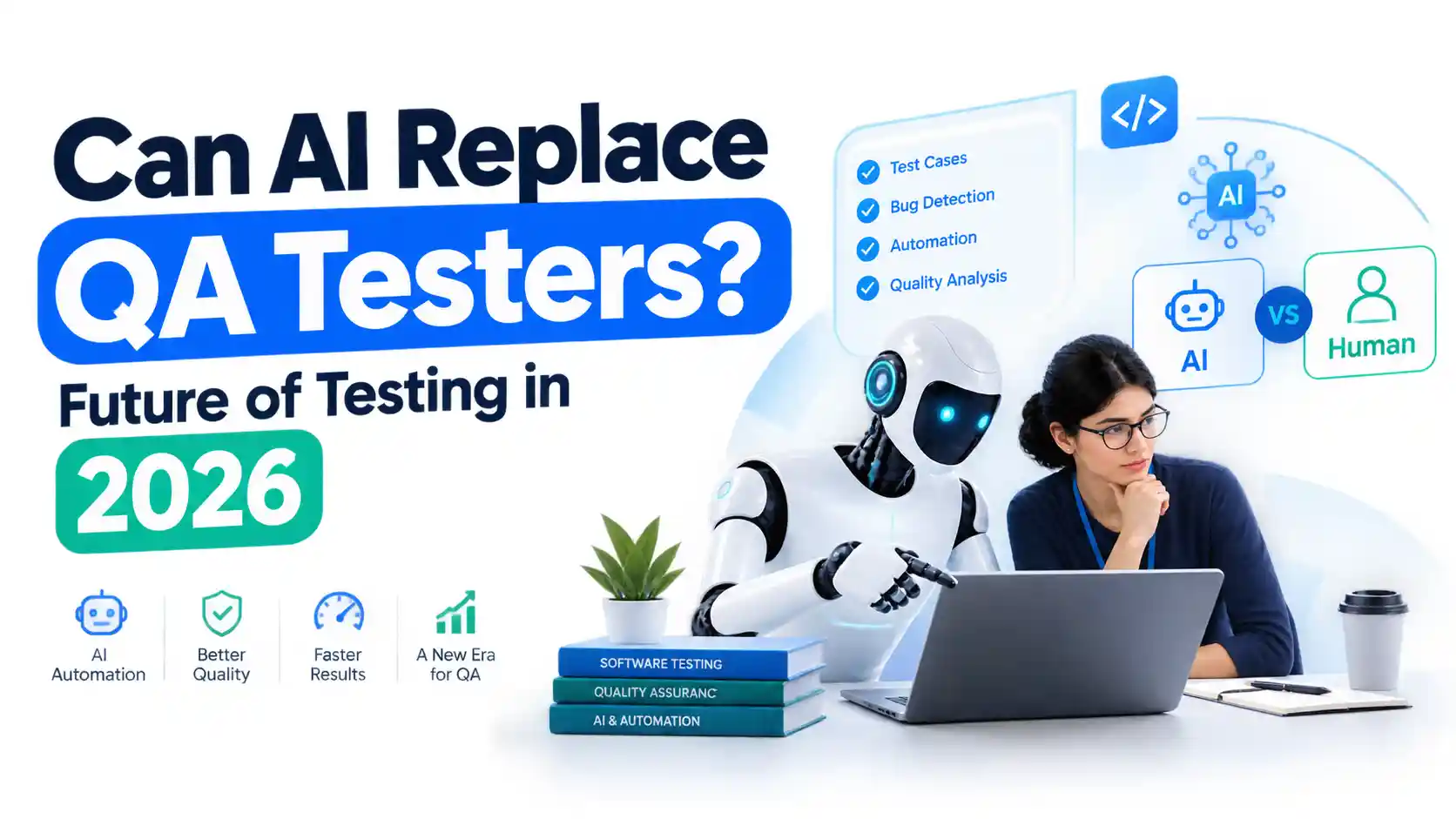
The short answer is that AI is changing QA work faster than it is removing it. Drafting test cases, generating test data and repairing simple script failures are increasingly automated. Judging risk, questioning requirements and deciding whether software is ready to release still need people.
This guide explains what AI can and cannot do in software testing in 2026. It also covers which testing tasks are most exposed, what the available data actually says, and which skills will keep QA testers valuable. The aim is a clear, evidence-based answer, not hype or fear.
Short answer: AI is unlikely to replace QA testers as a profession in 2026, but it is already replacing parts of the work. Repetitive tasks such as drafting test cases, generating test data and repairing broken locators are increasingly automated. Judgement, risk assessment and accountability for quality still sit with people. The testers most at risk are those who only do repetitive, script-following work and never learn to work with AI.
This is an interpretation based on the sources cited below, not a guarantee. Tools and hiring practices are changing quickly.
What is AI in software testing?
AI in software testing means using machine learning and large language models (LLMs) to support testing activities. These include test design, test generation, execution, maintenance and defect analysis.
Three related ideas are often mixed up:
- AI-assisted testing: a human leads and AI suggests, for example drafting test cases from a requirement.
- Intelligent or self-healing automation: tools adjust scripts when the user interface changes.
- Autonomous testing: agents explore an application and run tests with limited human input. This is the least mature of the three.
What AI can already do for QA teams
Current tools can help with several parts of the testing lifecycle:
- Drafting test cases and scenarios from user stories or requirements.
- Generating test data, including edge cases.
- Writing first-draft automation scripts in frameworks such as Playwright or Selenium.
- Repairing broken tests after minor UI changes.
- Summarising failures and logs so testers triage faster.
- Prioritising regression tests based on what changed.
Playwright's official documentation is a clear example. It describes three built-in test agents: a planner that explores an app and writes a Markdown test plan, a generator that turns that plan into test files, and a healer that attempts to repair failing tests. The same documentation notes that a healer's outcome is either a passing test or a skipped one if it believes the functionality is genuinely broken. That wording shows the tool still needs a person to decide what a failure means.
What AI cannot reliably do (yet)
This section is analysis, not a measured result.
Understand business risk. AI does not know that a rounding error in a payment screen matters more than a misaligned logo.
Question the requirement. Good testers ask whether the requirement itself is wrong or incomplete.
Do real exploratory testing. Curiosity, user empathy and unexpected thinking remain human strengths.
Take accountability. A release decision needs someone who answers for it.
Check its own output without bias. AI-written tests can look convincing while missing the point, or can be rewritten around a real bug so they pass.
Which testing roles are most exposed?
This is an opinion, not data. Exposure depends on the work, not the job title.
| Type of work | Exposure to AI | Why |
| Repetitive script execution and simple regression checks | Higher | Easy to automate and easy to generate |
| Writing basic test cases from clear requirements | Higher | LLMs draft these quickly, though they need review |
| Automation engineering | Medium | AI speeds up coding, but framework design and debugging need skill |
| Exploratory, usability and risk-based testing | Lower | Depends on judgement and context |
| Test strategy, quality leadership, testing AI systems | Lower | Growing, higher-responsibility work |
What the data says
Be careful with numbers here. Few reliable statistics measure AI's direct effect on QA jobs specifically.
- US outlook (jurisdiction: United States). The US Bureau of Labor Statistics groups software developers, QA analysts and testers together. It projects 15% employment growth from 2024 to 2034, and reports that software QA analysts and testers held about 201,700 jobs in 2024. This is a combined category, so it does not isolate manual testers, and it is not a Pakistan figure.
- Global outlook. The World Economic Forum's Future of Jobs Report 2025 surveyed over 1,000 employers. It projects 170 million new roles and 92 million displaced roles by 2030. It lists AI and big data among the fastest-growing skills and finds that many employers plan reskilling alongside AI adoption.
The accurate reading is that tech roles are expected to keep growing, and the skills required are shifting. These sources do not say QA is safe or doomed.
Manual testing, automation testing and AI: what changes?
Manual testing will not vanish, but pure "follow the script" manual work will shrink. Exploratory, usability, accessibility and domain-heavy testing stay valuable.
Automation testing changes most. Writing a first draft of a script becomes faster. The valuable skills become reviewing generated code, designing stable frameworks, and deciding what deserves automation. If you are choosing between tools, the Selenium documentation and the Playwright docs are good first-hand references to learn from.
QA engineers and SDETs increasingly act as quality owners. They set strategy, supervise AI output and protect release quality.
New risks: why human oversight matters
AI adds new things to test and new ways to get things wrong:
- Hallucinated or shallow tests that pass but prove little.
- Privacy risk if confidential requirements or production data are pasted into public AI tools.
- Over-trust, where teams stop reviewing generated tests.
- Security risks in LLM-based features, such as prompt injection. The OWASP project maintains a Top 10 for LLM applications that testers can use as a checklist when assessing AI features.
The ISTQB, the body behind the Certified Tester scheme, has addressed this directly. Its announcement of the CT-GenAI certification says the syllabus covers applying LLMs and prompt engineering, plus risk management. The syllabus was approved on 25 July 2025. Training providers state that the ISTQB Foundation Level certificate is a prerequisite for the exam. Check ISTQB's official pages for the current syllabus version before you commit to study.
A new opportunity: testing AI-powered products
As companies add AI features such as chatbots and recommendations, someone must test them. That means checking accuracy, bias, safety, consistency and security. This is closer to quality engineering than script execution, and it is a growth area. Related reading on how AI is reshaping software work: how AI is changing web development.
An illustrative workflow (not a case study)
This is an example of a sensible process, not a documented result from a real team:
A tester gives AI a requirement and asks for draft test scenarios.
The tester removes weak scenarios and adds risk-based and edge cases the AI missed.
AI drafts automation code. The tester reviews it, runs it and fixes flaky parts.
After a UI change, a healing tool proposes fixes. The tester checks that it fixed the test rather than hiding a real defect.
The tester decides what is safe to release.
The tool saves time, but a person owns every decision that matters.
Skills QA testers should build in 2026
- Strong testing fundamentals: test design techniques, risk-based testing, bug reporting.
- Automation basics: at least one language and one framework (Playwright or Selenium).
- API testing and CI/CD understanding.
- Prompting and reviewing AI output critically.
- Basic data and SQL skills.
- Security and privacy awareness when using AI tools.
- Communication and critical thinking, which the WEF report also highlights as rising skills.
If you want a structured start, see how AI-related learning is explained in this guide on what you learn in an AI course. For broader context on employer demand, read top AI skills companies are hiring for.
Should beginners still choose QA in 2026?
Yes, but plan for an AI-literate career, not a script-only one. Start with fundamentals, add automation, then learn to use AI tools with judgement. IDT Pakistan also offers an AI Automation course, which can complement testing skills. Check the course pages for current details.
Common mistakes to avoid
- Assuming AI-generated tests are correct without review.
- Pasting confidential code or data into public AI tools.
- Skipping fundamentals because "AI will do it".
- Automating everything instead of what carries the most risk.
- Ignoring the wider impact of AI on jobs. For that wider picture, see AI and traditional jobs in 2026.
Best practices for using AI in QA
- Keep a human reviewer on every AI-generated test and every self-healed fix.
- Use approved tools and anonymised data.
- Track whether AI actually improves quality, not just speed.
- Document where AI was used.
- Re-check tools often, because features change quickly.
Verdict
AI will change QA work more than it will end it. Routine tasks shrink, and review, strategy, risk judgement and AI-product testing grow. Testers who combine solid fundamentals, automation and responsible AI use are better placed than those who rely on one narrow skill.
Frequently asked questions
Can AI replace QA testers?
Not entirely in 2026. AI can automate parts of testing, but people are still needed for judgement, risk decisions and accountability.
Will AI replace manual testers?
Repetitive manual execution is the most exposed. Exploratory, usability and domain-heavy testing is much harder to automate.
Will AI replace automation testers?
It will change the job. AI can draft scripts, but testers are still needed to design frameworks, review code and fix flaky tests.
Can AI write test cases?
Yes, as a first draft. Humans need to review them for gaps, accuracy and business context.
Is QA still a good career after AI?
It can be, if you keep learning. Roles are shifting toward automation, AI-assisted testing and quality ownership.
What should QA testers learn in the AI era?
Testing fundamentals, one automation framework, API testing, prompting and critical review of AI output, and security awareness.
Is there an AI certification for testers?
ISTQB offers the Certified Tester Testing with Generative AI (CT-GenAI) certification. Check ISTQB for current prerequisites and syllabus version.
Start building QA skills
If you want structured, instructor-led learning in testing fundamentals, visit the Software Quality Assurance course page at IDT Pakistan. Check that page for the current syllabus, duration, fees, certificate and batch details. This article makes no promises of jobs, income or results.
Conclusion
AI will not make QA testers obsolete in 2026, but it will change what a good tester does. Repetitive execution and first-draft test writing are shrinking. Exploratory testing, risk-based thinking, automation design and careful review of AI output are becoming more important.
The testers best placed for the future are those who build strong fundamentals, learn at least one automation framework, and use AI tools critically instead of trusting them blindly. As more products include AI features, testing those features for accuracy, safety and security is also becoming a new area of work.
The practical takeaway is simple. Do not compete with AI at repetitive tasks. Learn to work with it, and keep the judgement that only a human tester can provide.
If you want to build these fundamentals in a structured way, visit the Software Quality Assurance course page at IDT Pakistan and check the current syllabus, duration, fees and batch details there.
Conclusion
AI will not make QA testers obsolete in 2026, but it will change what a good tester does. Repetitive execution and first-draft test writing are shrinking. Exploratory testing, risk-based thinking, automation design and careful review of AI output are becoming more important.
The testers best placed for the future are those who build strong fundamentals, learn at least one automation framework, and use AI tools critically instead of trusting them blindly. As more products include AI features, testing those features for accuracy, safety and security is also becoming a new area of work.
The practical takeaway is simple. Do not compete with AI at repetitive tasks. Learn to work with it, and keep the judgement that only a human tester can provide.
If you want to build these fundamentals in a structured way, visit the Software Quality Assurance course page at IDT Pakistan and check the current syllabus, duration, fees and batch details there.