Quick Answer
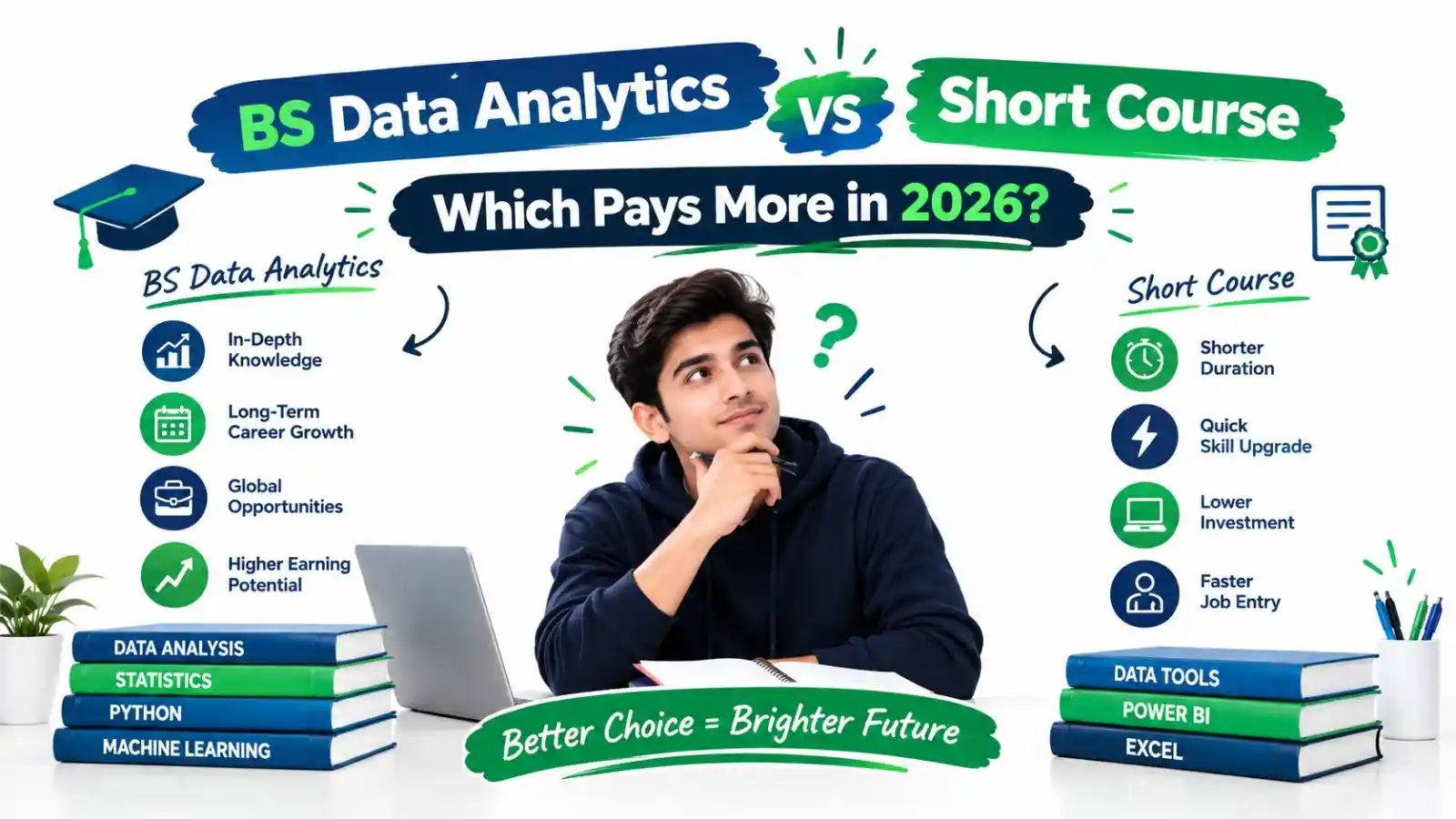
For most people in Pakistan, a data analytics short course pays more in the first three to four years because you start earning years earlier and spend far less. A BS degree pays more over the long run only when it opens doors to banks, multinationals, government jobs or study abroad. The highest earners combine both: a degree plus job-ready skills, as our Data Analytics Career Scope 2026 guide explains.
Introduction
The BS Data Analytics vs short course debate is one of the most common questions we hear from students after FSc, fresh graduates and working professionals. Some families believe only a four-year degree leads to a respectable salary. Many students watch peers land analyst jobs after a few months of focused training and wonder whether spending four years and nearly two million rupees on a degree still makes sense.
At the Institute of Digital Trainings (IDT), we train data analysts in Islamabad, Lahore and Karachi. We see both kinds of students in the same classroom: BS Computer Science graduates who cannot write a SQL query, and BCom graduates who build strong Power BI dashboards within weeks. This guide uses verified 2026 salary data, official university fee structures and our classroom experience to answer one question honestly: which path actually pays more? If you want to see the skills employers are testing right now, start with our Certified Data Analyst course outline.
Book a Free Career Counselling Session →
Key Takeaways
- Salary is driven by skills, not by certificate type. Indeed Pakistan reports an average data analyst salary of about Rs 68,231 per month, based on 166 salaries updated in June 2026. Your employer, city and tool stack decide where you land in that range.
- A degree costs years and lakhs. NUST's 2026-27 fee for national students in computing programmes is PKR 216,750 tuition per semester, plus PKR 5,000 miscellaneous charges per semester, a PKR 35,000 admission fee and a PKR 10,000 refundable security deposit.
- A short course gets you earning in months. Focused training in Excel, SQL, Power BI and Python can make you interview-ready in 3–6 months. See IDT's 30-day roadmap after a digital course.
- A degree still matters for certain doors. Banks, telecoms, multinationals, government jobs and foreign work visas often screen for a bachelor's degree.
- The winning formula in 2026: any bachelor's degree + a practical data analytics course + one global certification + a public portfolio.
What Is the Difference Between a BS Data Analytics Degree and a Short Course?
A BS Data Analytics (or Data Science) degree is a four-year, HEC-regulated undergraduate programme that covers mathematics, statistics, programming, machine learning and general education. A data analytics short course is a 3–6 month, skills-focused programme that trains learners on the tools analysts use daily: Excel, SQL, Power BI, Python and data cleaning. The degree builds academic depth, while the short course builds job-ready speed.
The two paths serve different goals, and understanding that difference prevents costly mistakes. Under HEC's Undergraduate Education Policy, an undergraduate degree requires 120–144 credit hours, normally taken at 15–18 credit hours per semester. A short course is closer to professional training: fewer hours, narrower scope, and a direct focus on employability. Our comparison of data analytics vs web development in Pakistan shows how short, skill-first training fits into Pakistan's wider digital job market.
| Feature | BS Data Analytics / Data Science Degree | Data Analytics Short Course | Recommendation |
| Duration | 4 years (8 semesters) | 3–6 months | Short course for speed |
| Credit load | 120–144 credit hours | Not credit-based | Degree for academic depth |
| Typical cost | PKR 1.3–1.8 million+ (top universities) | A small fraction of degree cost; some government programmes are free | Short course for budget |
| Eligibility | FSc/ICS/A-Level + entry test | Usually open to Inter, graduates, professionals | Short course for flexibility |
| Core focus | Theory, statistics, ML, research | Tools, dashboards, real datasets | Combine both |
| Time to first income | After graduation (year 4+) | Within months | Short course |
| Employer degree filters | Passes them | May fail them if no bachelor's | Degree for corporate/govt jobs |
| Long-term ceiling | Higher for data science and research roles | High if skills keep growing | Degree + upskilling |
| Freelancing readiness | Low unless you build a portfolio | High, portfolio built in class | Short course |
Does a "BS Data Analytics" Degree Actually Exist in Pakistan?
Very few Pakistani universities offer a degree titled exactly "BS Data Analytics." Most offer the closest equivalents: BS Data Science, BS Business Analytics, BS Statistics or BS Computer Science with data electives. Students searching for "BS Data Analytics in Pakistan" should compare these programmes by curriculum, not by title, because employers hire for data analyst skills, not degree names.
This is a gap most articles ignore. The reality in 2026 looks like this:
- BS Data Science: NUST offers a BS Data Science programme covering data analysis, machine learning and statistical methods. FAST-NUCES lists Data Science among its undergraduate programmes alongside Computer Science, AI and Cyber Security.
- BS Business Analytics: FAST-NUCES also runs a Business Analytics programme under its business and computing admissions.
- BS Data Science and Statistics-with-Analytics degrees: The Institute of Business Management (IoBM) in Karachi lists both BS Data Science and BS Statistics and Business Analytics among its undergraduate programmes.
- Other options: COMSATS University Islamabad, University of the Punjab, University of Karachi and IBA Karachi offer computing, statistics or data-related programmes. Always check the current prospectus, because programme names change between intakes.
If you are still choosing a stream after Matric or Inter, our guide on digital skills to learn after Matric in Pakistan helps you pick a direction before committing to a four-year degree.
What Is the Data Analyst Salary in Pakistan in 2026?
In 2026, a typical data analyst in Pakistan earns roughly PKR 52,000 to 133,000 per month, according to Glassdoor's percentile range. Indeed Pakistan reports an average of about PKR 68,231 per month. Senior analysts at larger firms can cross PKR 300,000 per month. Pay depends on seniority, city, employer type and tool expertise, not on whether you studied through a degree or a short course.
Salary sources in Pakistan use different methods, so reading them together gives a more honest picture than trusting one number. Glassdoor places the typical Pakistani data analyst pay range at about PKR 52,000 to PKR 133,000 per month. Its estimates draw on 173 anonymously submitted salaries, and top earners report up to about PKR 224,000. Levels.fyi, which leans towards tech-company pay, shows a median total compensation of PKR 1,697,509 per year for Pakistani data analysts, with the 90th percentile reaching PKR 4.55 million. For context on how these figures compare with other digital careers, see our breakdown of the highest-paying freelancing skills in 2026.
Data Analyst Salary in Pakistan by Source (2026)
| Source | Figure | Basis |
| Indeed Pakistan | Avg. ~PKR 68,231/month | 166 salaries, updated June 2026 |
| Glassdoor | ~PKR 52,000–133,000/month (25th–75th percentile) | 173 anonymous salaries |
| Levels.fyi | Median ~PKR 1,697,509/year (~PKR 141,459/month) | Tech-company-weighted, updated April 2026 |
| ERI SalaryExpert | Avg. ~PKR 2,770,266/year | Modelled from employer surveys, August 2026 |
ERI SalaryExpert's model puts the average data analyst gross salary in Pakistan at Rs 2,770,266 per year as of August 2026, with entry-level analysts at about Rs 1,982,034. Modelled figures often run higher than self-reported ones, so treat them as an upper reference rather than a starting-salary promise. Our article on how Pakistani freelancers earn with AI shows how remote clients can push analyst income above these local benchmarks.
Data Analyst Salary by City
Salaries vary noticeably between Pakistan's three major job markets.
| City | Typical Monthly Range (Glassdoor) |
| Karachi | ~PKR 73,000–156,000 |
| Lahore | ~PKR 51,000–165,000 |
| Islamabad | ~PKR 57,000–107,000 |
Glassdoor shows Karachi's typical data analyst range at roughly PKR 73,000 to 156,000 per month, Lahore's at roughly PKR 51,000 to 165,000, and Islamabad's at roughly PKR 57,000 to 107,000. Karachi's higher floor reflects its concentration of banks, FMCG companies and telecom headquarters. Students based in the capital can explore our Islamabad training campus for local job-market guidance. Salary: Data Analyst in Karāchi 2026 | Glassdoor +2
Data Analyst Salary by Experience Level
Career stage moves salary more than any other factor. Glassdoor lists the average Junior Data Analyst salary in Pakistan at about PKR 76,667, while Senior Data Analysts in Karachi report roughly PKR 138,000 to 367,000 per month. The jump from junior to senior usually comes from mastering SQL, data modelling, Power BI and Python, and from owning business-facing reporting. Our guide to top AI skills companies are hiring for in 2026 shows which skills unlock that jump fastest.
| Career Level | Typical Title | What Drives Pay |
| Entry (0–1 yr) | Junior Data Analyst, Reporting Analyst | Excel, SQL basics, dashboards |
| Mid (2–4 yrs) | Data Analyst, BI Analyst | Power BI/Tableau, data modelling, stakeholder reporting |
| Senior (5+ yrs) | Senior Data Analyst, Analytics Lead | Python, cloud (Azure/AWS/GCP), team leadership |
| Advanced pivot | Data Scientist, Analytics Engineer, Data Engineer | Statistics, ML, data pipelines |
Important note: No verified public dataset in Pakistan separates data analyst salaries by "degree holder" versus "short course graduate." Any article quoting an exact percentage gap is guessing. The reasoning below uses real salary ranges and real fee structures instead.
BS Data Analytics vs Short Course: Which Path Pays More in Pakistan?
A data analytics short course pays more during the first three to four years because learners start earning while degree students are still paying fees. A BS degree tends to pay more after year five when roles require a bachelor's, such as bank analytics, multinational BI teams, government projects and foreign job applications. The highest-paid analysts usually hold a degree and add practical short-course skills on top.
The answer depends on your starting point, so it helps to split it into two stages. In the short run, the short-course path wins on earnings because of time and cost. In the long run, salary depends on skills, experience and access to high-paying employers, and a degree improves that access. Our comparison of freelancing vs a job in Pakistan explains how the earning path you choose after training also changes the outcome.
The Four-Year Earnings Gap (Illustrative Example)
Consider two 18-year-olds in 2026. The example below uses real fee and salary figures, with simple, stated assumptions.
| Path A: BS Degree (NUST computing, 2026-27 rates) | Path B: Short Course + Certification | |
| Education cost over 4 years | ~PKR 1,819,000 (tuition, misc., admission, security; excludes hostel and fee revisions) | Short course fee + one certification exam |
| Months earning as an analyst in years 1–4 | 0 | ~42 (assuming a job within 6 months) |
| Illustrative earnings in years 1–4 | PKR 0 | ~PKR 2,184,000 (42 × PKR 52,000, the Glassdoor 25th percentile) |
| Position at end of year 4 | Fresh graduate, starting career | ~3.5 years' experience, likely mid-level |
How the NUST figure is calculated: PKR 216,750 tuition × 8 semesters = PKR 1,734,000; plus PKR 5,000 × 8 = PKR 40,000 miscellaneous; plus PKR 35,000 admission and PKR 10,000 refundable security = PKR 1,819,000.
Assumptions and limits: Path B assumes the learner lands an analyst role at a lower-percentile salary. That is harder without a bachelor's degree, and many learners on this path start with freelancing or smaller firms. The example ignores raises, taxes and inflation. It shows the direction of the gap, not a guaranteed result. For a realistic early-income plan, read how to earn your first $100 online in Pakistan.
What Happens After Year Five?
After year five, the gap narrows and can reverse. Degree holders pass HR filters at banks, telecoms, multinationals and government bodies. They can move into data science, pursue an MS, and apply for skilled jobs abroad. Short-course-only analysts who keep upskilling can still reach senior roles, especially in startups, agencies and remote work, but some corporate doors stay closed without a bachelor's. The practical conclusion: the short course wins the sprint; the degree plus skills wins the marathon. Our article on setting career goals and actually achieving them helps you plan both stages.
How Much Does Each Path Cost in Pakistan?
A BS Data Science or related degree at a leading Pakistani university costs roughly PKR 1.3 million to 1.8 million or more in university charges over four years, excluding hostel and living costs. A data analytics short course costs a small fraction of that. Global certifications add modest extra fees, and some government-funded NAVTTC programmes are free for eligible youth.
Cost is where the two paths differ most sharply. At FAST-NUCES, fees are charged per credit hour. One admissions guide lists a Rs 30,000 one-time admission fee, a Rs 20,000 refundable security deposit and tuition of about Rs 10,000 per credit hour, while another quotes PKR 11,000 per credit hour for Fall 2025. FAST's BSCS is a four-year, 130-credit-hour degree, so tuition alone lands roughly between PKR 1.3 million and 1.6 million depending on the rate. Always confirm current rates on the official admissions portal. If budget is your main constraint, our list of the best online courses for high-income skills in 2026 compares lower-cost routes. FAST University Admission 2025 – Test Pattern, Eligibility, Merit, Fees & Scholarships | Maqsad Blog +2
| Option | Approximate Cost | Duration | Notes |
| NUST (computing programmes) | ~PKR 1,819,000 over 4 years | 4 years | Official 2026-27 rates; subject to revision |
| FAST-NUCES | ~PKR 1.3–1.6 million tuition + admission/security | 4 years | Per-credit-hour billing; verify at nu.edu.pk |
| Google Data Analytics Certificate (Coursera) | Typically under USD 300 | Under 6 months at <10 hrs/week | Financial aid available |
| Microsoft PL-300 (Power BI) exam | ~USD 165 headline price | Exam only | Price varies by country |
| NAVTTC Skills of Tomorrow | Free for eligible candidates | ~3 months | Limited seats, eligibility rules apply |
| IDT Certified Data Analyst | Contact IDT for current fee | Short-term, practical | Physical, online and hybrid classes |
The IDT Certified Data Analyst programme is designed so that one short-term investment covers the full analyst toolkit, from Excel to Azure, instead of buying separate courses for each tool.
Get the Latest Course Fee & Batch Dates
How Long Does Each Path Take?
A BS Data Analytics or Data Science degree takes four years, or eight semesters, under HEC rules. A focused data analytics short course takes about three to six months. Most learners need another one to three months to build a portfolio and land a first role, which means the short-course path can reach first income around the time a degree student finishes the first year.
The time difference compounds. Every year spent studying is a year without professional experience, and experience is what employers pay for. Coursera states that the Google Data Analytics Certificate can be completed in under six months at fewer than 10 hours per week, putting most learners' total cost under USD 300. Short timelines only work with consistent practice, which is why our skills you can learn in 30 days to earn online guide stresses daily hands-on work.
Typical timeline comparison:
| Milestone | BS Degree Path | Short Course Path |
| Month 0 | Admission + entry test | Enrolment |
| Month 3–6 | Semester 1 (general education, maths) | Course complete, portfolio started |
| Month 6–9 | Semester 2 | First job, internship or freelance client |
| Year 2 | Core programming, databases, statistics | ~1.5 years' experience |
| Year 4 | Capstone, internship, graduation | ~3.5 years' experience |
| Year 5+ | Entry/junior role, MS option | Mid/senior role, possible degree via part-time study |
Who Is Eligible for Each Path?
A BS degree in data science or analytics usually requires at least 60 percent marks in SSC and HSSC with mathematics, plus a university entry test such as NUST's NET or the FAST NU Entry Test. A data analytics short course has open eligibility: Intermediate students, graduates from any field, working professionals and freelancers can usually join, though basic computer literacy helps.
Eligibility often decides the path before salary does. For its BS Data Science programme, NUST requires at least 60 percent aggregate marks in SSC and HSSC from the Pre-Engineering, Computer Science or Pre-Medical groups, or equivalent qualifications. Students from Arts or Commerce backgrounds may find degree admissions restrictive, while short courses accept them. Our digital courses in Pakistan guide lists options for every academic background.
Short course eligibility checklist:
- Comfortable using a computer and the internet
- Basic school-level mathematics (percentages, averages)
- Willingness to practise 1–2 hours daily
- A laptop capable of running Excel and Power BI Desktop
What Do You Actually Learn in Each Path?
A BS degree teaches the theory behind data work: calculus, linear algebra, probability, statistics, programming, databases and machine learning. A short course teaches the daily tools of a data analyst: Excel, SQL, Power BI, Python, ETL and dashboard building on real datasets. The degree explains why methods work, while the short course trains you to deliver reports employers need this week.
Both matter, but for different roles. A data scientist building prediction models needs degree-level statistics. A reporting analyst or BI analyst mostly needs clean SQL, solid data modelling and clear dashboards. IDT's Certified Data Analyst course outline covers MS Excel, SQL, Data Warehouse concepts, MS Azure, ETL, Power BI and Python. Learners who want to add automation skills can pair data work with the IDT AI Automation course. idtpakistan
Talk to an Advisor About Course Modules
| Skill Area | BS Degree Coverage | Short Course Coverage |
| Statistics and probability | Deep, theory-heavy | Applied, as needed |
| Excel (pivot tables, formulas, dashboards) | Light | Deep, practical |
| SQL and databases | Moderate to deep | Deep, query-focused |
| Power BI / Tableau | Often elective or missing | Core module |
| Python for analysis | Moderate | Applied (pandas, automation) |
| Cloud (Azure, AWS, Google Cloud) | Varies by university | Introductory to applied |
| Machine learning | Deep | Introductory |
| Business communication and data storytelling | Limited | Built into projects |
| Portfolio projects | Capstone only | Multiple, real-world datasets |
Cloud skills increasingly separate mid-level analysts from juniors, which is why many learners follow data analytics with the IDT Cloud Computing course.
Ask About Data + Cloud Learning Paths
Pros and Cons of a BS Data Analytics or Data Science Degree
A BS degree gives academic credibility, deep statistical foundations and access to employers and visas that require a bachelor's. Its drawbacks are cost, four years without professional income, and curricula that can lag behind industry tools. The degree suits students who want data science, research, public-sector or international careers and who can afford the time and money.
Pros:
- Passes HR filters at banks, telecoms, multinationals and government bodies
- Builds mathematical and statistical depth needed for data science and ML roles
- Opens the door to MS programmes and skilled migration routes that score degrees
- University career fairs, alumni networks and structured internships
- HEC recognition that holds value across Pakistan and abroad
Cons:
- Roughly PKR 1.3–1.8 million or more in university charges at top institutions, before living costs
- Four years without analyst-level income or experience
- Tool training (Power BI, cloud) often lags industry demand
- Graduates frequently need a short course anyway to become job-ready
We regularly teach degree holders who realise the job market wants practical tools their syllabus skipped. Our post on what recruiters look for in candidates covers the same portfolio-first mindset that data hiring managers apply.
Pros and Cons of a Data Analytics Short Course
A data analytics short course is fast, affordable and tightly aligned with daily analyst work, and it produces a portfolio employers can inspect. Its limits are shallower theory, weaker standing with degree-filtering employers, and quality that varies widely between institutes. It suits graduates from any field, career changers, freelancers and professionals who need job-ready skills within months.
Pros:
- Job-ready in about 3–6 months
- Much lower cost than a degree
- Hands-on tools employers use: Excel, SQL, Power BI, Python
- Portfolio projects built during the course
- Flexible physical, online and hybrid formats
- Direct route to freelancing and remote work
Cons:
- Less depth in statistics and machine learning
- May not satisfy employers who require a bachelor's degree
- Quality varies, so trainer experience and curriculum must be checked
- Requires self-discipline to keep practising after the course
For learners who want the short-course route with strong trainer support, the IDT Certified Data Analyst course combines practical sessions with recorded lectures for revision.
Reserve Your Seat in the Next Batch
Do Pakistani Employers Prefer Degrees or Certifications?
Pakistani employers increasingly hire on demonstrated skills, but many corporate job postings still list a bachelor's degree as a minimum requirement. Banks, telecoms, multinationals and government projects tend to screen for degrees. Startups, software houses, agencies and foreign remote clients focus more on SQL tests, Power BI portfolios and practical case studies. A degree gets your CV shortlisted, while skills get you hired.
Skill-based hiring is growing worldwide. The World Economic Forum reports that seven in ten companies considered analytical thinking an essential skill in 2025, and it lists data analysts and scientists among the fastest-growing jobs to 2030. In our experience, local interview rounds for analyst roles usually include a practical SQL or Excel test, and candidates who cannot pass it lose out regardless of degree. Our guide on personal branding tips for freelancers explains how to present skills so recruiters notice them.
What typically moves a CV forward in Pakistan:
Bachelor's degree (any field) for corporate HR screening
SQL and Excel test performance
A public Power BI or Tableau portfolio
A recognised certification such as Microsoft PL-300
Communication: explaining insights in plain business language
Which Data Analytics Certifications Add the Most Value?
The most useful data analytics certifications for Pakistani job seekers in 2026 are the Microsoft Power BI Data Analyst Associate (PL-300), the Google Data Analytics Professional Certificate, the IBM Data Analyst Professional Certificate, the Tableau Certified Data Analyst and Microsoft Azure Data Fundamentals. Power BI certification carries particular weight because Power BI dominates corporate reporting in Pakistan.
A certification works best on top of real projects, not instead of them. Microsoft lists a headline price of USD 165 for associate-level exams such as PL-300, with the actual fee varying by country. Microsoft bases the exam price on the country or region where the exam is proctored, and role-based certifications must be renewed to stay valid. Our article on the best AI tools for students in 2026 lists free resources that help you prepare.
| Certification | Provider | Cost (Verified) | Best For |
| Power BI Data Analyst Associate (PL-300) | Microsoft | ~USD 165 headline; varies by country | Corporate BI and reporting roles |
| Google Data Analytics Professional Certificate | Google via Coursera | Typically under USD 300 total | Beginners and career changers |
| IBM Data Analyst Professional Certificate | IBM via Coursera | Check official page | Python- and SQL-focused beginners |
| Tableau Certified Data Analyst | Tableau (Salesforce) | Check official page | Visualisation-heavy roles |
| Azure Data Fundamentals (DP-900) | Azure Data Fundamentals (DP-900) | Check official page | Cloud data foundations |
| SAS Certified Specialist | SAS | Check official page | Banking, pharma and legacy analytics |
Can Freelancing and Remote Work Beat Both Paths?
Freelancing and remote work can beat local salaries for skilled data analysts because foreign clients often pay in US dollars. Upwork and Fiverr list steady demand for Excel automation, Power BI dashboards, SQL reporting and data cleaning. A strong portfolio matters far more than a degree to most international clients, which makes the short-course route especially effective for remote earning.
Pakistan's digital exports show the scale of this opportunity. Pakistan's ICT exports rose to a record USD 4.6 billion in fiscal year 2025-26, a 21 percent increase over the previous year, according to IT Minister Shaza Fatima Khawaja. Data services form part of that growing export base. To choose the right platform for data gigs, read our Upwork vs Fiverr comparison for Pakistan.
Popular data freelancing services:
- Excel dashboards and automation
- Power BI report building and data model fixes
- SQL queries and database reporting
- Data cleaning and CRM data preparation
- Python scripts for data extraction and analysis
A well-built profile makes the difference in the first 90 days. Follow our Upwork profile optimisation guide before sending your first proposal.
Decision Matrix: Which Path Is Right for You?
The right path depends on your age, education, budget and target employer. Intermediate students aiming for corporate or international careers should pursue a relevant BS degree and add a short course alongside it. Graduates from any field should take a short course first. Working professionals and freelancers benefit most from a short course plus one certification.
Use this matrix to match your situation to the path with the best earning outcome. If you are switching careers later in life, our article on why thousands are switching to digital careers shows the common routes that work.
| Your Situation | Best Path | Why |
| FSc/ICS student, family can afford a degree | BS Data Science/CS/Statistics + short course during summers | Degree opens corporate and international doors; course adds job-ready skills early |
| Inter student, limited budget | Short course now + freelancing + part-time degree later | Early income funds future study |
| Graduate in BCom, BBA, Economics or Statistics | Short course + PL-300 | Your degree already passes HR filters; you only need tools |
| BS CS/IT graduate without a job | Short course focused on Power BI, SQL and portfolio | Converts theory into employable proof |
| Working professional (finance, HR, sales, operations) | Weekend or online short course | Fastest route to promotion or role change |
| Career changer aged 30+ | Short course + portfolio + freelancing | A four-year degree rarely pays back at this stage |
| Aspiring data scientist or researcher | BS Data Science, then MS | ML and research roles need statistical depth |
Step-by-Step Roadmap to Becoming a Data Analyst in Pakistan
The fastest reliable route to a data analyst job in Pakistan follows eight steps: learn Excel, learn SQL, master Power BI, add Python basics, build three portfolio projects, earn one recognised certification, apply for internships or junior roles while freelancing, and keep upskilling in cloud and AI tools. Most dedicated learners complete these steps in 6–9 months.
This roadmap works whether you hold a degree or not. It mirrors how we sequence training at IDT, and it builds on the timeline in our 30-day roadmap after a digital course.
Master Excel (weeks 1–4): formulas, lookups, pivot tables, charts and basic dashboards.
Learn SQL (weeks 5–8): SELECT, WHERE, GROUP BY, JOINs, subqueries and window functions on MySQL, PostgreSQL or SQL Server.
Build in Power BI (weeks 9–12): Power Query, data modelling, DAX basics and interactive reports.
Add Python basics (weeks 13–16): pandas for cleaning, Matplotlib for charts, Jupyter Notebook for analysis.
Create three portfolio projects: for example, a sales dashboard, an HR attrition analysis and a customer segmentation report using public datasets.
Earn one certification: PL-300 for corporate roles or the Google certificate for a structured beginner credential.
Apply and freelance in parallel: internships, junior analyst roles and small freelance gigs build experience together.
Keep upskilling: cloud platforms (Azure, AWS, Google Cloud), AI-assisted analysis and data storytelling.
Once your portfolio is ready, our guide on landing your first Fiverr client without reviews helps you turn projects into paid work.
Common Mistakes Students Make When Choosing
The most common mistakes are choosing a degree only for its title, assuming a certificate alone guarantees a job, ignoring SQL, skipping portfolio projects, and picking an institute on price rather than trainer experience. Each of these mistakes delays the first salary and lowers starting pay. Avoiding them matters more than the degree-versus-course choice itself.
Across our batches, these mistakes appear again and again. Our article on AI replacing traditional jobs in 2026 explains why skipping future-proof skills is now especially costly.
- Choosing by degree name: a "Data Science" title with no SQL or BI in the scheme of studies leaves graduates unprepared.
- Treating the certificate as the goal: employers test skills in interviews; a certificate without projects rarely converts.
- Skipping SQL: SQL appears in nearly every analyst interview we prepare students for.
- No portfolio: recruiters want to see dashboards, not just read about them.
- Learning tools in isolation: analysts must connect Excel, SQL and Power BI into one workflow.
- Ignoring communication: a correct insight explained poorly loses its business value.
- Choosing the cheapest option blindly: check trainer credentials, curriculum and whether live support is included.
Expert Tips from IDT's Data Analytics Trainers
IDT's data analytics trainers recommend learning SQL before Power BI, working with messy real-world datasets early, building dashboards that answer one business question, and publishing every project on LinkedIn. They also advise graduates from commerce and business backgrounds that their domain knowledge is an advantage, not a weakness, when moving into analytics.
These observations come from teaching real batches, not from textbooks. The trainers' profiles are available on our About page.
- SQL JOINs are the first real hurdle. In our sessions, most beginners handle Excel comfortably but struggle with JOINs and data cleaning in the first two weeks. We slow down here deliberately because everything after depends on it.
- Business graduates adapt fastest. BCom and BBA students often build more useful dashboards than pure CS graduates because they understand KPIs like margin, churn and receivables.
- Messy data teaches more than clean data. We use imperfect datasets with blanks, duplicates and inconsistent dates because real company data looks like that.
- One dashboard, one question. Beginners overload reports with charts. Strong analysts design each page around a single decision.
- Publish as you learn. Students who post weekly project updates on LinkedIn tend to receive more interview calls and freelance enquiries than those who only list a certificate.
- Pair analytics with AI. Using AI assistants to draft SQL or DAX speeds work, but you must still verify every output.
Our guide to AI tools for freelancers in Pakistan covers the assistants we recommend for analysts.
2026 Trends Shaping Data Analyst Salaries in Pakistan
In 2026, five trends are shaping data analyst pay in Pakistan: record IT exports driving remote demand, AI tools changing analyst workflows, cloud-based BI becoming standard, government-funded skills programmes expanding access, and HEC's undergraduate policy reshaping degree structures. Analysts who combine data skills with AI and cloud knowledge are best positioned for higher salaries.
Latest Update: September 2026
- Data roles remain among the fastest-growing: The World Economic Forum's Future of Jobs Report 2025 names big data specialists, fintech engineers and AI and machine learning specialists as the three fastest-growing jobs in percentage terms.
- Skills are changing fast: WEF estimates that about 39 percent of workers' existing skills will be transformed or outdated between 2025 and 2030.
- Record digital exports: Pakistan's ICT exports reached USD 4.6 billion in FY2025-26, expanding remote and outsourcing demand.
- Free government training: NAVTTC's Skills of Tomorrow programme, run under the Prime Minister's Youth Programme, offers free digital skills training that includes Power BI and AI-driven analytics.
- Degree structure rules: HEC required all universities to adopt its Undergraduate Education Policy V1.1 from Fall 2023. Future of Jobs Report 2025: These are the fastest growing and declining jobs | World Economic Forum +3
What this means for your decision: AI will not remove the need for analysts, but it will reward those who can question data, validate AI outputs and explain insights. Our article on whether AI will replace freelancers in 2026 explains which analyst tasks are automated and which are growing.
Why Choose IDT for a Data Analytics Career That Pays in Pakistan?
The Institute of Digital Trainings (IDT) offers a practical Certified Data Analyst programme covering Excel, SQL, Data Warehousing, Azure, ETL, Power BI and Python. Classes run physically, online and in hybrid format across Islamabad, Lahore and Karachi. Training is led by industry practitioners, includes recorded lectures, and ends with an official IDT certificate that employers can verify online.
IDT built its data analytics programme around the gap this article describes: degree holders who lack tools, and career changers who need job-ready skills quickly. Here is what sets it apart:
- Industry-practitioner trainers: our data analytics trainer works as a Senior Consultant in data analytics with more than six years of industry experience and Microsoft certifications in Power BI, Azure and Fabric.
- Complete analyst toolkit in one programme: Excel → SQL → Data Warehouse → Azure → ETL → Power BI → Python.
- Flexible formats: physical, live online via Zoom, and hybrid classes.
- Recorded lectures for revision at your own pace.
- Career and freelancing support to help you turn skills into income.
- Verifiable certificates through IDT's certificate verification portal.
Explore the full Certified Data Analyst course or browse all IDT courses to plan a complete learning path.
Book Your Seat in the Certified Data Analyst Course
Frequently Asked Questions
Which pays more in Pakistan: a BS Data Analytics degree or a short course?
A short course usually pays more in the first three to four years because you start earning years earlier and spend far less. A degree tends to pay more later when employers require a bachelor's. The best-paid analysts combine a degree with practical skills. See our data analytics career scope guide.
Can I become a data analyst in Pakistan without a degree?
Yes. Startups, agencies and foreign freelance clients often hire on portfolio and skill tests. Some banks, multinationals and government roles still require a bachelor's, so a degree remains useful for those employers. Start with our guide on how to start freelancing in Pakistan.
What is the starting salary of a data analyst in Pakistan in 2026?
Entry-level data analysts typically start near the lower end of Glassdoor's PKR 52,000–133,000 monthly range, depending on city and employer. Indeed reports an overall average of about PKR 68,231 per month. Compare other entry-level digital salaries in our online earning guide for students.
How long does a data analytics short course take?
Most data analytics short courses take three to six months. Adding portfolio projects and job applications, most learners need six to nine months to land a first role or steady freelance work. View the modules in IDT's Certified Data Analyst course.
Ask About the Next Batch
Should I do BS Data Science or a short course after FSc?
If you can afford it and want corporate, research or international careers, choose BS Data Science, Computer Science or Statistics, and take a short course during summer breaks. If budget is tight, a short course plus freelancing gives earlier income. Our IT courses guide lists practical options.
Is a data analytics course worth it in Pakistan in 2026?
Yes, for most learners. Data roles are among the fastest-growing jobs globally, Pakistan's ICT exports hit a record USD 4.6 billion in FY2025-26, and analysts can work locally or remotely. Our list of freelancing skills in demand to 2030 shows why.
Which certification is best for data analysts in Pakistan?
Microsoft's Power BI Data Analyst Associate (PL-300) carries the most weight with Pakistani employers because Power BI dominates corporate reporting. The Google Data Analytics Certificate suits complete beginners. Build projects first, then certify. Our best digital training courses guide compares options.
Will AI replace data analysts?
AI automates routine tasks like basic queries and chart creation, but businesses still need analysts who frame questions, validate AI output and explain findings. Analysts who use AI tools well are becoming more valuable. Read our article on AI replacing traditional jobs.
Which city pays data analysts the most in Pakistan?
Karachi shows the highest salary floor on Glassdoor, at roughly PKR 73,000–156,000 per month, followed by Lahore and Islamabad. Remote work for foreign clients can outpay all three cities. Our Pakistani students earning $100 a day guide explores remote income.
Do I need coding to become a data analyst?
You need SQL, and basic Python helps, but you do not need software-engineering-level coding. Excel and Power BI cover much of daily analyst work. Learners from non-technical backgrounds succeed regularly. See our guide on AI without coding.
Final Verdict
So, which path pays more in Pakistan? In the short run, a data analytics short course wins because it costs a fraction of a degree and puts you in the job market years earlier. In the long run, a BS degree protects your access to employers and opportunities that filter for a bachelor's. The strongest earners do not choose one; they combine a degree with practical, tool-based training and a visible portfolio.
Our recommendation:
- Already have a bachelor's in any field? Take a practical data analytics short course now.
- Still in FSc or ICS? Pursue a relevant degree if you can, and build analyst skills alongside it.
- Changing careers or on a tight budget? Start with a short course, earn through jobs or freelancing, and add a degree later if your target employers require one.
Your logical next step is to review the IDT Certified Data Analyst course and speak with an advisor about the batch and format that fits your schedule.
Book a Seat Today