Quick Answer
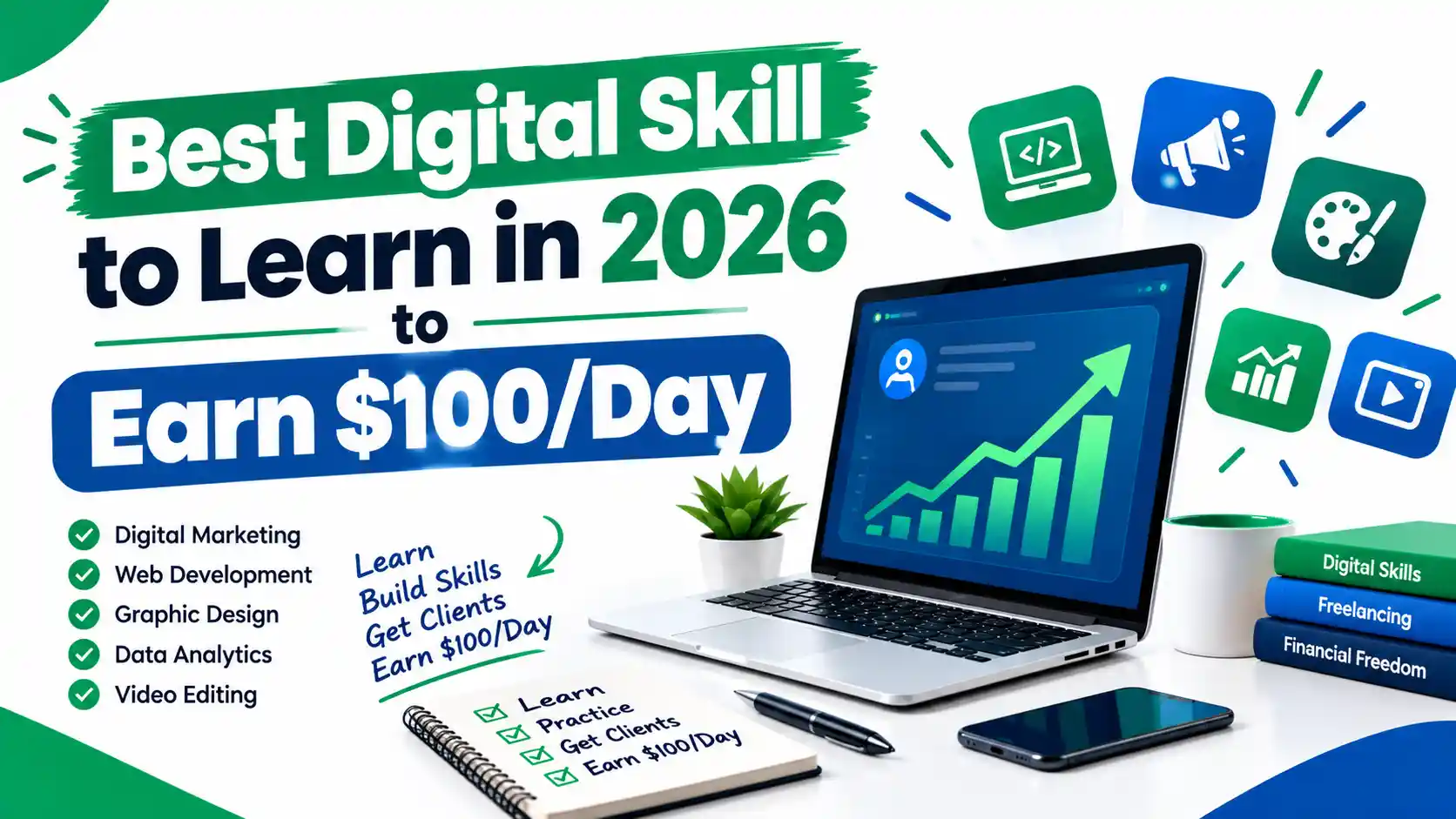
The best digital skill to learn in 2026 depends on your budget, time, and interest — but AI Automation, Digital Marketing (including SEO and paid ads), Web Development, and Data Analytics currently offer the fastest realistic path to $100/day for beginners in Pakistan, because they combine low startup cost, high global demand, and quick freelance entry points.
Introduction
If you've spent any time scrolling YouTube or TikTok lately, you've probably seen someone claiming they earn $100 a day from a laptop. Some of it is exaggerated. A lot of it is real. The honest answer is that earning $100/day online in 2026 is genuinely possible for people in Pakistan — but only if you pick the right skill, learn it properly, and treat it like a real career, not a lottery ticket.
That's exactly what this guide is for. At the Institute of Digital Trainings (IDT), we train thousands of students, freelancers, and career changers across Pakistan every year, and the single most common question we get is: "Which skill should I actually learn?" This article breaks that decision down step by step, comparing the skills that are realistically earning people money right now, so you can pick one with confidence instead of guessing. You can browse all available programs directly on our courses page as you read through the comparisons below.
Key Takeaways
- There is no single "best" skill for everyone — the right choice depends on your learning speed, budget, and whether you prefer technical, creative, or client-facing work.
- AI-related skills (AI Automation, prompt engineering) are growing the fastest, but Web Development, SEO, and Graphic Design remain reliable, beginner-friendly earners.
- Most students in Pakistan need 2–4 months of consistent practice before landing their first paid client.
- $100/day is achievable but usually happens after 6–12 months of skill-building, portfolio work, and client acquisition — not overnight.
- Choosing a skill with strong local training support, a mentor, and a real portfolio matters more than chasing whatever skill is "trending" this month.
What Counts as a High-Income Digital Skill in 2026?
A high-income digital skill is any skill that lets you sell your time, output, or expertise online to clients or employers anywhere in the world — typically through freelancing platforms, remote jobs, or your own service business — without needing a physical office or local market. In 2026, this includes technical skills like AI automation and web development, as well as creative and marketing skills like SEO, content writing, and graphic design.
What separates a "high-income" skill from a low-paying one usually isn't the skill category itself — it's how in-demand it is globally, how quickly a beginner can reach a paid-work level, and how well the person markets themselves afterward. You can see a full breakdown of current high-income online courses and how they're evaluated for earning potential.
Why Is 2026 Different From Previous Years?
2026 is different because artificial intelligence has moved from being a "nice to have" tool to becoming the baseline expectation across almost every digital job — from marketing to development to customer support. According to the World Economic Forum's Future of Jobs Report, technological change and AI adoption are among the biggest forces reshaping the global labour market this decade, with around 170 million new jobs expected to be created globally through 2030, alongside roughly 92 million existing roles being displaced by the same trends. Separately, industry research shows a large share of workers' core skills will need to change by 2030 as employers adjust to new technology.
For Pakistani freelancers and job seekers, this shift is actually an opportunity rather than a threat. Skills that combine human judgment with AI tools — like AI-assisted marketing, AI automation, and data-informed decision-making — are seeing faster hiring growth than skills that don't touch AI at all. You can read more about how this shift is playing out locally in our breakdown of AI replacing traditional jobs in 2026.
How to Choose the Right Skill for You (Decision Framework)
The right digital skill for you is the one that matches three things at once: your available learning time, your natural interest (technical, creative, or people-facing), and your budget for tools or a course. Trying to force yourself into a "trending" skill you don't enjoy is the number one reason people quit within the first month.
Ask yourself these four questions before choosing:
Do I enjoy logic and problem-solving, or do I enjoy visual/creative work? — This alone splits most people between technical skills (web development, data analytics, cybersecurity) and creative skills (graphic design, video editing, content writing).
How many hours per week can I realistically commit? — 5 hours/week suits slower-paced skills like content writing; 15+ hours/week suits faster-moving skills like web development or AI automation.
Do I want to work with international clients directly, or would I prefer a structured job/remote role? — This affects whether you lean toward freelancing platforms or job-focused skills like data analytics and cybersecurity.
What's my budget for a laptop, internet, and training? — Some skills (content writing, social media management) need almost no extra tools; others (video editing, graphic design) benefit from paid software.
Once you've answered these, use the comparison table in Section 5 to shortlist 1–2 realistic options. For a deeper approach to setting a clear direction, see our guide on how to set career goals and actually achieve them.
Top Digital Skills to Learn in 2026 to Earn $100/Day
Below are the skills consistently generating real income for beginners and intermediate freelancers in Pakistan right now, based on current course enrollment trends and freelance marketplace demand.
AI Automation
AI Automation is currently the fastest-growing skill category, involving building automated workflows using tools like ChatGPT, Zapier, and Make to help businesses save time on repetitive tasks. It suits people who enjoy logical problem-solving and are comfortable learning new software tools quickly.
Because so few people currently offer this service compared to demand, beginners with even a basic portfolio can charge premium rates faster than in more saturated fields. Explore the full curriculum in our AI Automation course.
Talk to an Advisor About This Course →
Digital Marketing & Paid Ads (Meta Ads)
Digital marketing — especially running paid ad campaigns on platforms like Meta (Facebook/Instagram) — remains one of the most reliable income sources because nearly every business, local or international, needs help getting customers online. This skill blends creative thinking with data analysis, making it ideal for people who like both sides of marketing.
Businesses are usually willing to pay well for someone who can prove a return on ad spend, which is why a strong portfolio matters more here than in almost any other skill. Our Meta Master course is built specifically around this outcome.
Talk to an Advisor About This Course →
SEO (Search Engine Optimization)
SEO is the practice of helping websites rank higher on Google, and it remains one of the highest-paying entry-level digital skills because most business owners don't understand it well enough to do it themselves. It rewards patience and analytical thinking more than raw creativity.
SEO freelancers who can show even one successful ranking case study tend to land retainer clients (monthly recurring income) much faster than one-off gig work. Read why SEO is considered one of the highest-paying skills right now.
Web Development
Web development involves building and maintaining websites using languages like HTML, CSS, JavaScript, and frameworks such as React or WordPress. It has one of the highest ceilings for long-term income but also a steeper initial learning curve than marketing or design skills.
Beginners typically start with WordPress-based projects before moving into custom development, which shortens the time-to-first-client significantly. See our full breakdown of how to become a web developer in Pakistan.
Graphic Design
Graphic design covers everything from social media creatives to branding and packaging design, using tools like Canva, Figma, and Adobe Photoshop. It's one of the most accessible entry points for people without a technical background.
The tradeoff is that graphic design is more saturated than some technical fields, so standing out requires a genuinely strong, niche-focused portfolio rather than generic templates. Check out available graphic design training options in Islamabad to get started.
Video Editing
Video editing demand has grown sharply alongside the rise of short-form content on YouTube Shorts, Instagram Reels, and TikTok, with businesses and creators alike needing fast, engaging edits. It suits people with patience for detail work and a good sense of pacing and storytelling.
Editors who specialize in a specific niche (e.g., podcast editing, faceless YouTube channels, or Reels) tend to earn more consistently than generalists. Learn more in our guide to the best video editing courses in Pakistan.
Data Analytics
Data analytics involves collecting, cleaning, and interpreting business data using tools like Excel, SQL, and Power BI to help companies make better decisions. It's a strong fit for detail-oriented people who enjoy working with numbers and patterns rather than pure creative output.
This skill leans more toward stable remote jobs than one-off freelance gigs, making it a good choice for people who prefer consistent monthly income over unpredictable client work. Explore our Data Analyst course for a structured path in.
Talk to an Advisor About This Course →
Cybersecurity
Cybersecurity focuses on protecting systems, networks, and data from breaches — a field where global demand consistently outpaces the supply of trained professionals. It requires strong technical fundamentals and a genuine interest in how systems can be exploited and defended.
Because cybersecurity roles often require some form of certification to be taken seriously by employers, structured training matters more here than in most other digital fields. Our Certified Cyber Security Expert course is designed around this exact requirement.
Talk to an Advisor About This Course →
Cloud Computing
Cloud computing skills — working with platforms like AWS, Microsoft Azure, and Google Cloud — are in high demand as more companies move their infrastructure online. This field suits people who already have some technical comfort and want to move into higher-paying enterprise-level roles.
It typically takes longer to become job-ready in cloud computing than in most other skills on this list, but the long-term salary ceiling is among the highest. See our Cloud Computing course for the full learning path.
Talk to an Advisor About This Course →
Content Writing
Content writing involves creating blog posts, website copy, and marketing content for businesses that need to communicate clearly online. It's one of the lowest-cost skills to start with, requiring nothing more than a laptop and strong English writing ability.
Writers who develop a specific niche — like tech, finance, or health writing — tend to charge significantly more than generalist writers. Our guide on content writing courses in Pakistan covers how to build that specialization from day one.
E-commerce
E-commerce skills involve setting up, managing, and marketing online stores — a field that's expanded rapidly alongside platforms like Shopify and Daraz in Pakistan. It suits people interested in both the business and marketing sides of selling products online.
This path often has a higher earning ceiling than pure service-based skills, since it can scale into an actual business rather than staying limited to hourly freelance work. Explore our E-commerce course to see how the full setup works.
Talk to an Advisor About This Course →
Truck Dispatching
Truck dispatching is a remote-work niche where you coordinate freight loads and routes for trucking companies, mostly in the U.S. and Canadian markets, entirely from Pakistan. It's less well-known locally but has become one of the more consistent income sources for people willing to work U.S. business hours.
Because it's a service-based, relationship-driven skill rather than a creative one, dispatchers who build strong carrier relationships often see steady repeat income. Learn more in our Truck Dispatching course and career guide for 2026.
Talk to an Advisor About This Course →
Comparison Table: Which Skill Fits Your Goals?
| Skill | Avg. Learning Time | Startup Cost | Beginner-Friendly | Earning Potential | Best For |
| AI Automation | 6–10 weeks | Low | Moderate | Very High | Tech-curious problem-solvers |
| Digital Marketing (Meta Ads) | 6–8 weeks | Low | High | High | Creative + analytical thinkers |
| SEO | 8–10 weeks | Very Low | Moderate | High (recurring) | Patient, detail-oriented learners |
| Web Development | 3–5 months | Low | Moderate | Very High | Logical, technical learners |
| Graphic Design | 6–8 weeks | Low–Medium | High | Moderate–High | Visual/creative thinkers |
| Video Editing | 4–6 weeks | Medium | High | Moderate–High | Detail-focused storytellers |
| Data Analytics | 3–4 months | Low | Moderate | High (stable) | Numbers-driven, structured thinkers |
| Cybersecurity | 4–6 months | Medium | Lower | Very High | Technically strong learners |
| Cloud Computing | 4–6 months | Medium | Lower | Very High | Long-term tech career seekers |
| Content Writing | 4–6 weeks | Very Low | High | Moderate | Strong English writers |
| E-commerce | 2–3 months | Medium | Moderate | High (scalable) | Business-minded entrepreneurs |
| Truck Dispatching | 4–6 weeks | Low | High | High (consistent) | Communication-focused, night-shift flexible |
You can find more skill-by-skill breakdowns in our roundup of highest-paying freelancing skills for 2026.
Step-by-Step Roadmap: From Zero to $100/Day
Reaching $100/day doesn't happen from a single course alone — it follows a fairly predictable sequence that most successful students go through.
Pick one skill and commit for at least 60 days before evaluating whether to switch — skill-hopping is the biggest time-waster for beginners.
Learn through structured training, not scattered YouTube videos, so you build fundamentals in the right order instead of skipping steps.
Build 3–5 portfolio pieces (even unpaid or practice projects) before applying for your first paid work.
Create profiles on Upwork, Fiverr, and LinkedIn with a clear, specific niche rather than a generic "I do everything" description.
Take your first 2–3 clients at a lower rate to build reviews and testimonials, then raise your pricing steadily.
Reinvest your first earnings into better tools, certifications, or advanced training to increase your rate ceiling.
For a more detailed breakdown of this exact sequence, see our 30-day roadmap after completing a digital course.
How Much Can You Realistically Earn?
Most beginners in Pakistan don't reach $100/day in their first month — it usually takes somewhere between 3 to 12 months of consistent client work to reach that level, depending on the skill and how actively you market yourself. Early on, $10–$30/day is a more realistic first milestone, with income scaling up as your portfolio and client base grow.
Skills like AI automation, web development, and SEO tend to reach higher day-rates faster because clients pay for results rather than hours. Skills like content writing and graphic design often start lower but scale well once you build a reputation and repeat clients. You can read real examples in our feature on Pakistani students earning $100/day in 2026.
Career Scope and Future Trends Beyond 2026
The digital skills market isn't slowing down — if anything, the gap between AI-literate professionals and everyone else is expected to widen further as more businesses integrate automation into daily operations. Skills that combine a traditional discipline (marketing, writing, development) with AI tool fluency are likely to remain the most resilient over the next several years.
Cybersecurity and cloud computing, in particular, are expected to keep growing steadily because the underlying infrastructure need doesn't disappear even as AI automates other tasks. For a closer look at where things are heading, see our analysis of top AI skills companies are hiring for in 2026.
Common Mistakes Beginners Make
Most people who fail to reach consistent income don't fail because the skill was wrong — they fail because of avoidable process mistakes. In our experience training thousands of students, the same patterns show up again and again in the first few months.
- Jumping between skills every few weeks instead of committing long enough to get good at one.
- Skipping portfolio-building and trying to apply for paid work with nothing to show.
- Underpricing so drastically that clients assume the quality is low, or overpricing before having any proof of results.
- Ignoring soft skills like client communication, deadlines, and professionalism, which often matter more than raw technical ability.
- Learning passively through videos without ever practicing on real or simulated projects.
We've broken down similar patterns in our piece on common mistakes beginner web developers make, many of which apply across other digital skills too.
Expert Tips and Best Practices
Based on patterns we consistently see among our highest-earning graduates, a few habits separate people who reach $100/day from those who stall out early. First, successful freelancers treat their first few months like a job, not a hobby — showing up daily even before they have paying clients. Second, they specialize early rather than trying to serve everyone, which makes their marketing and pricing far more effective.
Third, they invest time in personal branding — a professional profile picture, a clear bio, and consistent posting — because clients trust freelancers who look established, even early on. Our guide on personal branding tips for freelancers walks through exactly how to build this from scratch.
Latest Updates Shaping the 2026 Digital Job Market
Two shifts are worth watching closely this year. First, AI tools are increasingly being layered into existing skills rather than replacing them entirely — marketers now use AI for ad copy, developers use it to speed up coding, and writers use it for research and outlines, which means AI fluency has become a multiplier rather than a separate skill on its own. Second, clients on freelance platforms are becoming more selective, favoring freelancers who can demonstrate results and use AI tools efficiently over those offering only manual work.
For a practical look at how Pakistani freelancers are adapting to this shift, see our roundup of AI tools for freelancers in Pakistan for 2026.
Pros and Cons of Switching to a Digital Career
Pros:
- Location independence — work with clients anywhere in the world
- Lower startup cost compared to most traditional businesses
- Flexible hours once you have an established client base
- Multiple income streams possible (freelancing, remote jobs, own agency)
Cons:
- Income can be inconsistent in the first few months
- Requires self-discipline without a traditional office structure
- Some fields (cybersecurity, cloud computing) need a longer learning runway
- Competition on freelance platforms can be intense for generalist profiles
For a deeper side-by-side look at the tradeoffs, read our comparison of freelancing vs. a traditional job in Pakistan for 2026.
Why Choose Institute of Digital Trainings (IDT) to Earn $100/Day in 2026?
Choosing the right skill is only half the equation — how and where you learn it determines whether you actually reach paid work or stay stuck at the theory stage. The Institute of Digital Trainings (IDT) was built specifically to close that gap, with hands-on, project-based training across every skill covered in this guide, delivered by instructors who work in these fields, not just teach them.
What sets IDT apart is the structure around the learning itself: real client-style projects, portfolio-building support, and career guidance that continues after the course ends — not just video lectures. You can review our training approach and instructor backgrounds on our About Us page, and verify completed certifications through our official certificate verification portal, which many employers and clients check directly.
Frequently Asked Questions
Q1. Which digital skill is easiest to learn for a complete beginner?
Content writing, graphic design, and social media marketing are generally the easiest starting points, since they require minimal technical background and can start generating small income within 4–6 weeks of consistent practice.
Q2. Can I really earn $100/day within a few months of learning a skill?
It's possible but not guaranteed for everyone — most beginners reach $100/day gradually over 3–12 months, depending on the skill, effort, and how actively they market themselves to clients.
Q3. Is AI automation better than web development for beginners?
AI automation often has a shorter learning curve and less competition right now, while web development takes longer to learn but offers a higher long-term earning ceiling — the better choice depends on your patience and technical comfort.
Q4. Do I need a laptop and fast internet to start freelancing?
Yes, a working laptop and stable internet connection are essential for almost every digital skill, though the specific hardware requirements (like a strong GPU for video editing) vary by field.
Q5. Which skill has the least competition on freelance platforms right now?
AI automation and truck dispatching currently have comparatively less competition than saturated fields like generic graphic design or basic content writing.
Q6. Should I learn a skill through free YouTube videos or a paid structured course?
Free resources can work for very self-disciplined learners, but structured courses typically get beginners to paid-work readiness faster because they remove guesswork, provide feedback, and follow a proven sequence.
Q7. How long before I can quit my job and freelance full-time?
Most successful transitions happen after 6–12 months of part-time freelancing alongside a job, once income becomes consistent enough to replace a salary safely.
Q8. Is it too late to start learning digital skills in 2026?
No — demand for digital skills is still growing, and most fields on this list have room for skilled newcomers, especially those who combine their skill with AI tool fluency.
Conclusion
There's no single "best" digital skill for 2026 — there's only the best skill for you, based on your time, budget, and interests. What matters most isn't picking the trendiest option; it's committing to one skill long enough to build real proof of work, then marketing yourself consistently until clients start coming to you instead of the other way around.
If you're ready to stop researching and start building a real skill, explore the full range of programs on our courses page, or reach out directly through our contact page and our team will help you pick the right path based on your goals.