Introduction
Walking into a QA interview can feel daunting, especially if it is your first one. You may know what a test case is, but can you explain it clearly, give an example, and stay calm when the interviewer asks a follow-up question? That is where most candidates struggle, not because they lack knowledge, but because they have not practised putting it into words.
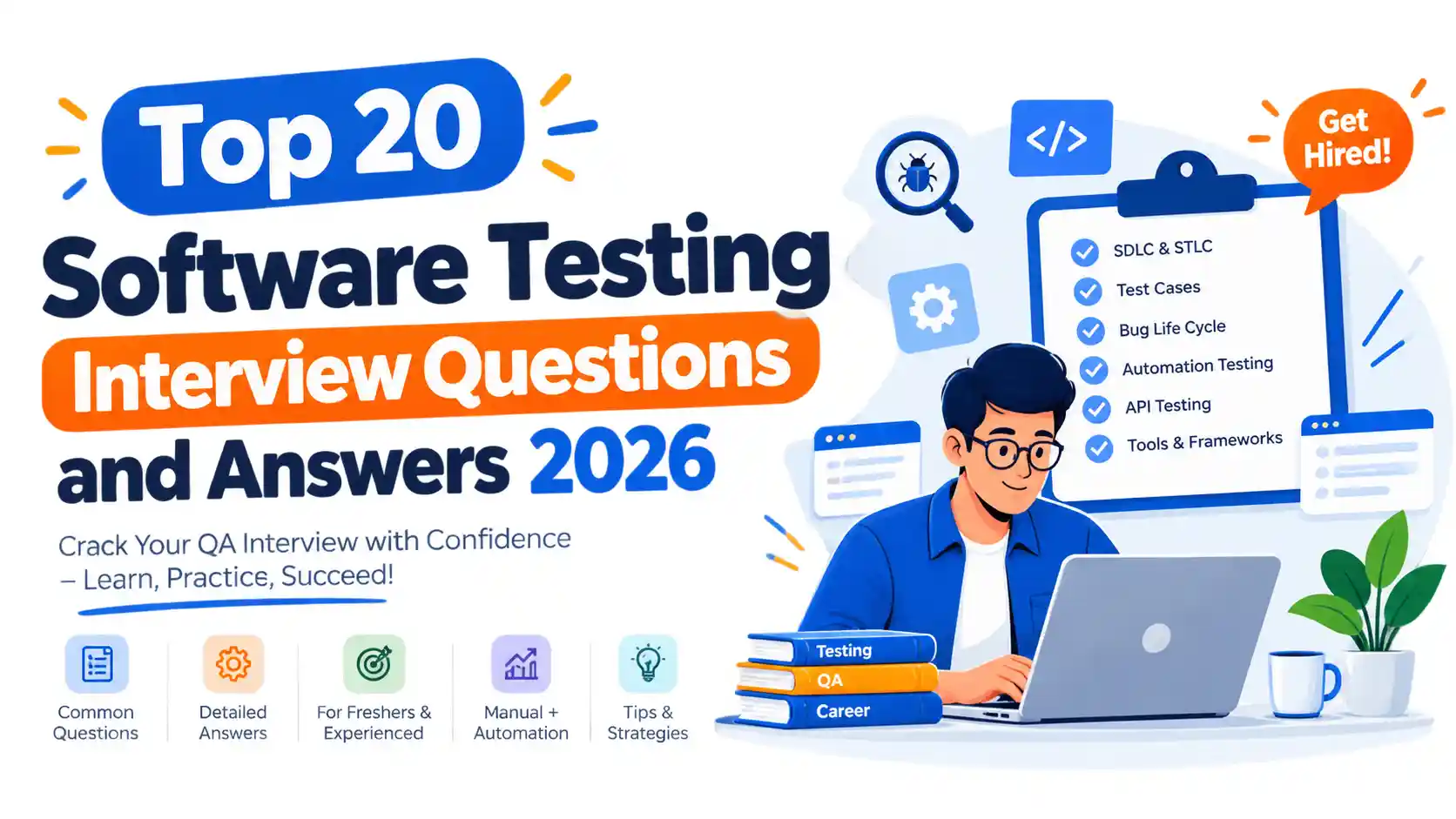
This guide brings together the top 20 software testing interview questions and answers for 2026, covering the topics that come up most often: testing fundamentals, test design, defect management, testing types, automation, API testing and Agile. Each answer is short and practical, so you can understand the idea and then explain it in your own voice.
It is written mainly for freshers, career changers and junior testers preparing for manual or entry-level automation roles. You do not need to memorise every line. Focus on understanding the reasoning, because interviewers usually care more about how you think than whether you can recite a definition.
If you are still building your foundation, the Software Quality Assurance course at IDT Pakistan covers many of these topics in a structured way. Check the course page for current de
How Software Testing Interviews Usually Work
Most QA interviews follow a similar pattern:
Fundamentals: definitions, SDLC, STLC, testing types.
Practical skills: writing test cases, reporting bugs, using tools like Jira.
Scenario questions: "How would you test a login page?"
Automation basics: Selenium, Playwright, API testing (more common for automation roles).
Behavioural questions: how you handle disagreements with developers or tight deadlines.
The exact format varies by company, so treat this as a general guide rather than a fixed rule.
Basic Software Testing Interview Questions
1. What is software testing?
Software testing is the process of evaluating a software product to check that it meets requirements and to find defects before release. It covers verifying that the product is built correctly and validating that it solves the user's actual need.
2. What is the difference between QA, QC and testing?
- Quality Assurance (QA) is process-focused. It aims to prevent defects through good standards and practices.
- Quality Control (QC) is product-focused. It identifies defects in the finished work.
- Testing is an activity within QC that executes the software to find defects.
A simple way to say it in an interview: QA improves the process, QC checks the product, and testing is one of the ways QC does that.
3. What is the difference between verification and validation?
Verification asks, "Are we building the product right?" It checks work products such as requirements, designs and code against specifications, often through reviews and walkthroughs.
Validation asks, "Are we building the right product?" It checks that the working software meets user needs, usually through executed tests.
4. What are SDLC and STLC?
The Software Development Life Cycle (SDLC) describes the stages of building software, from requirements and design to development, testing, deployment and maintenance.
The Software Testing Life Cycle (STLC) describes the testing activities within that process. A common breakdown is:
- Requirement analysis
- Test planning
- Test case design
- Test environment setup
- Test execution
- Test closure
Some organisations name the phases slightly differently, so be ready to explain the idea rather than recite one fixed list.
5. What is the difference between a test scenario and a test case?
A test scenario is a high-level statement of what to test, for example "Verify user login."
A test case is a detailed set of steps with preconditions, test data, expected results and actual results, for example "Log in with a valid email and a wrong password and confirm an error message appears."
One scenario usually produces several test cases.
Test Design and Documentation Questions
6. What makes a good test case?
A good test case is clear, specific, repeatable and traceable to a requirement. It should include:
- A unique ID and title
- Preconditions
- Steps
- Test data
- Expected result
- Actual result and status after execution
Anyone on the team should be able to run it and reach the same conclusion.
7. What are black box, white box and grey box testing?
- Black box: you test behaviour without knowing the internal code.
- White box: you test with knowledge of the internal structure, such as code paths and conditions.
- Grey box: you have partial knowledge of the internals, for example database structure or API behaviour.
8. What are boundary value analysis and equivalence partitioning?
These are test design techniques that reduce the number of tests while keeping good coverage.
- Equivalence partitioning groups inputs that the system should treat the same way. You test one value from each group.
- Boundary value analysis tests values at the edges of those groups, where defects often occur.
Example: If a field accepts ages 18 to 60, equivalence partitions are below 18, 18 to 60, and above 60. Boundary tests would include 17, 18, 60 and 61.
9. What is the difference between severity and priority?
Severity is the technical impact of a defect on the system. Priority is how urgently it should be fixed from a business point of view.
- High severity, low priority: a crash in a rarely used feature.
- Low severity, high priority: a spelling mistake in the company name on the homepage.
Interviewers like examples like these, because they show you understand that the two are not the same.
10. What is a traceability matrix?
A requirement traceability matrix (RTM) maps requirements to test cases so you can confirm every requirement is covered by at least one test. It also helps assess the impact when a requirement changes.
Defect Management Questions
11. What is the bug life cycle?
The bug life cycle describes the stages a defect passes through. Typical statuses are:
New
Assigned
Open or In Progress
Fixed
Retest
Verified and Closed
Reopened (if the fix fails) or Rejected or Deferred
Status names vary between teams and tools, such as Jira workflows, so explain the flow rather than insisting on exact labels.
12. How do you write a good bug report?
A useful bug report is reproducible and easy to understand. Include:
- A clear, specific title
- Environment (browser, device, operating system, build version)
- Steps to reproduce
- Expected result and actual result
- Severity and priority
- Screenshots, video or logs
Keep it factual and avoid blaming language.
13. What would you do if a developer rejects your bug as "not a defect"?
Stay professional. Re-check the requirement or acceptance criteria, reproduce the issue again, and share evidence such as steps, logs or screenshots. If the requirement is unclear, involve the product owner or business analyst. The goal is a shared understanding, not winning an argument.
Testing Types and Approaches
14. What is the difference between smoke testing, sanity testing and regression testing?
- Smoke testing: a quick check that the main functions of a new build work, deciding whether deeper testing is worthwhile.
- Sanity testing: a narrow check after a minor change or fix to confirm that specific area works.
- Regression testing: re-testing existing functionality to make sure recent changes have not broken it.
15. What is the difference between functional and non-functional testing?
Functional testing checks what the system does, such as login, search or payment.
Non-functional testing checks how well it does it. Common areas include performance, security, usability and compatibility.
16. What is exploratory testing and when is it useful?
Exploratory testing is simultaneous learning, test design and execution without relying only on scripted cases. It is useful when requirements are incomplete, when time is short, or when you want to find unexpected issues that scripted tests may miss.
17. What is the difference between manual and automation testing, and what should be automated?
Manual testing is performed by a person following or exploring test cases. Automation uses scripts and tools to run tests.
Good candidates for automation are repetitive, stable and high-value tests, such as regression suites and smoke tests. Poor candidates include one-off tests, rapidly changing features and tests that need human judgement, like visual or usability evaluation.
If you want a deeper comparison, see our guide on manual testing vs automation testing and which to learn first. (Replace this link with the blog URL once that article is published. Only URLs from your approved list should be used.)
Automation, API and Agile Questions
18. What are Selenium and Playwright?
Both are open-source tools for automating web browsers. Selenium WebDriver is long established and supports many languages and browsers. Playwright is a newer framework from Microsoft with built-in features such as auto-waiting. Read the official Selenium documentation and Playwright documentation to see how each approaches browser automation.
In an interview, avoid claiming one is simply "better". Explain the trade-offs and say which one you have practised with.
19. What is API testing?
API testing verifies that the interfaces between systems return correct responses, status codes, data and error messages without going through the user interface. Tools such as Postman are commonly used. Good answers mention checking status codes, response body, headers, authentication and negative cases. The Postman Learning Center is a useful official resource.
20. What is the role of a tester in Agile and Scrum?
In Agile teams, testers work alongside developers and product owners throughout the sprint rather than only at the end. They help refine acceptance criteria, test early, give fast feedback and support continuous regression testing. The Scrum Guide defines the framework itself, and note that it does not prescribe a separate "tester" role, so quality is a shared responsibility of the team.
Scenario Question to Practise: "How Would You Test a Login Page?"
A strong answer covers several angles:
- Positive: valid email and password logs in.
- Negative: wrong password, empty fields, unregistered email.
- Boundary: minimum and maximum field lengths.
- Security: password masking, lockout behaviour, no sensitive data in error messages.
- Usability: clear error messages, keyboard navigation, "forgot password" link.
- Compatibility: different browsers and devices.
How to Prepare for a QA Interview
Learn the fundamentals first. Be able to explain SDLC, STLC, test design and the bug life cycle without notes.
Practise writing. Create real test cases and bug reports for a public website or app.
Pick one tool path. Learn Jira basics, plus either Postman, Selenium or Playwright, rather than skimming many.
Prepare examples. Describe a bug you found during practice, how you reported it and what happened next.
Learn the job market. The US Bureau of Labor Statistics describes the work of software quality assurance analysts and testers, which helps you understand how the profession is defined.
Consider certification. The ISTQB Foundation Level is an internationally recognised credential, and the ISTQB glossary is a reliable source for standard terminology.
Common Interview Mistakes to Avoid
- Memorising answers word for word instead of understanding them
- Claiming tool experience you cannot demonstrate
- Blaming developers in behavioural answers
- Giving definitions without an example
- Not asking any questions at the end of the interview
Next Steps
If you want structured, guided practice for these topics, you can explore the Software Quality Assurance course at IDT Pakistan, meet the team on the mentors page, or read about the career support information. Check each page for current details. No specific job or income outcome is guaranteed.
Frequently Asked Questions
What are the most common software testing interview questions?
Common questions cover the difference between QA and QC, SDLC and STLC, test cases versus test scenarios, severity versus priority, the bug life cycle, and types of testing such as smoke, sanity and regression.
How do I prepare for a software tester interview as a fresher?
Learn the fundamentals, practise writing test cases and bug reports on real applications, learn one tool such as Jira or Postman, and rehearse explaining concepts with examples.
Do I need to know programming for a QA interview?
For manual testing roles, programming is usually not essential, though basic SQL and logic help. For automation roles, you typically need at least one language used with tools like Selenium or Playwright.
What is the difference between a test case and a test scenario?
A test scenario is a high-level idea of what to test. A test case is a detailed set of steps, data and expected results for checking it.
What is the bug life cycle?
It is the sequence of statuses a defect moves through, from New to Closed, with possible Reopened, Rejected or Deferred outcomes.
Conclusion
A good software testing interview answer is clear, honest and backed by an example. As you work through these 20 questions, try explaining each one aloud as if you were talking to a colleague, then test yourself with a real scenario, such as writing test cases and a bug report for a public website. That kind of practice builds confidence far more effectively than reading alone.
Remember that interview formats differ between companies, and no list of questions can predict every one. What stays constant is the need for solid fundamentals: understanding the testing life cycle, designing sensible test cases, reporting defects clearly and communicating well with developers. Build those first, then add one tool such as Jira, Postman, Selenium or Playwright, rather than trying to learn everything at once.
If you would like guided practice with mentors, you can explore the Software Quality Assurance course at IDT Pakistan and review the current syllabus and details on the official page. Results depend on your effort and the job market, so no job or income is guaranteed. Good luck with your interview preparation.