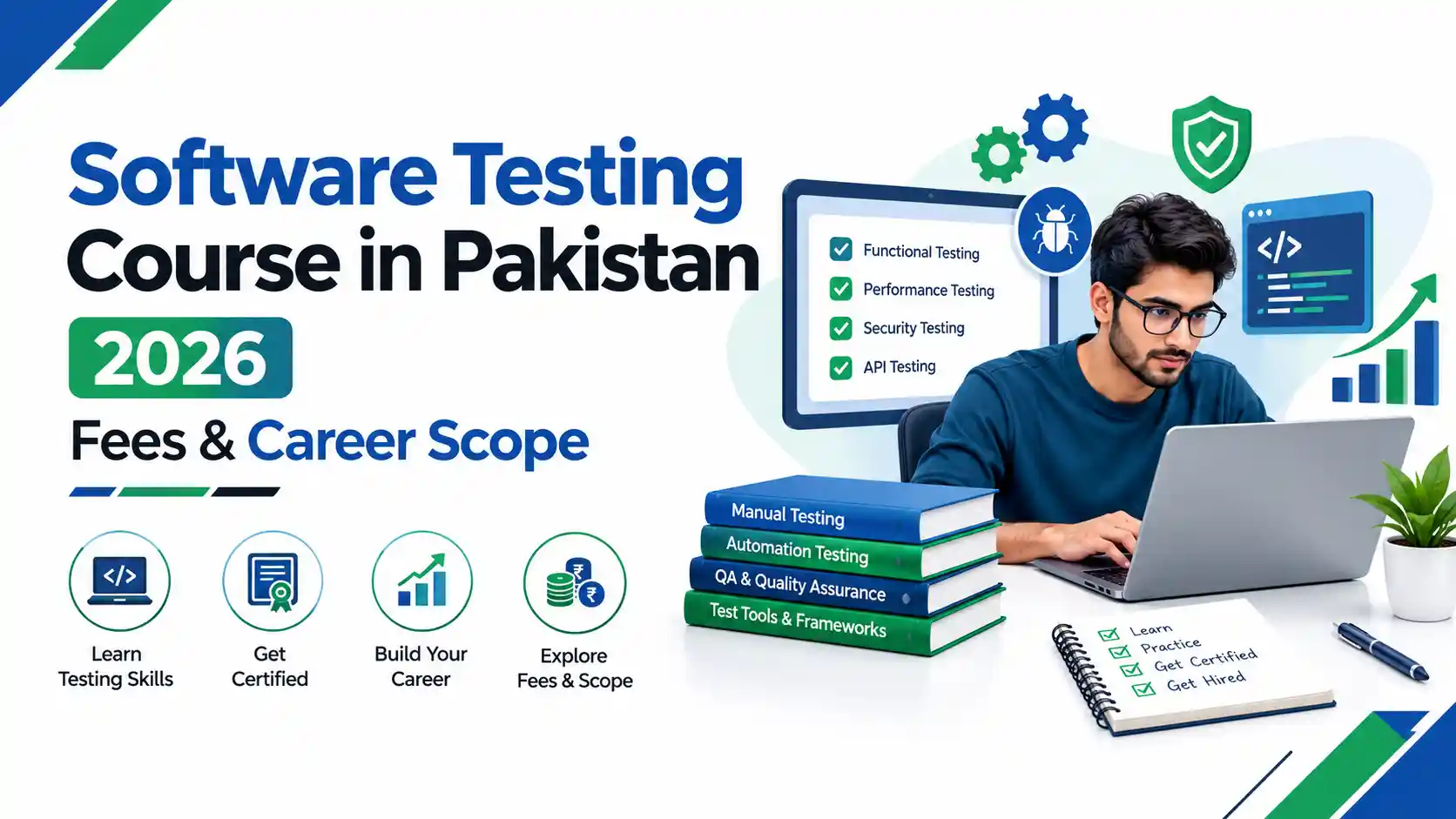
Quick Answer: A software testing course in Pakistan teaches manual testing, automation with Selenium, API testing with Postman and performance testing with JMeter. Fees vary widely by institute, format and certification, so compare the syllabus, practical projects and exam support before paying. Testing careers include QA tester, SQA engineer and automation engineer, with remote options for skilled candidates.
Introduction
Anyone searching for a software testing course in Pakistan in 2026 usually wants three answers: what it costs, what they will learn and whether it leads to a job. The Institute of Digital Trainings (IDT) runs a practical Software Quality Assurance course and explains its training approach on its About page. This guide uses verified facts, sourced figures and plain language, and it states clearly where numbers vary.
CTA BUTTON: Talk to IDT About the Software Quality Assurance Course
You will find fee factors, tools, ISTQB exam details, salary ranges, job-search tactics and a decision framework. If you are still comparing skills, the best online courses for high-income skills in 2026 guide shows where testing sits among other options.
Key Takeaways
- Software testing is a practical entry point into IT. Manual testing needs no coding background, and automation can be added later.
- Course fees differ sharply between providers, so compare what is included, not just the price.
- The ISTQB Foundation exam (CTFL v4.0) has 40 questions, lasts 60 minutes and needs a 65% score to pass.
- Salaries depend on city, skills and employer. Treat published averages as estimates and check live job listings.
- Employers hire on proof of skill. Build a portfolio of test cases, bug reports and one automation project.
- Avoid any institute that guarantees a job.
What is a software testing course, and what will you learn?
A software testing course in Pakistan is a structured training program that teaches how to find defects in software before users do. It covers manual testing, test case design, bug reporting, automation with Selenium, API testing with Postman and performance testing with JMeter. Graduates can apply for QA tester and SQA engineer roles.
See IDT's Software Quality Assurance course
CTA BUTTON: Ask IDT About Admission
Three terms are often confused, so here are the differences:
- Software testing finds defects by running or reviewing the software.
- Quality assurance (QA) is the process that prevents defects across the whole development lifecycle.
- Quality control (QC) checks finished outputs against requirements.
A QA professional works inside the Software Development Life Cycle (SDLC) and follows the Software Testing Life Cycle (STLC): requirement analysis, test planning, test case design, environment setup, execution and closure. IDT's own Blog explains how technical skills fit into wider digital careers.
A single bug's journey shows how this works. A tester finds that a payment button fails on mobile and reports it with steps, screenshots and severity. A developer fixes it, and the tester retests and then runs regression testing to confirm nothing else broke. That cycle is the daily rhythm of QA work, and the ISTQB glossary and syllabus resources define the standard terms.
Why is software testing worth learning in Pakistan in 2026?
Software testing is worth learning in Pakistan in 2026 because software companies need testers as their products grow. Pakistan's IT and telecom exports reached about $4.6 billion in FY2025-26, up roughly 20% from about $3.8 billion a year earlier, according to State Bank of Pakistan figures reported in the press. More software means more demand for quality checks.
Check the primary data yourself at the State Bank of Pakistan. Reports vary slightly, from about $4.5 billion to $4.6 billion, depending on how telecom and computer services are grouped. The direction is consistent: strong growth. For a wider view of in-demand skills, read Top AI Skills Companies Are Hiring For in 2026.
Here are the practical reasons that matter to learners:
- Lower entry barrier: Manual testing starts with logic, observation and communication, not heavy programming. IDT's guide on digital skills to learn after matric shows how beginners choose a starting skill.
- Every software team needs QA: Banks, e-commerce stores, healthcare apps and software houses all ship products that need testing.
- Clear growth path: Testers can move into automation, performance testing, security testing or QA leadership.
- Remote and freelance options: Skilled testers can work with international clients, as covered in how to start freelancing in Pakistan in 2026.
How much do software testing course fees in Pakistan cost in 2026?
Software testing course fees in Pakistan vary by institute, city, duration and certification, so no single price applies. As a reference, one Karachi training academy listed its ISTQB Foundation course at Rs 80,000, while an international provider listed the same certification track in US dollars. For IDT's current fee, contact the team directly.
CTA BUTTON: Get the Current SQA Course Fee from IDT
Published prices change often, so confirm every figure with the institute. The reference points below were visible at the time of writing:
| Provider type | Example listing | What to note |
| Local academy (Karachi) | ISTQB Foundation course listed at Rs 80,000 (discounted from Rs 85,000) | Exam-focused, short duration |
| International classroom provider | ISTQB Foundation listed from $3,995 for Pakistan | Premium pricing, short intensive format |
| Practical skills institute | Fee varies; see IDT's Software Quality Assurance course | Broader tool training, longer duration |
These comparisons are not like-for-like. A 5-day exam course teaches different things from a multi-month practical program. Learn how institutes differ in IDT's guide to the best digital training courses in Pakistan.
Seven factors that change the fee:
| Factor | Lower-cost option | Higher-cost option | What to check |
| Duration | Short crash course | Multi-month program | Total learning hours |
| Format | Recorded or online | On-campus or live | Live support included? |
| Tools covered | Manual only | Manual plus Selenium, Postman, JMeter | Real tool practice |
| Certification | Completion certificate | ISTQB exam preparation | Who issues the credential |
| Trainer level | Junior trainer | Industry professional | Trainer background |
| Projects | Theory-heavy | Hands-on projects | Portfolio output |
| Career support | None | Interview and freelancing guidance | What exactly is offered |
Warning: Be cautious with unusually cheap courses and with "100% job guarantee" claims. Ask for the syllabus, trainer profile and certificate verification method in writing. IDT's certificate verification page shows how a certificate can be checked.
Budget for extras too: a reliable laptop, stable internet and any external exam fee, such as the ISTQB exam. Exam fees are set by the exam provider, not the training institute.
Which skills and tools does a job-ready software testing course cover?
A job-ready software testing course covers seven core areas: QA foundations, SDLC models, manual testing, automation basics, Selenium, API testing with Postman and performance testing with JMeter. IDT's Software Quality Assurance course follows this seven-module outline. Learners should also practice Jira-style bug tracking and basic SQL, which many QA interviews check.
Explore the IDT SQA course outline
CTA BUTTON: Request the Full Syllabus
IDT's published course outline lists these modules:
| Module | Focus | Why employers care |
| 1. QA Foundations | Core QA concepts and workflows | Shared vocabulary with teams |
| 2. SDLC Expertise | Agile, Scrum, Waterfall | Testing fits each project model |
| 3. Manual Testing Skills | Test planning, execution, bug reporting | The base skill for every QA role |
| 4. Automation Essentials | Automation fundamentals | Faster, repeatable checks |
| 5. Selenium Mastery | Selenium WebDriver test cases | Common browser automation tool |
| 6. API Testing Power | Postman, response validation | Backend testing without a UI |
| 7. Performance Testing | JMeter stability and speed checks | Finds slowdowns before launch |
Each tool has official learning resources worth bookmarking:
- Selenium documentation for browser automation.
- Postman Learning Center for API testing.
- Apache JMeter for load and performance testing.
- Atlassian Jira for defect tracking.
Beginners often ask which language to learn for automation. Java, Python and JavaScript are all common. If you lean toward JavaScript, IDT's JavaScript for beginners guide is a practical starting point. For modern frameworks, explore Playwright after you master the basics.
Manual testing or automation testing: which should you learn first?
Learn manual testing first, then add automation. Manual testing teaches test design, bug reporting and product thinking, which every QA role requires. Automation with Selenium or Playwright then speeds up repeated checks and often opens higher-paying roles. Many employers value manual skills plus at least basic automation awareness.
IDT's web development roadmap for beginners helps you judge how much coding you want to learn. The table compares both paths:
| Feature | Manual Testing | Automation Testing | Recommendation |
| Entry barrier | Low, no coding needed | Needs scripting basics | Start manual |
| Main tools | Jira, spreadsheets, TestRail | Selenium, Playwright, Postman | Learn the tools in that order |
| Best for | New features, usability, exploratory checks | Repeated regression and API checks | Use both |
| Speed on repeat tests | Slower | Much faster | Automate stable, repeated tests |
| Typical roles | QA Tester, Test Analyst | Automation Engineer, SDET | Aim for a hybrid profile |
| Learning order | First 1–2 months | After manual foundations | Do not skip steps |
Automation cannot replace human judgment. A script can confirm that a button works, but only a tester notices that the checkout flow feels confusing. The Selenium project itself states that automation supports testing rather than replacing exploratory thinking.
Who is eligible for a software testing course in Pakistan?
Anyone with intermediate education (FSc, ICS, I.Com or equivalent), a laptop and logical thinking can start a software testing course in Pakistan. A computer science degree helps but is not required for manual testing. IDT's website states its courses suit all levels and begin with the basics.
Eligibility depends on your starting point:
- After intermediate: You can start manual testing now. Read how to plan your first steps in IDT's guide to digital skills after matric.
- After graduation: A degree in any field is fine. IT graduates can aim for automation sooner.
- Freshers: Focus on a portfolio, because you lack work history.
- Career changers: Skills from support, operations or teaching often transfer well. The freelancing vs job comparison can help you plan the switch.
Basic requirements: A laptop, stable internet, comfortable English reading skills, patience for detail and curiosity about how software breaks.
How long does it take to learn software testing?
Most structured testing programs run three to six months, depending on class hours and practice time. IDT's website states most of its courses last three to six months, depending on program depth. Confirm the exact Software Quality Assurance schedule with IDT before enrolling.
CTA BUTTON: Ask IDT About Batch Timings
A realistic learning timeline looks like this:
| Phase | Focus | Output |
| Early weeks | Testing basics, SDLC, STLC, test cases | 20–30 written test cases |
| Middle phase | Bug reporting, Jira, SQL basics | A bug report portfolio |
| Automation phase | Selenium, API testing with Postman | One automation project |
| Final phase | Performance basics, interview practice | A complete portfolio and CV |
These phases are a planning guide, not a promise. Speed depends on daily practice. IDT's 30-day roadmap after completing a digital course explains what to do once classes end.
Is ISTQB certification worth it in Pakistan?
ISTQB Certified Tester Foundation Level (CTFL) v4.0 is worth taking if you want an internationally recognized testing credential. The exam has 40 multiple-choice questions, lasts 60 minutes and requires 26 correct answers (65%) to pass. The ISTQB released CTFL v4.0 in April 2023, and the exam has no prerequisites.
These figures come from the International Software Testing Qualifications Board (ISTQB) sample exam materials. Candidates sitting the exam in a language that is not their native language usually get 25% extra time, which makes it 75 minutes. Verify current rules with your exam provider.
A course completion certificate and an ISTQB certificate are different things:
| Feature | Institute completion certificate | ISTQB CTFL certificate |
| Issued by | The training institute | ISTQB through an exam provider |
| Proves | You finished a program and its projects | You passed a standardized exam |
| Best for | Showing practical training | Showing recognized theory knowledge |
| Recommendation | Take both when possible | Add after hands-on practice |
IDT awards a course certificate that anyone can check on its certificate verification page. Ask IDT whether ISTQB exam guidance is part of your batch. ISTQB also offers advanced certifications. For example, its generative AI testing certification builds on the Foundation Level.
What is the career scope of software testing in Pakistan?
Software testing offers a clear career ladder in Pakistan: QA tester, SQA engineer, automation engineer, QA lead and QA manager. Entry roles focus on manual testing, while automation and performance skills lead to specialist roles. Remote and freelance QA work adds options for skilled testers who build proof of work.
IDT's Career page and its guide on setting career goals help you map this ladder. Common roles include:
| Role | What the person does | Typical entry path |
| QA Tester / Manual Tester | Executes test cases, reports bugs | Course plus portfolio |
| SQA Engineer | Plans tests, owns quality processes | 1–2 years in testing |
| Test Analyst | Analyzes requirements, designs tests | Manual testing experience |
| Automation Test Engineer | Writes Selenium, Playwright or API scripts | Manual base plus coding |
| SDET | Builds test frameworks and tooling | Strong programming skills |
| Performance Test Engineer | Runs load and stress tests with JMeter | Automation plus system knowledge |
| QA Lead / Manager | Leads teams, strategy and releases | Several years of experience |
Security testing is a related specialization. If it interests you, IDT's Certified Cyber Security Expert course shows how it pairs with QA skills.
CTA BUTTON: Ask IDT About Cyber Security Training
AI and test automation is another growth area. Testers who learn AI tools can speed up test design and data creation. IDT's AI Automation course covers the wider automation skill set.
CTA BUTTON: Ask IDT About AI Automation Training
For international work, platforms such as Upwork list QA and testing projects. Use IDT's Upwork profile optimization guide to present your skills well.
How much do software testers earn in Pakistan?
Software tester salaries in Pakistan vary widely by city, skill and employer. Indeed Pakistan reports an average QA engineer salary of about Rs 80,941 per month, with junior roles averaging near Rs 53,797 and senior roles near Rs 176,420. These figures are self-reported estimates, so compare current job listings before negotiating.
The figures below come from Indeed Pakistan's salary page, which showed an update in July 2026:
| Level | Indicative monthly pay (PKR) | Note |
| Junior QA Engineer | About Rs 53,797 (average) | Entry roles, manual-heavy |
| QA Engineer (all levels) | About Rs 80,941 (average) | Mixed experience |
| Senior QA Engineer | About Rs 176,420 (average) | Automation and leadership skills |
The same page also showed sample listings, such as a junior SQA role in Karachi at Rs 60,000–80,000 and a mid-level QA role at Rs 80,000–120,000. Islamabad was listed among the higher-paying cities. Listings change quickly, so treat these as snapshots.
Three habits raise your earning potential:
Add automation (Selenium, Playwright, Postman) to manual skills.
Learn SQL and basic API testing.
Build a public portfolio and a clear LinkedIn profile.
For the bigger picture on income options, read Freelancing vs Job in Pakistan: What's Better in 2026?.
Where can you find software testing jobs in Pakistan?
Software testing jobs in Pakistan are advertised on Rozee.pk, LinkedIn, Indeed and company career pages, with many openings in Islamabad, Lahore and Karachi. Apply with a portfolio of test cases, bug reports and an automation project, because employers hire on proof of skill more than certificates alone.
Start with LinkedIn Jobs and Rozee.pk, and follow the career pages of software houses in your city. IDT's Career page is another starting point. Remote roles also exist, so widen your search beyond your city.
A hiring-ready portfolio includes:
- 20–30 test cases for a real website or app.
- 5–10 well-written bug reports with steps, screenshots and severity.
- One Selenium or Postman collection stored on GitHub.
- A short test plan for a small feature.
Employers also look for communication and teamwork. IDT's article on what recruiters look for in web developers shows how hiring managers judge juniors, and many of the same points apply to QA candidates.
What is the step-by-step roadmap to become a software tester?
To become a software tester in Pakistan, follow eight steps: learn testing basics, practice manual testing, learn Jira and SQL, add Selenium automation, test APIs with Postman, build a portfolio, consider ISTQB CTFL, then apply for internships or junior QA roles. Each step builds on the previous one.
IDT's guide on how to become a web developer in Pakistan shows a similar roadmap if you want to compare paths. The QA version is:
Learn the basics: SDLC, STLC, test levels and test types.
Practice manual testing: Write test cases and run them on real websites.
Learn defect tracking: Report bugs in Jira with clear steps.
Study SQL and Git basics: Both are common interview topics.
Add automation: Start with Selenium WebDriver or Playwright.
Test APIs: Use Postman to validate responses and status codes.
Build a portfolio: Publish your work on GitHub and LinkedIn.
Apply smartly: Target junior QA, internships and remote trial projects.
Classroom, online or hybrid: which format works best?
Choose classroom if you need structure, online if you live outside a training city, and hybrid if you want both. IDT offers physical, live Zoom and hybrid classes for its courses, plus recorded lectures. The best format is the one you will attend consistently and practice after every session.
See the options on IDT's Software Quality Assurance course page.
CTA BUTTON: Choose Your Class Format with IDT
| Feature | Physical | Online (Live) | Hybrid | Recommendation |
| Interaction | Face to face | Live on Zoom | Mixed | Physical for beginners who need focus |
| Flexibility | Low | High | Medium | Online for working professionals |
| Travel | Required | None | Partial | Online for out-of-city learners |
| Hands-on help | Immediate | Screen sharing | Both | Hybrid for balanced learners |
How do you choose the best software testing institute?
Choose a software testing institute by checking five things: a syllabus with real tools, hands-on projects, trainer experience, verifiable certificates and clear fees. Ask for a demo class and a written course outline. Avoid any provider promising guaranteed jobs, because hiring depends on your skills and the market.
Use this checklist when you compare providers, including IDT:
- Written syllabus listing tools (Selenium, Postman, JMeter, Jira)
- Trainer profile with real industry experience
- Practical projects, not slides only
- Certificate that can be verified online
- Transparent fee, installment and refund terms
- Recorded lectures or revision access
- Honest career guidance with no guaranteed-job claims
- A question about which registrations the institute holds (ask about NAVTTC or provincial technical education authority recognition)
Use the decision matrix to score each provider from 1 to 5:
| Criterion | Weight | Question to ask | Red flag |
| Syllabus depth | High | Which tools will I use weekly? | Only theory |
| Trainer quality | High | What projects has the trainer tested? | No profile shared |
| Practice time | High | How many hands-on hours? | No labs |
| Certificate value | Medium | Can employers verify it? | No verification |
| Support | Medium | Is there interview help? | "Job guaranteed" |
| Price clarity | Medium | What is included? | Hidden charges |
Compare more options in IDT's IT courses near me guide.
What mistakes do beginners make?
The most common beginner mistakes are memorizing definitions, skipping manual testing, copying automation scripts without understanding them and writing vague bug reports. Each mistake slows hiring. Practicing on real websites and reviewing your own bug reports corrects most of them within weeks.
A pattern seen among new testers is writing test cases like "check login works." Employers want specific cases such as "login with a valid email and an expired password shows the correct error message." [Author's note: replace with a firsthand IDT trainer observation before publishing.]
Mistakes to avoid:
- Jumping into Selenium before understanding test design.
- Ignoring SQL, Git and API basics.
- Building no portfolio.
- Collecting certificates without hands-on proof.
- Choosing a course by lowest price alone.
IDT's common web developer mistakes article shows the same learning traps in a neighboring field.
Which expert tips and best practices help most?
Practice daily on live applications, write test cases before touching automation, and keep a public portfolio. These habits matter because interviewers often ask candidates to test a login page or write a bug report on the spot. Learn SQL and Git basics early, since both appear often in QA interviews.
IDT's best AI tools for students in 2026 shows how to use AI to practice smarter. Use these best practices:
- Think like a user first, then like a tester. Ask what could confuse or annoy a real customer.
- Test boundaries: empty fields, long inputs, special characters and slow networks.
- Write reproducible bug reports: steps, expected result, actual result, environment, screenshot.
- Automate only stable tests, not every test.
- Verify AI output. AI tools can draft test cases, but a human must check them.
- Stay current: follow the Selenium and Playwright release notes.
What are the pros and cons of a software testing career?
Software testing offers an accessible entry into IT, remote options and steady demand. Repetitive tasks, tight release deadlines and a pay gap between manual and automation roles are real drawbacks. Weigh both sides against your goals before enrolling in any software testing course.
Read IDT's freelancing vs job comparison to see how career structure affects the trade-offs.
| Pros | Cons |
| Low barrier to start | Repetitive work in manual roles |
| Clear growth to automation and leadership | Deadline pressure before releases |
| Remote and freelance potential | Pay gap between manual and automation roles |
| Valued across industries | Needs constant tool learning |
| Builds analytical thinking | Bugs can create friction with developers |
Why not choose testing? If you dislike detail work, documentation or repeating checks, development or design may suit you better.
QA vs web development vs data analytics: which fits you?
Choose QA if you enjoy finding problems and want a lower coding barrier, web development if you want to build products, and data analytics if you prefer numbers and reporting. All three lead into Pakistan's IT sector. The right choice depends on your strengths, patience and goals.
For a deeper comparison, read Data Analytics vs Web Development: Which Gets You Hired Faster in Pakistan.
| Bugs can create friction with developers | Software Testing (QA) | Web Development | Data Analytics | Recommendation |
| Coding needed | Low to medium | High | Medium (SQL, Python) | QA for gentler start |
| Core strength | Attention to detail | Building and logic | Numbers and insight | Match your strength |
| Entry roles | QA Tester | Junior Developer | Data Analyst | All viable |
| Further reading | This guide | Web development guide | Data Analytics scope | Read before deciding |
If analytics interests you more, see IDT's Data Analytics course.
CTA BUTTON: Compare Courses with an IDT Advisor
What are the 2026 trends and latest updates?
Three trends shape software testing in 2026: AI-assisted test creation, wider use of Playwright alongside Selenium, and Agile and DevOps-focused syllabi such as ISTQB CTFL v4.0. Testers who combine QA fundamentals with AI tool literacy are better prepared than those who rely on tools alone.
2026 Trend Callout: Pakistan's IT and telecom exports reached roughly $4.6 billion in FY2025-26, and the government has set a target of about $15 billion for IT and IT-enabled services by 2030, according to press reports of official figures. Check the Pakistan Software Export Board (PSEB) for current policy updates.
Practical meaning for learners:
- AI in testing: Use AI to draft test ideas, then verify them yourself. IDT's AI tools for freelancers in Pakistan shows safe use cases.
- Shift-left testing: Teams test earlier in development, so QA joins planning meetings.
- CI/CD integration: Automated tests run on every code change, which makes basic Git and pipeline knowledge valuable.
- API-first testing: Backend checks with Postman matter as much as UI checks.
Why Choose IDT for a Software Testing Course in Pakistan
The Institute of Digital Trainings (IDT) combines a practical seven-module Software Quality Assurance outline with flexible class formats and certificate verification. Its course page lists manual testing, automation, Selenium, Postman and JMeter, taught by industry-oriented trainers. You can compare it with any institute using the checklist above, then verify details with the team.
Here is what IDT's own website states about the SQA course:
- Practical outline: Seven modules from QA Foundations to Performance Testing.
- Real tools: Selenium, JIRA, Postman and JMeter.
- Three class formats: Physical, live online via Zoom and hybrid.
- Recorded lectures for revision.
- Official certificate on completion, verifiable on the certificate verification page.
- Career and freelancing support across its programs.
- Locations: Islamabad, Lahore and Karachi, with online access for other cities.
IDT does not guarantee jobs, and no honest institute can. What it offers is structured practice and guidance. Explore its full course catalog or read its Institute of Digital Training Islamabad overview.
CTA BUTTON: Contact IDT to Enroll in the Software Testing Course
Frequently Asked Questions
What is the best software testing course in Pakistan?
The best software testing course is the one with a tool-based syllabus, hands-on projects, verifiable certificates and clear fees. Compare providers using a demo class and written outline. IDT's SQA course is one option to evaluate.
How much is a software testing course in Pakistan in 2026?
Fees vary by duration, format and certification. One Karachi academy listed ISTQB Foundation at Rs 80,000, while practical multi-month programs price differently. Ask IDT for its current Software Quality Assurance fee.
Can I learn software testing without coding?
Yes. Manual testing needs no coding, only logic, observation and clear writing. Automation roles need basic scripting, which you can add later. See the JavaScript for beginners guide when you are ready.
Is software testing a good career in Pakistan in 2026?
Yes, for people who enjoy detail and problem-finding. Pakistan's IT exports grew about 20% in FY2025-26, according to State Bank of Pakistan data reported in the press. Success still depends on skills, portfolio and consistent practice.
How long does a software testing course take?
Most structured programs run three to six months. IDT's website states most courses fall in that range depending on depth. Confirm the exact SQA schedule before you enroll.
Is ISTQB certification required to get a QA job?
No. ISTQB CTFL v4.0 is optional but respected. The exam has 40 questions, lasts 60 minutes and needs 65% to pass. Employers usually weigh hands-on skills heavily, as noted in what recruiters look for.
What is the salary of a software tester in Pakistan?
Indeed Pakistan reports an average QA engineer salary near Rs 80,941 per month, with juniors lower and seniors higher. Figures are estimates and vary by city and employer. Compare live listings and read freelancing vs job.
Is software testing course worth it after intermediate or graduation?
Yes, if you commit to practice. After intermediate, you can start manual testing immediately. After graduation, add a portfolio and automation. Read skills to learn after matric for planning ideas.
Can I work remotely as a software tester from Pakistan?
Yes, remote QA and freelance testing roles exist, but they need proof of skill and good English communication. Build a portfolio and optimize your profile using the Upwork profile guide.
10. Should I learn Selenium or Playwright first?
Learn manual testing first, then pick one automation tool. Selenium appears in many existing job ads, while Playwright is growing quickly. Start where your target employers hire, and keep the Selenium and Playwright docs handy.
Final recommendation and next steps
A software testing course in Pakistan is a practical, accessible route into IT if you choose a program with real tools, hands-on projects and verifiable credentials. Fees, salaries and job availability vary, so rely on written syllabi, live listings and honest institute answers rather than promises.
Your logical next step is to shortlist two or three providers, request a syllabus and attend a demo class. If IDT is on your list, review the Software Quality Assurance course and ask about fees, batch dates and class formats.
Sources
ISTQB: International Software Testing Qualifications Board: certification information and CTFL v4.0 sample exam materials
State Bank of Pakistan: official IT and services export statistics
Pakistan Software Export Board: IT sector policy and updates
NAVTTC: national technical and vocational training authority
Indeed Pakistan: QA Engineer Salaries
Omni Academy ISTQB course listing and The Knowledge Academy ISTQB Pakistan listing: fee reference points, viewed October 2026
IDT Software Quality Assurance course page: syllabus, class formats, certificate details