Introduction
Remote data analyst jobs are one of the most realistic ways for a Pakistani graduate or career changer to work with international teams without relocating. The role is built around SQL, spreadsheets, dashboards and clear reporting, all of which can be done from a laptop. The harder question is where to actually apply, and how to avoid wasting weeks on listings that were never open to you.
This guide explains where to look, what employers commonly ask for, how freelance and full-time routes differ, and how to spot fake offers. It also covers portfolio projects, certifications, interviews and the practical issues around getting paid from Pakistan.
Nobody can honestly promise a job or a fixed income in this field. What follows is a practical, evidence-based route, and where we could not verify a figure, we have left it out.
Quick Answer: Where Can Pakistanis Apply for Remote Data Analyst Jobs?
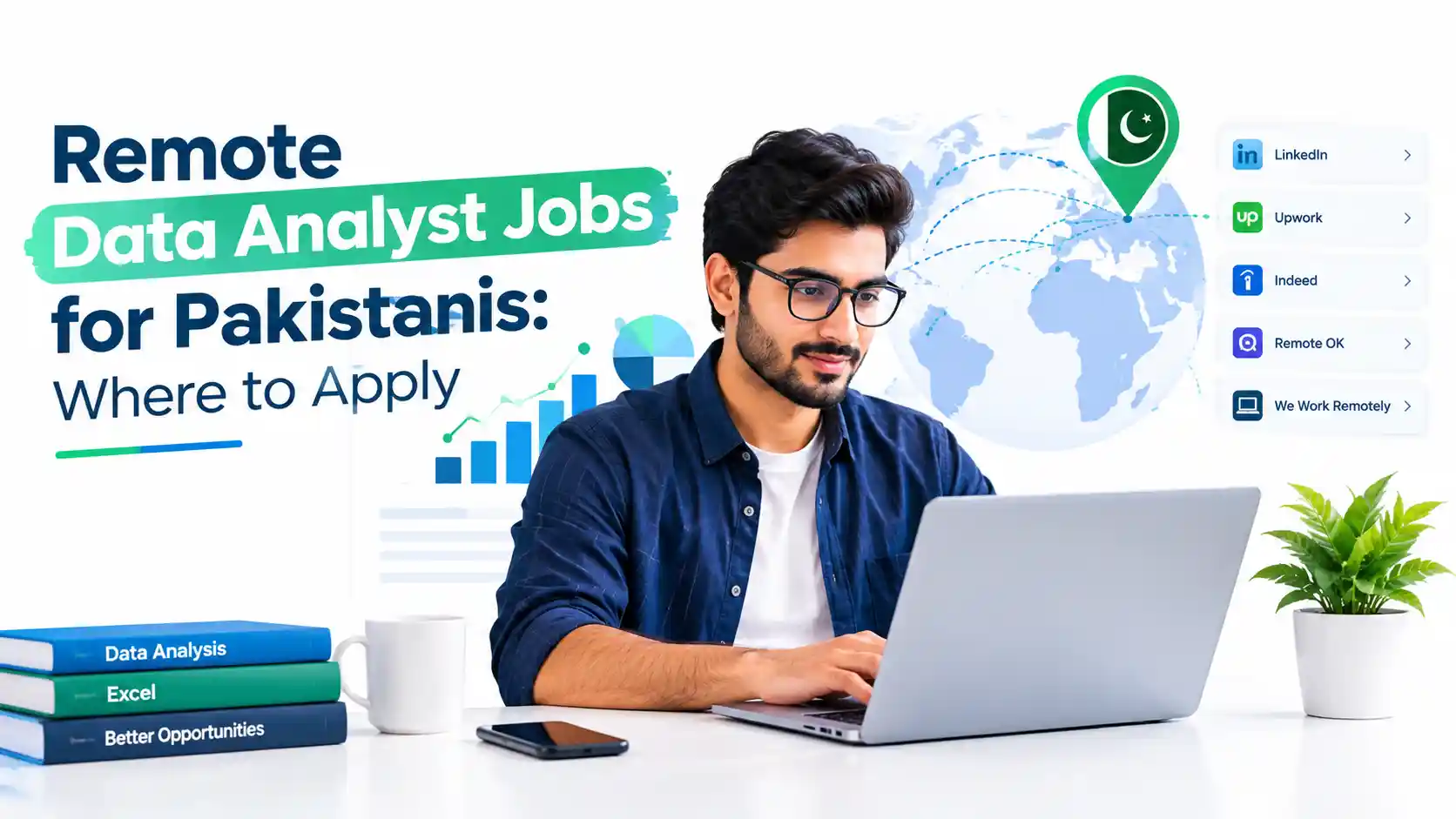
Pakistanis can apply for remote data analyst jobs through LinkedIn, Indeed, remote-first job boards such as We Work Remotely and Himalayas, and freelance platforms such as Upwork. Employers commonly ask for SQL, Excel or Power BI, and a portfolio. Always check a listing’s location eligibility and verify the employer before sharing documents or paying anything.
Key points:
- Filter for roles marked “worldwide”, “anywhere” or that name Pakistan, not just “remote”.
- SQL, Excel and one BI tool (Power BI or Tableau) are the most common starting stack.
- A portfolio of two to four real projects usually matters more than a long list of courses.
- Freelance work is easier to start; full-time remote roles usually ask for more proof of skill.
- Never pay a recruiter, “training fee” or “equipment deposit” to secure a job.
What Is a Remote Data Analyst Job?
A remote data analyst collects, cleans and interprets data, then explains the findings so a business can make better decisions. Google’s own description of the role is similar: analysts prepare, process and analyse data, build visualisations, and present recommendations to stakeholders (Google Data Analytics Certificate).
“Remote” simply means you do this from home or a co-working space, often for a company in another country. In practice, that can mean three different things:
- Fully remote employee: you are hired by one company and work its agreed hours.
- Contractor: you invoice a company for ongoing or project-based work.
- Freelancer: you find short projects yourself on platforms or through your own network.
Each has different expectations, paperwork and payment routes, which we cover below.
What a remote analyst actually does day to day
- Writes SQL queries to pull data from databases
- Cleans messy spreadsheets and datasets
- Builds dashboards in tools such as Power BI or Tableau
- Tracks key business metrics and flags changes
- Presents findings in writing or on calls with non-technical colleagues
Why Remote Data Analyst Jobs Matter in 2026
Demand for data skills is a global trend, not a Pakistan-only story. The World Economic Forum’s Future of Jobs Report 2025 draws on the views of more than 1,000 employers across 55 economies, and data-related roles appear among the fastest-growing in its 2025 to 2030 outlook (WEF Future of Jobs Report 2025). Media coverage of the report also highlights that a large share of existing skills are expected to change by 2030, which is a useful reminder to keep learning.
For comparison, the US Bureau of Labor Statistics does not list “data analyst” as its own occupation. Its closest category, operations research analysts, is projected to grow 12% from 2025 to 2035, against 3% for all occupations, with a median wage of $88,940 in May 2025 (BLS Occupational Outlook Handbook). This is US employment data for a related role. It is context for demand, not a salary promise for remote work from Pakistan.
Key Skills and Tools Employers Commonly Ask For
Job descriptions vary widely, so always read each listing. These are the skills that appear most often in analyst-style roles and in the official curricula we checked.
Core technical skills
- Excel or Google Sheets: formulas, pivot tables, lookups, charts
- SQL: querying and joining tables, filtering, aggregating
- A BI tool: Power BI or Tableau for dashboards and reports
- Python (or R): useful for cleaning and exploring larger datasets
- Statistics basics: averages, distributions, correlation, sampling
Google’s certificate, for example, teaches spreadsheets, SQL, Tableau and Python, and includes training on using AI tools to speed up cleaning and visualisation ideas (Google Data Analytics Certificate). Microsoft’s Power BI Data Analyst Associate certification focuses on preparing, modelling, visualising and securing data in Power BI, and expects proficiency with Power Query and DAX (Microsoft Learn).
Skills that make remote work easier
- Clear written English for emails, Slack messages and documentation
- Time-zone discipline and reliable communication
- Data storytelling: explaining what a chart means and what to do next
- Comfort with Slack, Microsoft Teams, Jira or Trello
AI tools in 2026
Many teams now use AI assistants for drafting queries, summarising data and checking formulas. Treat these as helpers, not replacements. Employers still need people who can check whether a result makes sense, which is why SQL and statistics fundamentals remain important.
Where to Apply: The Main Routes
General job boards
LinkedIn and Indeed carry the largest volume of listings. Glassdoor is useful for company reviews and interview reports. Their weakness is volume: many “remote” roles are limited to a specific country or region.
Practical tips:
- Use search phrases such as “remote data analyst”, “data analyst worldwide” and “data analyst anywhere”.
- On LinkedIn, set the location to “Pakistan” and the workplace type to “Remote”, then also search with “Worldwide”.
- Read the “about the job” section for phrases like “must be authorised to work in the US”. Skip those unless the employer explicitly says contractors are welcome.
Remote-first job boards
These sites list only remote roles, which saves filtering time. Examples include We Work Remotely, Remote OK, Himalayas, Working Nomads, Remotive, Dynamite Jobs and Jobgether. Wellfound (formerly AngelList Talent) is popular for startup roles. FlexJobs typically charges a membership fee, so check its current terms before paying.
Whichever you use, check each listing’s location rules. A role on a remote board can still exclude certain countries.
Freelance platforms
Upwork and Fiverr suit beginners who want paid project experience. Toptal and Arc are more selective and usually expect proven experience. Contra is aimed at independent professionals. If you are weighing these options, our comparison of Upwork vs Fiverr for Pakistani freelancers explains how each works for beginners.
Direct applications and LinkedIn outreach
Many hiring teams respond to a short, specific message more than to a mass application. Find analytics managers at companies you admire, send a brief note with one relevant portfolio link, and ask about contractor openings. Keep it polite and specific.
Recruitment agencies and consultancies
Some agencies place analysts with international clients. Treat them as you would any employer: confirm the company exists, check reviews, and never pay to be placed.
Entry-Level, Junior and Internship Routes
Searches for “remote entry level data analyst jobs” and “junior data analyst jobs” are common, but true entry-level remote roles are competitive. A realistic approach is to build proof of skill first.
- Remote internships: search “data analyst intern remote” on LinkedIn and Indeed. Unpaid internships exist, so read terms carefully.
- Junior contractor roles: smaller companies sometimes hire juniors for reporting and spreadsheet work.
- Local-first, then remote: some Pakistanis gain experience in a Karachi, Lahore or Islamabad company, then move to international remote work with a stronger CV.
- Freelance first: small projects on Upwork or Fiverr build reviews and real examples.
Do you need a degree or experience?
It depends on the employer. Google states that its Data Analytics Certificate requires no prior experience or degree to start, and that most learners finish in three to six months (Google Data Analytics Certificate). That tells you about the course, not about every employer’s hiring rules. Some job listings ask for a degree; others focus on skills and portfolio. Apply to both types, but prioritise listings that match what you can demonstrate.
Freelance vs Full-Time Remote: Which Suits You?
| Factor | Freelance / contract | Full-time remote |
| Getting started | Faster, lower barrier | Usually slower, more screening |
| Income pattern | Varies project to project | More predictable, if employed directly |
| Time zone | Often flexible | Often tied to team hours |
| Admin | You handle invoices, tax, registration | Employer handles more |
| Growth | Depends on reviews and clients | Depends on promotion and team |
Neither is “better”. Many analysts start with freelance projects to build experience, then apply for contract or full-time roles. Our article on freelancing vs a job in Pakistan goes deeper into this trade-off.
Getting Paid and Staying Compliant from Pakistan
Payment and tax rules change, so verify the latest position with official sources and a qualified adviser. We are not tax advisers. The points below are what recent reporting shows.
- PSEB registration and tax: reporting by The News, citing State Bank of Pakistan data, notes that a reduced 0.25% tax rate for registered freelancers has encouraged remittances through formal channels. The same report says freelancers earned $959 million in the first ten months of fiscal year 2026, up 49% year on year (The News).
- Foreign-currency accounts: in January 2023, the State Bank directed banks to credit a share of IT export proceeds into special foreign-currency accounts for PSEB or P@SHA registered exporters (ProPakistani). Retention limits have been revised since, so check the current State Bank guidance with your bank.
- Employee vs contractor: if a foreign company hires you through an employer-of-record service, your tax position may differ from a freelancer’s. Ask your accountant.
Keep invoices, contracts and bank records organised from day one. This also makes it easier to prove income later.
How to Build a Portfolio That Gets Replies
A strong portfolio shows how you think, not just which tools you know. Aim for two to four projects, each with a clear question, a cleaned dataset, an analysis, and a written conclusion.
Project ideas for beginners
Sales dashboard: build a Power BI or Tableau report on sales by region, product and month.
Customer churn analysis: explore which customer groups leave and suggest actions.
SQL case study: answer ten business questions from a public database.
Python exploratory analysis: clean and explore a public dataset, then explain what you found.
Financial or operations report: track costs, revenue or delivery times and highlight risks.
Publish your work on GitHub or a simple portfolio page, and write a short summary for each project: the question, the method, the finding and the recommendation. Public datasets from sources such as Kaggle are a common starting point; always check the dataset’s licence.
How to Write a Remote Data Analyst CV and Cover Letter
- Put your strongest skills and projects near the top.
- Describe achievements in plain terms, such as what you analysed and what decision it supported. Do not invent numbers.
- Match keywords from the job description honestly; do not list tools you cannot use.
- Keep the CV to one or two pages and link to your portfolio.
- In the cover letter, name the company, the role and one specific reason you are a fit.
- Optimise your LinkedIn headline and “About” section with the same skills and project links.
Interview Preparation
Remote hiring often includes a technical screen, a take-home task and a conversation about communication.
- SQL: practise joins, grouping, window functions and filtering.
- Excel / Power BI / Tableau: be ready to explain how you built a dashboard and why.
- Python: be comfortable with basic data cleaning and exploration.
- Take-home assignments: read the brief carefully, state your assumptions and explain your conclusions clearly.
- Communication: practise explaining a result to a non-technical person in two minutes.
Are Certifications Worth It?
Certifications can help show structured learning, but they do not replace projects. Two well-known options:
- Google Data Analytics Certificate: eight courses covering data foundations, cleaning, analysis, visualisation, Python and a capstone. Google estimates around 240 hours in total, and says it can be completed in three to six months. Pricing varies by country, so check the enrolment page for your local cost (Google Data Analytics Certificate). Its employer consortium and career support are described mainly for US graduates, so do not assume the same access from Pakistan.
- Microsoft Power BI Data Analyst Associate (PL-300): a role-based certification that requires passing one exam. Microsoft’s page states the exam is 100 minutes, and that the certification needs renewing every 12 months (Microsoft Learn).
If you choose a local training programme instead, compare its syllabus with what your target job listings ask for.
Remote Data Analyst Salaries: What We Can and Cannot Say
Searches for “remote data analyst salary in Pakistan” are common, but we could not find a reliable, current, publicly verifiable source for remote analyst pay specific to Pakistani workers. Rather than guess, we have left a figure out.
Here is a safer way to benchmark:
- Compare pay stated in several current listings for the same seniority and tools.
- Ask recruiters for the pay band early; many will share it.
- Remember that freelance rates, contract rates and salaries are not comparable one to one.
- Use official labour statistics, such as the BLS data above, only as context for demand, not as a promise.
How to Spot a Remote Job Scam
Scams target job seekers precisely because remote work is popular. Warning signs include:
- You are asked to pay for a “training fee”, “equipment deposit” or “registration fee”.
- The recruiter uses only a personal email address or messaging app and avoids video calls.
- The offer arrives without an interview, or the pay seems unusually high for the work.
- You are asked for bank details, ID documents or passwords before a signed contract.
- The company has no verifiable website, LinkedIn page or employee presence.
Verification checklist: search the company name with “scam” or “reviews”, check that the recruiter’s LinkedIn profile matches the company, ask for a written contract, and speak to the company on a scheduled video call.
Common Mistakes to Avoid
- Applying to dozens of roles without tailoring your CV
- Ignoring the location eligibility line in listings
- Listing tools you have never used
- Building a portfolio of tutorial copies, not original questions
- Sending documents or paying money before verifying the employer
- Waiting to feel “ready” before applying
A Simple 90-Day Plan
Days 1 to 30: build the base. Learn Excel and SQL basics, and start one project. Our 30-day roadmap after a digital course is a useful template for structuring this month.
Days 31 to 60: add a BI tool and projects. Learn Power BI or Tableau, finish two projects, and publish them.
Days 61 to 90: apply and improve. Update your CV and LinkedIn, apply to a small number of targeted listings each week, and keep a simple tracker of applications and responses. For a wider view of the market, see our guide to data analytics career scope in 2026.
Does Location in Pakistan Matter?
For genuinely remote roles, your city matters less than your skills, time-zone availability and internet reliability. Listings for Karachi, Lahore, Islamabad, Rawalpindi, Peshawar, Faisalabad, Multan or Sialkot may mean office-based or hybrid work, so read them carefully. A stable internet connection, power backup and a quiet workspace are practical advantages worth planning for.
Future of Remote Data Analyst Careers
AI tools are changing how analysts work, but the WEF’s 2025 outlook still places data-related roles among the growing ones. The likely direction is that routine tasks become faster, and analysts spend more time on judgement, communication and domain knowledge. Building both technical depth and business understanding is the safest long-term strategy.
Frequently Asked Questions
Are remote data analyst jobs available in Pakistan?
Yes. Some employers hire Pakistan-based analysts as employees or contractors, and freelance platforms offer project work. Availability depends on each employer’s rules, so check every listing.
Can I get a remote data analyst job without experience?
It is possible but competitive. Build two to four portfolio projects, consider internships or small freelance projects, and apply for junior roles.
Do I need a degree?
Not always. Some employers require one; others focus on skills and portfolio. Google states its own certificate does not require a degree or experience to start.
Which skills should I learn first?
Start with Excel and SQL, then add Power BI or Tableau. Python is useful once you have the basics.
Which websites are best for finding remote data analyst jobs?
LinkedIn, Indeed, We Work Remotely, Remote OK, Himalayas, Working Nomads, Remotive, Wellfound and Upwork are common starting points. Always check location eligibility.
How do I avoid remote job scams?
Never pay to get hired, verify the company and recruiter, insist on a written contract, and be cautious about sharing documents.
How do Pakistani freelancers receive international payments?
Through banking channels and payment services that meet State Bank rules. Rules change, so confirm the current process with your bank and an adviser.
Is PSEB registration necessary?
It is not required to apply for jobs, but reporting indicates a reduced tax rate for registered freelancers. Confirm current rules before relying on this.
Is a certification worth it?
It can support your profile, but projects and clear communication usually carry more weight.
Conclusion
Remote data analyst jobs for Pakistanis are real, but they reward preparation. Learn SQL, Excel and one BI tool, build a few honest projects, apply through the right mix of job boards and freelance platforms, and protect yourself from scams by verifying every offer. Check payment and tax rules with official sources, because they change.
If you want structured, hands-on training in the tools employers commonly ask for, you can explore IDT’s Certified Data Analyst programme. According to the course page, it covers MS Excel, SQL, Data Warehouse, MS Azure, ETL, Power BI and Python, with physical, online and hybrid classes and a certificate on successful completion. It does not promise jobs or income, so use it as one step alongside your own projects and applications.