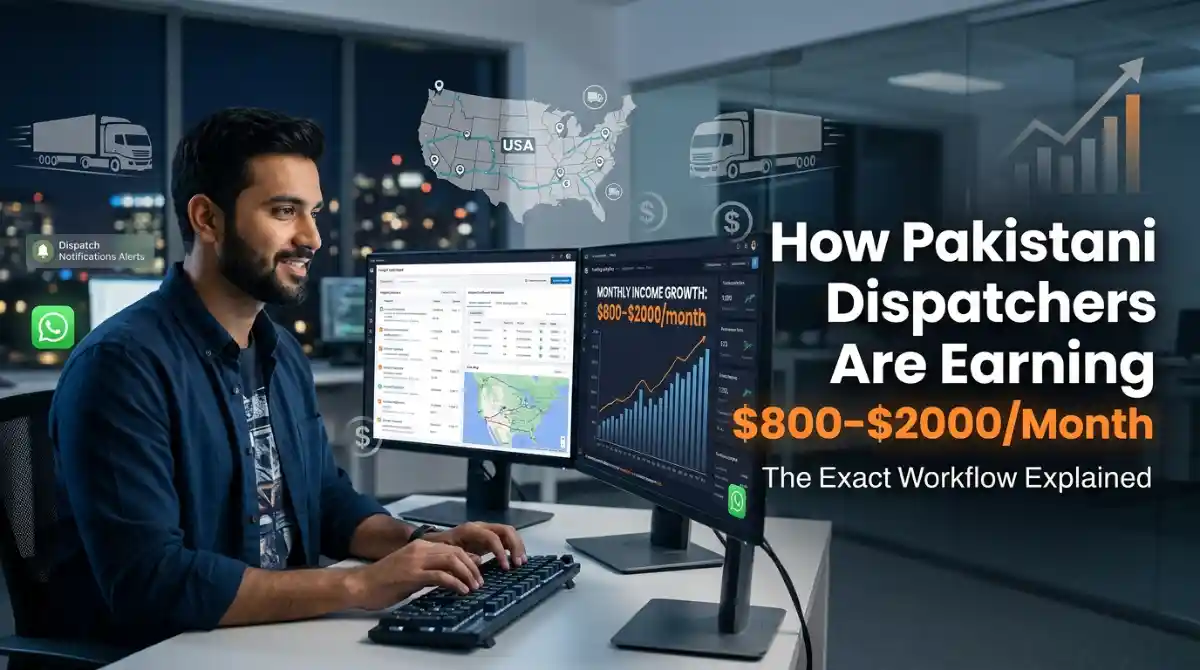
If you've been scrolling through LinkedIn or Facebook groups lately, you've probably seen posts from Pakistanis proudly sharing screenshots of dollar payments — and a big chunk of those are truck dispatchers working remotely with US trucking companies. It's not a scam. It's not luck. It's a real, structured remote career that hundreds of Pakistanis from Karachi, Lahore, Islamabad, and even smaller cities like Multan and Peshawar are quietly building.
In this guide, we're going to break down the exact workflow — step by step — that Pakistani truck dispatchers use to earn $800 to $2000 every single month, sitting right at home.
What Is Truck Dispatching and How Does It Work?
Before we get into the money, let's make sure you understand what a truck dispatcher actually does.
A truck dispatcher is the person who connects freight (cargo that needs to be moved) with truck drivers (owner operators or small carriers). Think of it as a middle role — you find loads on load boards, negotiate the best rate per mile, handle the paperwork, and make sure the driver gets paid well for every trip.
You are essentially running the business side for a truck driver. They drive. You handle everything else.
The US trucking industry moves over $800 billion worth of goods every year, according to the American Trucking Associations. Owner operators — independent truck drivers who own their own trucks — often don't have time to find loads, negotiate rates, or handle admin work. That's exactly where a Pakistani remote dispatcher steps in.
The best part? You don't need a US license, a visa, or even a college degree. What you need is training, the right tools, and consistency.
Why Pakistan Is Perfectly Positioned for This Career
Let me give you a real picture of why this works so well from Pakistan specifically.
The US trucking industry runs 24/7. Drivers operate across different time zones — Eastern, Central, Mountain, Pacific. When it's early morning in Texas or midnight in California, dispatchers in Pakistan are already awake and at their desks. The time difference, which many see as a barrier, is actually an advantage for remote dispatching.
On top of that, the cost of living in Pakistan means that even $800/month is significant income. Convert it to rupees at current rates, and you're looking at PKR 220,000 to PKR 560,000 per month — numbers that are competitive with senior office jobs in major Pakistani cities.
Pakistanis already have strong English communication skills, a culture of hard work, and increasingly fast internet access. The infrastructure for this career path already exists. What's been missing is structured training and awareness — and that gap is now closing fast.
The Exact Step-by-Step Workflow Pakistani Dispatchers Use
This is the part most people don't share in detail. Here's the real workflow, broken down simply.
Step 1 — Find an Owner Operator (Your Client)
Your first job is to get a client — an owner operator or a small carrier who needs dispatching help. This is done through:
You pitch your services and offer a trial run. Most Pakistani dispatchers charge 5% to 10% of the gross load value as their dispatch fee. On a $2,000 load, that's $100 to $200 — just for one load.
Before you start working with a driver officially, you send them a carrier setup packet — a document that includes your service agreement, your fee structure, and authorization to book loads on their behalf. This is a basic legal step that protects both parties.
Step 2 — Get Set Up on Load Boards
Once you have a client, you access load boards — online marketplaces where freight brokers post available loads. The most popular ones used by Pakistani dispatchers are:
You log in, filter loads by your driver's truck type (dry van, flatbed, reefer, hotshot), preferred freight lanes, and available dates. You look for loads that pay the highest rate per mile and minimize dead miles (empty driving with no pay).
Step 3 — Negotiate the Freight Rate
This is where the money is made or lost.
When a load is posted, brokers often post a lower rate expecting negotiation. As a Pakistani dispatcher, your job is to negotiate a better rate per mile for your driver. You call the broker, explain your driver's equipment, and push for a higher number.
For example, if a load from Chicago to Atlanta is posted at $1.80 per mile and it's 700 miles, that's $1,260. A skilled dispatcher can often push that to $2.20 per mile — bringing the load value to $1,540. That difference goes directly into your driver's pocket (and increases your fee too).
Pakistani dispatchers who become good at negotiation are the ones who end up with long-term clients and high monthly income.
Step 4 — Book the Load and Send Confirmation
Once you've agreed on a rate, you book the load and the broker sends you a rate confirmation sheet — a document showing the agreed rate, pickup and delivery details, and broker contact info.
You review it carefully. Check the detention pay terms, lumper fees, accessorial charges, and any special requirements. Then you send it to your driver and confirm all the details.
Step 5 — Manage the Load During Transit
Your job doesn't stop at booking. You actively track the load:
This hands-on management is what separates average dispatchers from great ones — and great dispatchers keep clients for years.
Step 6 — Invoice and Get Paid
After the load is delivered, you help your driver submit the invoice to the broker or factoring company. Factoring companies advance payment to drivers immediately (for a small fee), so drivers don't have to wait 30 to 45 days for broker payment.
You then send your dispatch invoice to your driver for your percentage. Pakistani dispatchers typically receive payments via Payoneer, Wise, or direct bank transfer.
Manage 4 to 8 loads per week per driver, multiply by your fee, add one or two more clients — and the $800 to $2000 monthly income becomes very real.
Tools Pakistani Truck Dispatchers Actually Use
Here's your complete toolkit for dispatching remotely from Pakistan:
You don't need expensive equipment. A decent laptop, a reliable internet connection, and your subscriptions to load boards are enough to start.
How Much Can You Realistically Earn?
Let's do the actual math.
A typical Pakistani dispatcher works with 2 to 3 owner operators. Each driver runs 3 to 5 loads per week. The average load value ranges from $1,500 to $3,000. At a 7% dispatch fee, that's $105 to $210 per load.
With two active clients running 4 loads each per week, that's 8 loads weekly. At an average of $140 per load: 8 × $140 = $1,120 per week, or roughly $4,480 per month.
Now that's a high-performing dispatcher. Beginners with one client typically start at $400 to $800 per month and scale from there. Most Pakistani dispatchers land comfortably in the $800 to $2,000 monthly range within 3 to 6 months of working consistently.
You can also explore how IDT's truck dispatcher salary guide breaks down earnings at different experience levels.
Is Truck Dispatching Legal and Halal from Pakistan?
Yes — and this is a question many Pakistani professionals ask before getting started.
Truck dispatching from Pakistan is completely legal. You are providing a business service to US-based carriers as a freelance contractor. No US license is required for independent freight dispatchers (as opposed to freight brokers, who need a broker authority under FMCSA regulations).
As for whether it's halal income — yes, by general Islamic finance principles. You are providing a legitimate service, receiving a transparent fee agreed upon by both parties, and no interest-based transactions are involved in the dispatching work itself. Many Pakistani dispatchers have consulted with scholars on this, and the general consensus is that the work itself is permissible.
Pakistani Dispatchers by City — Who Is Doing This?
This career is growing across every major city in Pakistan.
In Islamabad and Rawalpindi, many IT-educated professionals are adding dispatching as a parallel income stream. In Lahore, freelancers who were already working on platforms like Fiverr and Upwork are transitioning to dispatching for higher, more stable income. In Karachi, business-minded individuals with communication skills are building full dispatch agencies.
Even students in Faisalabad, Multan, and Peshawar are enrolling in dispatching courses and landing their first clients within weeks of completing training.
If you're in any of these cities, the opportunity is real and available to you right now. Explore all courses and training options for your city at the Institute of Digital Trainings.
How to Get Started: Learning Truck Dispatching in Pakistan
There are two ways to learn — the hard way (trial and error, months of wasted time) or the structured way (proper training, mentorship, and a clear roadmap).
Structured training is always better, especially in truck dispatching, because mistakes in this field cost your clients real money. A wrong booking, a missed deadline, or a poorly negotiated rate can cost your driver hundreds of dollars — and you your client.
The Advanced Truck Dispatching Course at IDT (Institute of Digital Trainings) covers:
IDT's courses are taught by industry practitioners with real dispatching experience — not just theory. You can also verify the credibility of IDT instructors and explore their backgrounds at Mubashir Zafar and Rai Basharat ALi.
For comparison of dispatching versus freight brokering, IDT also has a detailed guide.
And if you want to understand the full career path before enrolling, read the truck dispatching career guide for 2026.
Dispatcher vs Freight Broker — What's the Difference?
A question that comes up constantly:
A freight broker acts on behalf of shippers (companies that need goods moved). They need an FMCSA broker authority (MC number), a surety bond, and they deal with matching shippers to carriers. This requires US-based registration.
A freight dispatcher acts on behalf of carriers (truck drivers). You don't need a broker authority. You are representing the driver, not the shipper. This is the model that works legally and practically for Pakistanis working remotely.
The income potential is similar — sometimes dispatchers earn more because they build deeper, long-term relationships with drivers who stay loyal for years.
The Future of Remote Dispatching from Pakistan
The US trucking industry is not shrinking. There are currently over 3.5 million truck drivers in the United States, and a significant shortage of dispatchers who can handle the admin side for owner operators efficiently.
AI tools are actually making dispatching easier and faster — not replacing dispatchers. Tools that automate load searching, rate comparison, and communication are being integrated into dispatch workflows. Pakistani dispatchers who learn to use these tools will earn more, manage more clients, and scale their income significantly.
IDT has already published insights on how AI is changing the dispatching space.
The remote work from Pakistan to the USA is a proven model now. Just as medical billing professionals from Pakistan service US hospitals remotely, dispatchers are building the same kind of sustainable remote career.
Frequently Asked Questions
What is truck dispatching and how does it work? Truck dispatching is the process of finding freight loads for truck drivers, negotiating rates with brokers, managing the shipment, and handling paperwork. A dispatcher works as a remote business partner for the driver, earning a percentage fee on each load booked.
How much can a Pakistani dispatcher earn per month? Pakistani truck dispatchers typically earn between $800 and $2,000 per month, depending on the number of clients, loads managed per week, and their negotiation skills. Experienced dispatchers with multiple clients can earn $3,000 or more.
Do I need a US license or visa to do truck dispatching from Pakistan? No. Freight dispatchers (as opposed to freight brokers) are not required to have a US license or be physically present in the US. You work as a remote contractor for US-based truck drivers.
What is the best load board for beginners in Pakistan? The DAT Load Board is the most widely used in the US trucking industry. For beginners, 123 Load Board is also a good starting point due to its lower cost and user-friendly interface. Truckstop.io is another strong option once you're more comfortable.
How do Pakistani dispatchers get paid in dollars? Most Pakistani dispatchers receive payments through Payoneer or Wise (formerly TransferWise). These platforms allow direct bank transfers in USD that can be converted to PKR at competitive exchange rates.
How long does it take to learn truck dispatching in Pakistan? With structured training, most students are ready to take their first client within 4 to 8 weeks. The Advanced Truck Dispatching Course at IDT is designed to take you from zero knowledge to job-ready in the shortest time possible.
Is truck dispatching a sustainable long-term career? Yes. The US trucking industry is a $800+ billion sector with consistent demand. As long as goods need to be moved by road in America — which will be for decades — dispatchers will be needed. The remote nature of the job means geographical location is no barrier.
Conclusion — Your Next Step Starts Today
Pakistani dispatchers are not waiting for the economy to improve, for a visa to come through, or for a local job market to open up. They are building dollar-earning remote careers right now — from their homes in Karachi, Lahore, Islamabad, Rawalpindi, Faisalabad, Multan, and Peshawar.
The workflow is learnable. The tools are affordable. The income is real. What separates those who succeed from those who give up is structured training and mentorship.
If you're serious about starting your journey as a Pakistani truck dispatcher, there is no better step than enrolling in the Advanced Truck Dispatching Course at IDT — the Institute of Digital Trainings.
Book your seat today.
You can also explore the full range of high-income digital skills courses at IDT to find the right career path for you:
The dollar is waiting. The only question is — when do you start?