Introduction
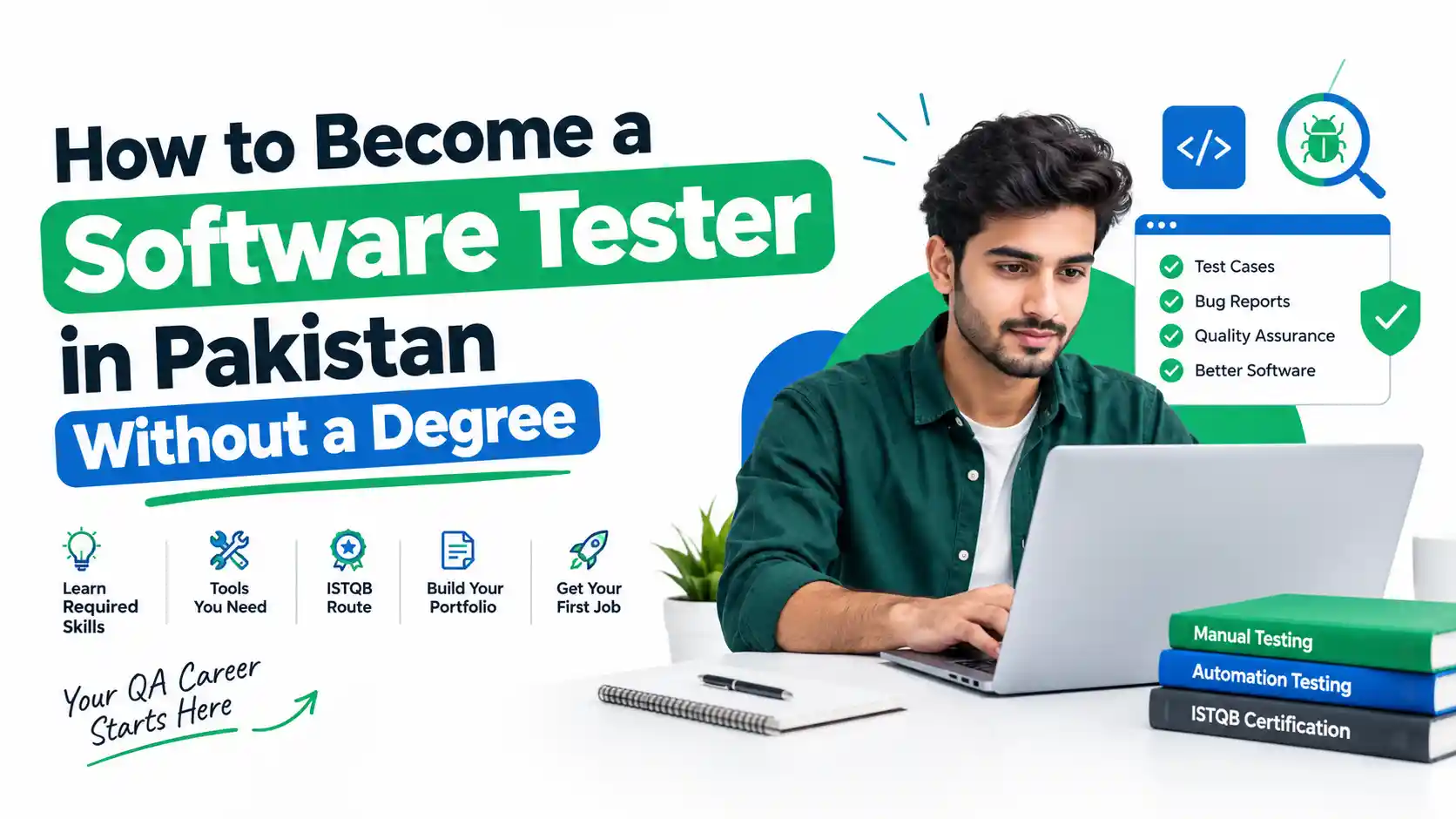
Many people in Pakistan want to work in tech but assume that without a degree, the door is closed. For software testing, the picture is more nuanced. Learning how to become a software tester in Pakistan without a degree is realistic, provided you build practical skills, show evidence of your work and understand how employers hire.
Some job adverts still ask for a bachelor's degree, and others focus more on what you can actually do. Software testing is also one of the more approachable entry points into IT, because you can begin with manual testing before touching any code.
In this guide, you will learn what a software tester does, which skills and tools to learn first, how a certificate such as ISTQB fits in, how to build a portfolio, and how to apply for your first role.
Can you become a software tester without a degree?
Short answer: It is possible, but not guaranteed. Be aware of two points.
- Certification: The ISTQB Foundation Level exam has no entry requirement. ISTQB states that no prior knowledge is required to be eligible to take the CTFL 4.0 exam, though it recommends accredited training or self-study with the official syllabus, glossary and mock exams.
- Hiring practice: In the United States, the U.S. Bureau of Labor Statistics lists a bachelor's degree as the typical entry-level education for software developers, QA analysts and testers. That is US data. Pakistani employers vary, so check the requirements on each advert.
Our interpretation: Where an employer lists a degree as "preferred" rather than "required", clear practical evidence can help you compete. That is an opinion, not a guarantee.
What does a software tester do?
A software tester checks that an application works as intended before real users see it. Day to day, that usually means:
- Reading requirements and working out what could go wrong.
- Writing test cases and test scenarios.
- Running tests on web or mobile apps.
- Reporting bugs clearly so developers can fix them.
- Re-testing after fixes (regression testing).
The terms QA, QC and testing overlap. Quality assurance (QA) covers the whole process of preventing defects. Testing is the hands-on checking inside that process. Job titles such as QA tester, QA analyst, QA engineer and test engineer often describe similar work at different levels.
Why software testing is worth considering
Software testing has a global job market, and Pakistan's IT sector is growing.
- Pakistan's IT sector: The State Bank of Pakistan reported IT and IT-enabled services exports of $4.184 billion for July–May FY2025-26, up 20 percent on the same period a year earlier, according to Business Recorder. The Daily Times reported a record $4.6 billion for the full fiscal year. Pakistan's covers the wider ICT export picture.
- US outlook (for context only): BLS data shows about 187,600 QA analyst and tester jobs in 2025, with a median pay of $104,300 and 6% projected growth for 2025–35. These figures describe the US market and say nothing about Pakistani salaries. Read the BLS occupation page for details.
- AI and testing: One industry commentator quoted by IEEE-USA expects demand for QA testers to rise partly to vet AI-assisted code. Treat that as one expert's view, not a forecast. The full piece is on
Pakistani salaries: Pay varies by city, company, tools and experience. Check current ranges on live job boards and ask recruiters before setting expectations.
Skills you need to become a software tester
Start with these, in this order.
Testing fundamentals: SDLC, STLC, test cases, test scenarios, test plans, and the difference between QA and QC.
Manual testing: functional, smoke, sanity, regression, exploratory and usability testing.
Bug reporting: writing clear, reproducible defect reports with steps, expected result and actual result.
Agile and Scrum basics: most teams work in sprints.
Tools: a bug tracker such as Jira, an API tool such as Postman, and later an automation tool such as Selenium.
Soft skills: attention to detail, clear writing and calm communication with developers.
Do you need coding? Not to begin. Manual testing needs no programming. Automation testing does, so plan to learn the basics later. The ISTQB course provider ISQI notes that programming knowledge is an advantage for the Foundation exam, though not a requirement.
Manual testing or automation first?
Learn manual testing first. It teaches you how to think like a tester. Automation then makes sense because you already know what is worth automating.
| Manual testing | Automation testing | |
| Coding needed | No | Yes (basic to moderate) |
| Best for | Beginners, exploratory work, usability | Repetitive checks, regression suites |
| Typical tools | Jira, spreadsheets, test management tools | Selenium, Postman, scripting languages |
A step-by-step roadmap
Learn the fundamentals. Cover SDLC, STLC, test design and bug reports.
Practise on real websites and apps. Pick a login page, a shopping cart or a signup form. Write test cases for it.
Build three to five portfolio items. Include a test case document, a bug report, a short test plan and an exploratory testing summary. Use only your own work. Never claim client or employer work you did not do.
Learn core tools. Start with Jira and Postman, then add Selenium.
Consider ISTQB Foundation. It is optional, but it gives you a recognised baseline. Study the syllabus and glossary and try the mock exams.
Prepare your CV and LinkedIn. List skills, tools, portfolio links and any certificates.
Apply widely. Try internships, junior QA roles, and companies that hire for manual testing. Tailor each application.
If you are still choosing a direction, our guide to digital skills to learn after matric in Pakistan compares several paths. For staying consistent after finishing a course, see our 30-day roadmap after a digital course.
Free and paid ways to learn
- Free: ISTQB syllabus and glossary, official mock exams, practice websites, YouTube tutorials and open-source test projects. These cost nothing but need self-discipline.
- Structured training: A course gives you a sequence, mentors, practice tasks and feedback. Compare syllabus, tools covered, class format and assessment before paying anyone, including us.
What IDT's Software Quality Assurance course covers
According to the IDT course page, the outline has seven modules: QA foundations, SDLC (Agile, Scrum, Waterfall), manual testing, automation essentials, Selenium, API testing with Postman, and performance testing with JMeter. IDT states that classes are available on campus, online (live on Zoom) or hybrid, and that lectures are recorded. Students receive an IDT certification on successful completion.
For current fees, duration and batch dates, please use the contact page.
Common mistakes beginners make
- Jumping to automation too early. Without test design skills, scripts test the wrong things.
- Collecting certificates without practice. Employers want to see what you can do.
- Writing vague bug reports. "Login not working" helps nobody. Give steps and screenshots.
- Applying with a generic CV. Match your skills to each role.
- Expecting a fixed salary or timeline. Outcomes depend on effort, interviews and the market.
Career path after your first role
A typical progression runs from junior QA tester to QA engineer, then to senior QA or automation engineer, and on to QA lead or test manager. Some testers move into performance testing, security testing or development. This is a common pattern, not a guaranteed path. See the IDT career page for how IDT supports learners.
Frequently asked questions
Can I become a software tester without a degree in Pakistan?
Yes, it is possible. Some employers still ask for a degree, so look for roles that value skills and portfolios.
Is a degree required for the ISTQB Foundation exam?
No. ISTQB states that no prior knowledge is required to take the exam.
Do I need to know coding to start?
No. Manual testing does not need coding. Automation testing does.
Should I learn manual testing before automation?
Yes. Manual testing builds the thinking skills that automation relies on.
Which tools should a beginner learn first?
Jira for bug tracking and Postman for API testing, then Selenium for web automation.
How long does it take to learn software testing?
It depends on your time, background and chosen course. Check the duration on any course page you are considering.
Ready to start learning?
If you want a structured path, explore IDT's Software Quality Assurance course and review the outline. It covers manual testing, Selenium, Postman and JMeter. Results depend on your effort, and we do not promise jobs or income.
Conclusion
You can start a software testing career in Pakistan without a degree, but you need to be realistic about it. Some employers will still ask for one, so the strongest approach is to make your skills easy to see.
To recap the route:
- Learn the fundamentals first: SDLC, STLC, test cases and bug reports.
- Master manual testing before moving to automation.
- Get comfortable with tools such as Jira and Postman, then add Selenium.
- Build a small portfolio of your own work, such as test cases, bug reports and a test plan.
- Consider the ISTQB Foundation certificate, which has no entry requirement, as a recognised baseline.
- Apply widely, and tailor your CV and LinkedIn profile to each role.
Progress depends on your effort, your practice and the job market, so avoid expecting fixed timelines or salaries.
If you prefer a structured path with guided practice, explore IDT's Software Quality Assurance course. It covers manual testing, Selenium, Postman and JMeter, and you can check the full outline on the course page. For current fees, duration and batch dates, please contact IDT directly.